





Yelp SEO Best Practices to Get More Calls and Leads
For local service providers, Yelp is often the first “search engine” a customer uses before they even touch Google. In fact, Yelp’s influence is so pervasive that 97% of people purchase from a business they found on Yelp within a week. This makes Yelp SEO—the practice of optimizing your business profile to rank higher in Yelp’s internal search results—a critical component of any local marketing strategy.
Unlike traditional search engines, Yelp’s algorithm is built on trust, proximity, and recency. Simply having a profile isn’t enough to capture Yelp lead generation opportunities. You must actively manage your presence to ensure that when a customer searches for “plumber near me” or “best Italian restaurant,” your business is the one with the “Highly Recommended” badge.
In this guide, we will break down the exact Yelp SEO strategy needed to outperform competitors, increase your visibility, and turn profile views into phone calls.
What is Yelp SEO?
Yelp SEO is the process of optimizing your Yelp Business Page to improve its visibility in Yelp’s search results and, by extension, Google’s local search results. Because Yelp has massive domain authority, your Yelp profile often outranks your own website for competitive local keywords.
Focusing on Yelp local SEO matters because of the “intent” of the user. While a Google user might be “just looking,” a Yelp user is usually “ready to buy.” According to a study, Yelp appears in the top 5 results for 92% of local search queries on Google. If you ignore your SEO for Yelp, you are essentially ceding the most valuable real estate on the internet to your competitors.
Understanding Yelp’s Ranking Algorithm
Yelp doesn’t publish detailed information about how its algorithm works. The company’s last significant public statement on the topic came in 2013. This means much of what we know about Yelp rankings comes from testing, experimentation, and observation from thousands of business owners. That said, Yelp has confirmed several ranking factors. These include:
– Location: How close your business is to the searcher.
– Business type: Whether your category matches what someone is searching for.
– Review volume and recency: How many reviews do you have, and how frequently new reviews arrive.
– Review quality and ratings: The strength of your reviews and your overall star rating.
– Business completeness: How fully you have filled out your profile.
– User engagement: How often customers interact with your listing.
The single most important factor? Reviews.
According to Yelp SEO experts, reviews are the NUMBER ONE ranking factor on Yelp. This includes the frequency of reviews (velocity), the total number, the ratings themselves, and the keywords contained within those reviews. This distinction matters.
On Google, backlinks, content quality, and user experience dominate. On Yelp, review signals are paramount. A business with dozens of recent, high-quality reviews will almost always outrank a business with outdated or sparse reviews, regardless of other factors.
Understanding this hierarchy helps you prioritize your optimization efforts. You can’t skip the fundamentals—a complete, accurate profile is essential—but you also can’t ignore the review piece. Both matter. However, the one that moves the needle most is consistent, quality reviews.
5 Core Pillars of a High-Ranking Yelp SEO Strategy
1. Accuracy and N.A.P. Consistency
The most fundamental step in local SEO Yelp management is ensuring your Name, Address, and Phone number (N.A.P.) are identical across the web. Yelp’s algorithm cross-references your data with other directories. Discrepancies lead to a “trust penalty,” which can suppress your rankings.
2. Category Optimization
This is the “secret sauce” of Yelp search engine optimization. Many businesses select only one broad category. Yelp allows you to select up to three.
- The Technique: Choose one broad category (e.g., “Home Services”) and two highly specific ones (e.g., “Water Heater Installation” and “Emergency Plumber”). This casts a wider net for Yelp business leads.
3. Review Velocity and Sentiment
It’s not just about having a 5-star rating; it’s about “Review Velocity”—how often you receive new reviews.
- Pro Tip: Yelp’s automated recommendation software is notoriously strict. To avoid having reviews hidden, encourage customers to interact with the platform (checking in, adding photos) rather than just leaving a text review. This signals to the SEO Yelp algorithm that the user is real and active.
4. Rich Media and Photo Engagement
Data from HubSpot suggests that businesses with professional photos see a significantly higher click-through rate. On Yelp, businesses with more than 10 photos get 12 times more customer leads than those with fewer.
- Optimization: Name your photo files with keywords (e.g., ac-repair-houston.jpg) before uploading them to improve Yelp SEO relevance.
5. Response Time and “Request a Quote”
Yelp prioritizes businesses that are active. If you have the “Request a Quote” feature enabled, your response time is displayed publicly. A response time of under 10 minutes significantly boosts your Yelp lead generation potential and signals to the algorithm that you are a reliable partner for their users.
Organic Yelp SEO vs. Yelp Advertising
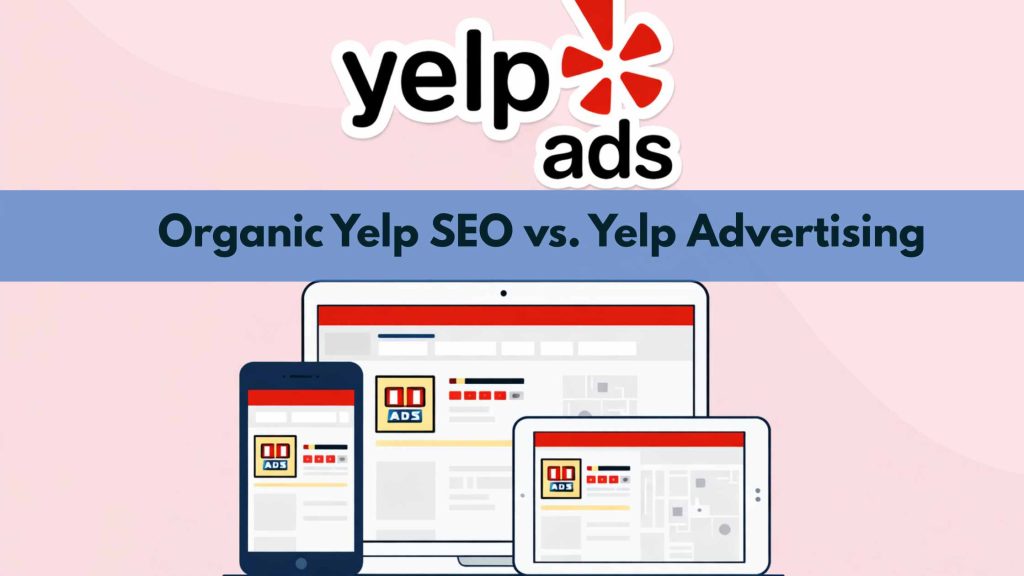
| Feature | Organic Yelp SEO | Yelp Paid Advertising |
| Cost | Free (Time Investment) | Monthly Ad Spend |
| Longevity | Permanent results | Ends when budget stops |
| Trust Factor | High (User-generated trust) | Moderate (Labeled as “Ad”) |
| Placement | Top of organic search | Above organic search |
| Best For | Long-term growth | Immediate Yelp business leads |
Common Mistakes in Yelp Local SEO
- Asking for Reviews: This is a direct violation of Yelp’s Terms of Service. Instead, use “Find us on Yelp” stickers to prompt organic discovery.
- Ignoring Negative Reviews: A negative review isn’t a ranking killer, but an unanswered one is. It shows a lack of engagement.
- Incomplete Service Lists: If you don’t check every box for the services you provide, you won’t show up in filtered searches (e.g., “accepts credit cards” or “free estimates”).
Best Practices to Execute Professional Yelp SEO Services
1. Choose the Right Primary and Secondary Categories
Categories are Yelp’s strongest relevance signal. Best practices include:
- Select one primary category that exactly matches your core service.
- Add 2–4 supporting categories only if they truly apply.
- Avoid broad or misleading categories.
Yelp confirms that incorrect categorization can negatively impact visibility.
2. Optimize Business Information for Yelp Local SEO
Accurate business data improves local SEO for Yelp and trust. Ensure consistency for:
- Business name (no keyword stuffing)
- Address and service areas
- Phone number
- Operating hours
- Website URL
NAP inconsistencies can confuse Yelp’s ranking system and reduce exposure.
3. Write a Keyword-Optimized Yelp Business Description
Your description helps Yelp understand relevance, but it is not indexed like Google content. Best practices:
- Naturally include service and location keywords
- Avoid promotional language or offers
- Focus on what makes your service unique
Example keyword usage:
“We provide emergency plumbing services for residential and commercial clients in Houston.”
4. Yelp SEO and Reviews: Quality Over Quantity
Reviews are a major Yelp SEO ranking factor, but manipulation is strictly penalized. According to BrightLocal, 87% of consumers read online reviews for local businesses, and Yelp reviews carry significant weight.
Best practices:
- Earn reviews organically
- Respond to reviews professionally
- Avoid review gating or incentives (violates Yelp policy)
Yelp’s recommendation software filters suspicious reviews automatically.
5. Maintain High Engagement Signals
Engagement influences Yelp search engine optimization visibility. Track and improve:
- Click-to-call actions
- Photo uploads
- Review responses
- Profile updates
Yelp reports that businesses with photos receive up to 35% more website clicks.
6. Leverage Yelp Attributes and Services
Attributes help Yelp match your business with specific search queries. For example:
- “Veteran-owned”
- “Locally owned”
- “Same-day service”
- “Free estimates”
Attributes improve discoverability in filtered searches and increase lead quality.
The Final Verdict
Yelp SEO success is built on trust, relevance, and consistent engagement—not shortcuts. Businesses that maintain accurate profiles, earn authentic reviews, and stay active outperform competitors in both visibility and lead quality. When Yelp SEO is approached strategically, it becomes a reliable lead channel, not just a directory listing.
Ready to dominate your local market? If you need expert help with your Yelp SEO strategy or comprehensive Yelp lead generation tactics, the team at Directory One is ready to assist. Contact our specialists at 713.269.3094 or visit Directory One to explore our local search solutions further.
About The Author
