





Shopify Ecommerce Website Design Guide to Increase Sales
Your Shopify ecommerce website design is the first thing customers judge — and the last thing standing between a visitor and a sale. With global ecommerce sales projected to reach $6.86 trillion in 2025, a poorly designed store is not just an aesthetic problem — it is a revenue problem. With the right strategy, Shopify ecommerce website design helps businesses create scalable eCommerce stores that attract customers and drive consistent sales.
Whether you are launching a new store or redesigning an existing one, this guide gives you the exact framework to design a Shopify store that converts.
What Is Shopify Ecommerce Website Design?

Shopify ecommerce website design is the process of structuring, styling, and optimizing a Shopify store to deliver a seamless shopping experience that converts visitors into buyers. It goes well beyond choosing colors and fonts.
A high-performing Shopify store design covers page layout, navigation architecture, product page structure, mobile responsiveness, checkout flow, and brand consistency across every customer touchpoint.
There are three primary approaches to Shopify website design:
- Using a pre-built Shopify theme: Fastest to launch, lowest cost. Shopify’s Theme Store offers over 100 free and paid themes. Best for new or small stores with limited budgets.
- Shopify website design and theme development services: A developer customizes an existing theme to match your brand, adding unique functionality and visual identity without building from scratch.
- Shopify store custom website design: A fully bespoke design built from the ground up. Recommended for brands with complex product catalogs, B2B requirements, or strong brand differentiation needs.
Modern stores also explore AI website design for Shopify, where AI tools assist in generating layouts, product recommendations, and automated design elements. As e-commerce competition increases, businesses rely on a specialized Shopify website design company in USA to build optimized stores.
Why Shopify Website Design Matters for Conversions
Effective Shopify ecommerce website design directly impacts conversion rates and customer experience. According to Google research, websites that load quickly and provide intuitive navigation significantly improve user engagement and purchase likelihood.
Additionally, studies cited by Semrush show that user experience and site performance strongly influence online conversions. Key benefits of optimized Shopify ecommerce website design include:
- Better user experience
- Higher conversion rates
- Improved brand credibility
- Increased mobile engagement
Businesses investing in a Shopify store custom website design often see better performance compared to generic template-based stores.
For companies expanding their eCommerce operations, professional Shopify website design services in Texas or other regional markets can help tailor stores to local audiences.
Shopify Website Design Best Practices
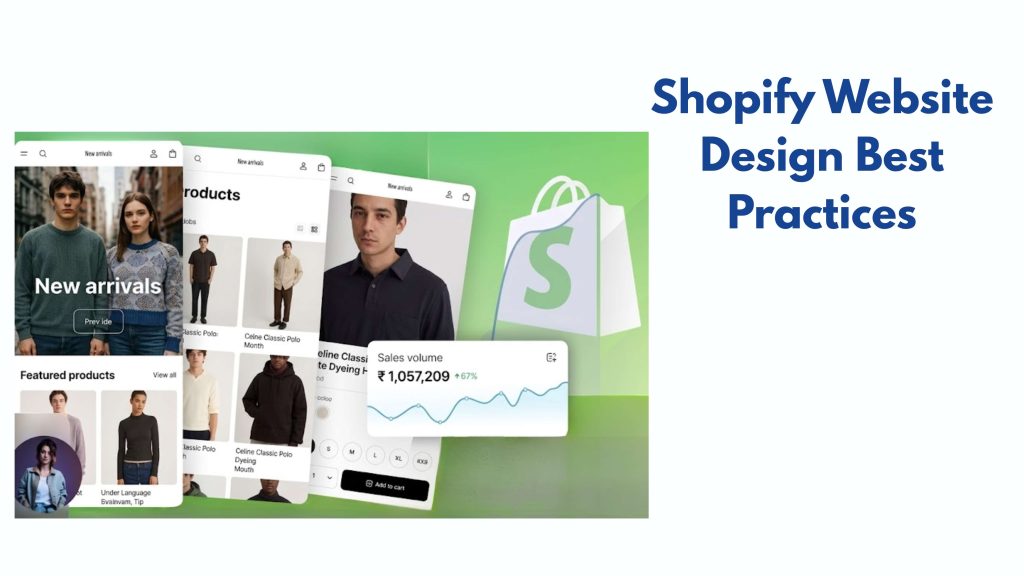
Implementing proven design practices is essential when planning a Shopify ecommerce website design.
1. Mobile-First Design
Mobile is no longer secondary — it is the primary shopping environment. In 2024, mobile devices drove 57% of global e-commerce traffic. Designing for mobile first means your Shopify store is built and tested on the smallest screen before being scaled up to desktop.
Actionable mobile-first steps:
- Use Shopify themes that are natively responsive and tested on iOS and Android.
- Keep tap targets (buttons, links) at a minimum of 44×44 pixels to prevent mis-taps.
- Place your primary CTA (Add to Cart or Buy Now) above the fold on product pages — no scrolling required.
- Compress all images using Shopify’s built-in image optimizer or a tool like TinyPNG.
- Avoid pop-ups that cover the full screen on mobile — Google penalizes intrusive interstitials in mobile rankings.
2. Fast Page Speed
Page speed is a direct ranking factor for Google and a direct conversion factor for your store. Google’s Core Web Vitals benchmark requires Largest Contentful Paint (LCP) under 2.5 seconds. Most Shopify stores fail this benchmark due to unoptimized apps and uncompressed images.
Actionable speed improvements:
- Audit your Shopify app list and remove any apps not actively contributing to revenue.
- Use lazy loading for images below the fold so they only load when a user scrolls to them.
- Avoid embedding large video files directly — host on YouTube or Vimeo and embed instead.
- Use a Content Delivery Network (CDN) — Shopify includes Fastly CDN by default, but custom code and third-party scripts can bypass it.
- Test your store regularly at Google PageSpeed Insights and target a score above 70 on mobile.
3. High-Quality Product Images
Product images are the closest substitute for physically handling a product. Research by Shopify shows that stores with professional, multi-angle product photography convert at significantly higher rates than those using single, low-resolution images.
Best practices for product images in Shopify ecommerce website design are:
- Use a minimum of 2048×2048 pixels for zoomable product images.
- Include at least 4–6 images per product: front, back, detail close-up, lifestyle, and scale reference.
- Add short product videos (15–30 seconds) — video on product pages increases add-to-cart rates by up to 80%.
- Maintain consistent background style and image dimensions across all product listings for a professional, trustworthy appearance.
4. Clear Navigation
Confusing navigation is among the top reasons shoppers abandon Shopify stores without purchasing. Your navigation should make it possible for any visitor to find any product within three clicks or fewer.
Actionable navigation guidelines are:
- Limit your main navigation to 5–7 top-level categories maximum.
- Use descriptive, keyword-rich labels — “Women’s Running Shoes” instead of just “Women’s”.
- Add a persistent, prominent search bar — 30% of ecommerce visitors use site search and convert at twice the rate of non-searchers.
- Include breadcrumb navigation on collection and product pages to reduce bounce rates.
- Add a sticky header so navigation remains accessible as users scroll down long product pages.
Steps to Build a High-Converting Shopify Store
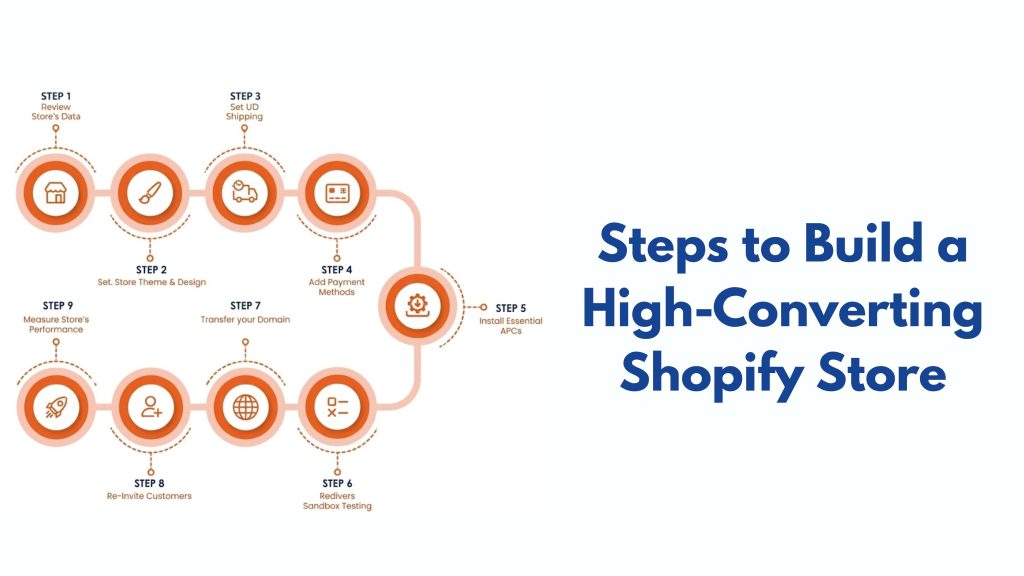
Building a successful store requires a structured approach to Shopify ecommerce website design. Follow this actionable sequence to design a website on Shopify the right way:
- Define your target customer and buying journey before touching a single design element. Every design decision should serve the customer, not personal preference.
- Choose or commission your Shopify theme. For most businesses, Shopify website design and theme development services offer the best balance of customization and cost.
- Build your site architecture. Map out all collections, product pages, landing pages, and supporting content (About, FAQ, Shipping Policy) before development begins.
- Optimize all product content. Write conversion-focused product descriptions, compress all images, and add structured data (schema markup) for rich results in Google search.
- Configure Shopify apps strategically. Install only what you need: reviews (Judge.me or Yotpo), upsells (ReConvert), email capture (Klaviyo), and live chat (Tidio). Every unnecessary app slows your store.
- Test before launch. Run your store through Google PageSpeed Insights, test every checkout flow on mobile and desktop, and audit all navigation paths for broken links or dead ends.
- Launch and monitor. Set up Google Analytics 4 and Shopify Analytics from day one. Track conversion rate, bounce rate, and average order value weekly.
Shopify Conversion Rate Optimization Tips
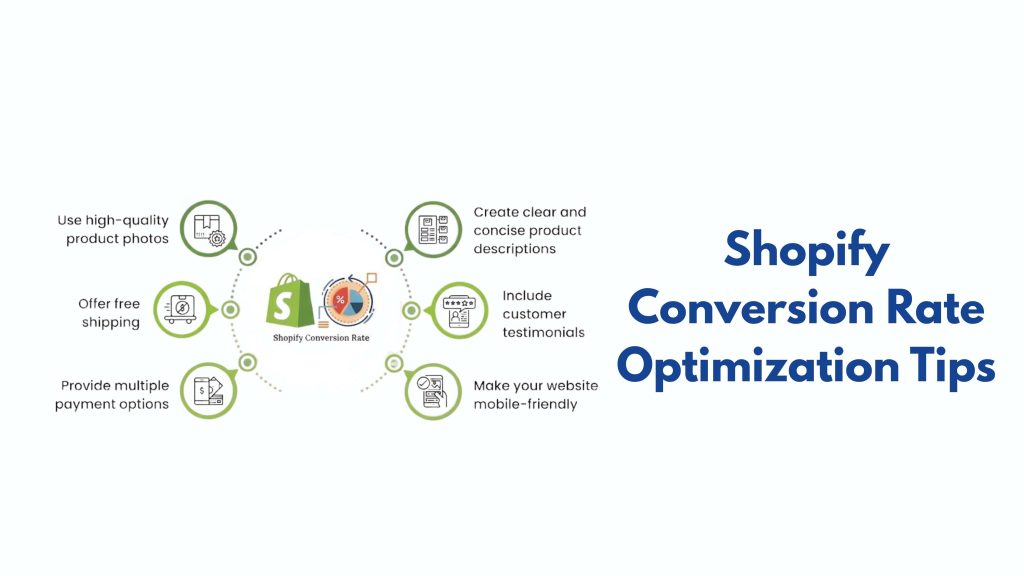
Great design is only the foundation. Conversion rate optimization (CRO) turns that foundation into revenue. Here are the highest-impact CRO techniques for Shopify stores:
- Simplify your checkout process
Shopify’s native one-page checkout (introduced in 2023) reduces friction significantly. Enable Shop Pay to offer a one-click checkout for returning customers — stores using Shop Pay see 18% higher conversion rates compared to standard checkout.
- Use trust signals strategically
Display security badges, money-back guarantee icons, and customer review counts near your Add to Cart button. According to BrightLocal, 93% of consumers say online reviews impact their purchasing decisions.
- Deploy exit-intent offers
Use tools like Privy or OptiMonk to trigger a discount or free shipping offer when a user moves to close the tab. Exit-intent popups recover an average of 10–15% of abandoning visitors.
- Create urgency and scarcity
Display real-time low stock indicators (“Only 3 left”) and countdown timers for limited-time offers. These triggers tap into loss aversion and increase conversion rates when used authentically — not manipulatively.
- A/B test your product pages
Use Shopify’s native analytics alongside tools like Google Optimize or Shoplift to test variations of headlines, CTA button colors, image order, and pricing display. Even a 0.5% improvement in conversion rate compounded across thousands of monthly visitors creates a significant revenue lift.
Tools for Shopify Store Optimization
These are the most effective tools used by professional Shopify website design companies in USA and agencies worldwide:
- Google PageSpeed Insights: Free page speed and Core Web Vitals audit — run monthly.
- SEMrush / Ahrefs: Keyword research for product and collection page SEO.
- Hotjar: Heatmaps and session recordings to see exactly where users drop off.
- Klaviyo: Email and SMS marketing automation natively integrated with Shopify.
- Yotpo / Judge.me: Customer review collection and display.
- TinyPNG: Image compression without quality loss before uploading to Shopify.
- Shoplift: Shopify-native A/B testing for landing and product pages.
- Tidio: Live chat and AI chatbot for real-time customer support.
- ReConvert: Post-purchase upsell funnels to increase average order value.
These tools are standard in any serious website design for a Shopify project and help bridge the gap between a good-looking store and one that consistently generates revenue.
Shopify Website Design Cost: What to Expect?
One of the most common questions from business owners is: “What does a Shopify website design cost?” The answer depends on the level of customization required.
| Approach | Typical Cost Range | Best For |
| Pre-built Shopify theme | $0–$400 (one-time) | Startups, MVP stores |
| Theme customization | $1,500–$5,000 | Growing brands needing unique design |
| Custom Shopify store design | $8,000–$30,000+ | Established brands, complex catalogs |
| Ongoing design retainer | $500–$3,000/month | Continuous CRO and design updates |
For businesses in Texas, Shopify ecommerce website design in Texas typically aligns with national pricing benchmarks, though Shopify website design services in Texas may offer more competitive rates than major coastal markets for comparable quality.
How a Shopify Design Agency Helps Businesses
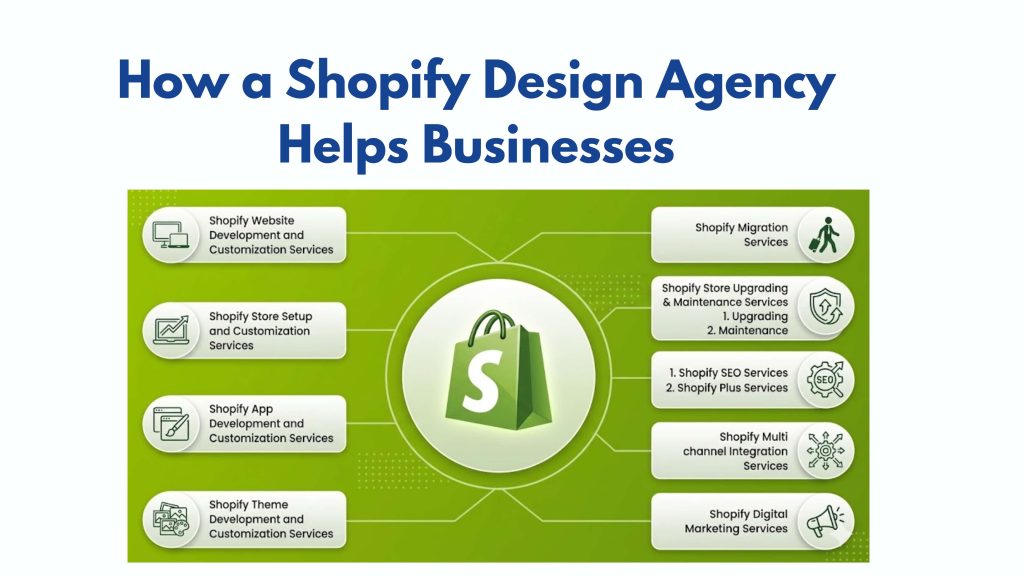
Many businesses attempt to design a website on Shopify independently, only to discover that technical execution, CRO knowledge, and brand strategy require expertise that takes years to develop.
Here is how working with a certified Shopify website design agency or top Shopify website design company in USA creates measurable value:
- Strategic audit:
Agencies begin with a conversion and technical audit of your existing store or competitive landscape, identifying exactly where revenue is being lost before writing a single line of code.
- Custom development:
A certified Shopify website design agency builds solutions your theme cannot — custom filtering, Shopify B2B website design for wholesale buyers, subscription flows, and multi-currency stores.
- Shopify B2B website design:
Agencies specializing in B2B understand the unique requirements of wholesale portals, net payment terms, tiered pricing, and customer-specific catalogs that standard Shopify themes do not support natively.
- AI website design for Shopify:
Leading agencies now leverage AI website design for Shopify to generate layout variations, automate personalization, and deliver dynamic content to different customer segments — dramatically improving conversion rates.
- Ongoing optimization:
The best Shopify website design company in USA has ongoing relationships. Agencies run continuous A/B tests, monitor Core Web Vitals, and iterate on design based on real store data.
For businesses seeking affordable local SEO-friendly and conversion-optimized Shopify stores, Shopify website design services in Texas offer strong value — particularly for retail, food and beverage, fashion, and home goods brands looking to scale in competitive U.S. markets.
Final Thoughts
Shopify ecommerce website design is not about trends. It is about clarity, trust, and ease. When visitors understand your store quickly, they buy with confidence.
At Directory One, we help brands turn Shopify stores into reliable sales engines. If your goal is to rank higher, convert better, and build credibility, your design must work as hard as you do. A well-designed Shopify ecommerce website does not just look good. It performs.
Call at 713.269.3094 and let’s build a Shopify store that works as hard as you do.
About The Author
