





Website Content Development Guide for Better Branding and Engagement

Your website content is not just a copy on a page. It is your brand’s voice, your primary sales tool, your SEO engine, and the first real conversation you have with every prospective customer who finds you online. Website content development — the strategic process of planning, creating, optimizing, and maintaining that content — is one of the highest-leverage investments a brand can make in its digital presence.
However, effective website content development goes beyond writing text. It combines brand voice, search visibility, audience psychology, and performance-driven structure. This guide explains how businesses can approach website content development to strengthen branding and increase engagement.
What is Website Content Development?
Website content development is the end-to-end process of strategizing, creating, structuring, optimizing, and continuously improving the content that lives on your website. It encompasses everything from homepage copy and service pages to blog articles, landing pages, product descriptions, FAQs, and visual media.
It is not the same as simply writing text for a website. Effective website content development integrates brand strategy, audience research, search engine optimization, user experience design, and increasingly, optimization for AI-powered search systems — all working together toward the same business goals.
How Effective Content Elevates Brand Identity?

The importance of structured website content development becomes clear when you look at what happens without it:
- Pages that do not address search intent fail to rank, regardless of how well written they are.
- Content without a clear hierarchy confuses users and increases bounce rates.
- 88% of people say they are unlikely to return to a site after a bad user experience — and poor content structure is among the most common causes.
- Users make a snap evaluation of a website within 50 milliseconds, and for 94% of users, that initial impression hinges on design and content clarity.
A disciplined website content development plan eliminates these failure points systematically — ensuring every page of your site earns its place by serving both users and search engines effectively.
Businesses that invest in expert website content development services see stronger engagement and improved search rankings. Whether working with a dedicated website content developer or a full-service agency, structured planning is essential.
What Should You Consider When Developing Your Website Content?

The question of what you should consider when developing your website content is where most brands go wrong. They start with what they want to say, not what their audience needs to hear. Effective website content development always begins with strategy, not writing.
1. Know Your Audience at a Granular Level
Every content decision — topic selection, tone, format, depth, and call to action — flows from a precise understanding of your audience. Before developing a single page, define:
- Who your ideal visitors are: demographics, professional roles, experience levels, and decision-making authority.
- What they are trying to accomplish: the specific problem, question, or intent that brought them to your site.
- Where they are in the buyer’s journey: awareness, consideration, or decision stage — each requires a different content approach.
- What objections or hesitations they carry: content that preemptively answers objections converts significantly better than content that only advocates.
2. Define Clear Business Objectives for Every Page
Every page of your website should exist to accomplish something specific — and that objective should be defined before content creation begins. Common page-level objectives include:
- Organic search ranking for a target keyword
- Converting visitors into leads through a contact form or demo request
- Building brand credibility through thought leadership and educational depth
- Supporting a sales conversation by answering pre-purchase questions in detail
- Reducing support burden by preemptively addressing common customer questions
When page objectives are clear, every content decision — headline structure, word count, visual hierarchy, and CTA placement — can be evaluated against whether it serves that objective. This discipline is the foundation of professional website content development services.
3. Map Content to the Full Customer Journey
A common failure in developing website content is over-investing in bottom-of-funnel conversion content while neglecting the awareness and consideration stages where most of your audience actually lives.
A complete website content development plan should address:
- Awareness content: Educational blog posts, explainer pages, glossaries, and how-to guides that answer the questions your audience is actively searching before they know your brand exists
- Consideration content: Comparison pages, case studies, service deep-dives, and testimonials that help prospects evaluate whether your solution fits their needs
- Decision content: Pricing pages, contact forms, free trial offers, and strong service page CTAs that remove friction from the final purchase or inquiry decision
Core Components of a Website Content Development Plan
Content audit of existing pages
Before creating anything new, evaluate what you already have. Identify high-performing pages to build on, underperforming pages to improve, and thin or outdated content to consolidate or remove.
Only around 16% of the 1.2 billion websites online are considered active, maintained, and updated regularly. The rest remain dormant, inactive, or abandoned. A content audit separates your site from the majority immediately.
Keyword and topic research
Map out the specific search terms and topics your target audience uses when looking for what you offer.
Cluster related topics into content pillars — comprehensive, authoritative content hubs supported by related subtopic pages. This architecture signals topical authority to search engines and gives users clear pathways through your content ecosystem.
Content calendar
Define publication frequency, content types, responsible owners, and review checkpoints. 83% of marketers believe it is more effective to focus on quality over quantity of content, even if it means publishing less often, according to HubSpot. A well-structured calendar enforces that discipline.
Distribution and promotion plan
Creating content without a distribution strategy is one of the most common content marketing failures. Define how each piece of content will be promoted — organic search, email, social media, internal linking — before it is published.
Measurement framework
Define the KPIs that will determine whether each content investment is working — organic traffic, time on page, bounce rate, leads generated, and conversion rate by page. Without measurement, website content development is guesswork.
Website Content Development Structure
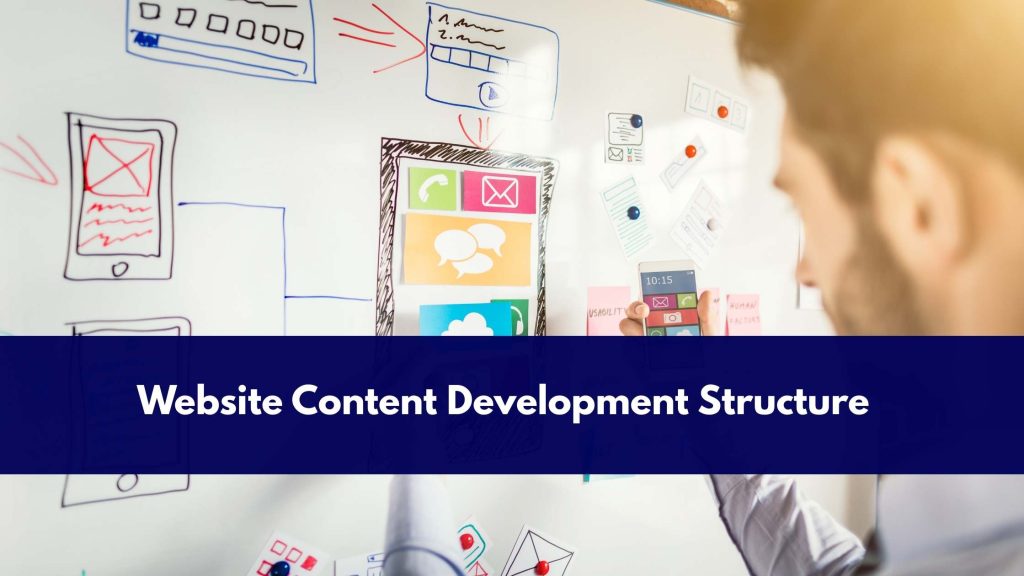
Most website visitors do not read — they scan. Your content structure must serve that behavior by making key information immediately findable:
- Use a clear heading hierarchy: H1 for the page title, H2 for major sections, H3 for subsections. This structure helps both users and search engine crawlers understand the organization of your content.
- Lead with the most important information: Address the user’s core question or need in the first paragraph, not after a lengthy preamble.
- Use short paragraphs: Two to three sentences maximum per paragraph. Dense text blocks are abandoned by mobile users at high rates.
- Incorporate visual breaks: Subheadings, bullet lists, tables, and images reduce cognitive load and improve comprehension — particularly for complex or technical content.
The Role of AI in Website Content Development
AI tools are transforming how businesses approach website content development. An AI website content creator can support ideation and drafting. Similarly, an AI content creation website may assist in generating structured outlines and keyword suggestions.
However, while AI tools enhance efficiency, professional website content development services ensure accuracy, brand alignment, and strategic messaging. Many businesses use an AI website content creator for drafts, but rely on expert website content developer oversight for final optimization.
Conclusion
Every other digital investment you make — paid advertising, social media campaigns, email marketing — drives visitors to your website. What happens when they arrive is determined almost entirely by your website content development.
The brands that consistently win in digital are not the ones with the largest advertising budgets. They are the ones that have invested in website content development as a strategic discipline — building a growing library of authoritative, audience-serving content that earns trust, visibility, and revenue simultaneously.If you are thinking of developing website content? that truly performs, contact us at 713.269.3094.
At Directory One, our team delivers end-to-end website content development services designed for brands that take their digital presence seriously. Our AI website content creator? is ready to audit your current content, build a strategic content development plan, and produce the high-quality content your brand deserves.
About The Author
