





SEO Writing: 9 Proven Tips to Create Search-Optimized Content
Most content published online never gets read. Not because the writing is poor, but because it was never built to be found. SEO writing is the discipline that bridges the gap between what you want to say and what your audience is actively searching for. Done right, it turns a well-written article into a consistent source of organic traffic. Done wrong, even the best content gets buried on page three with no visitors and no results.
Whether you manage content in-house or are exploring professional SEO content writing services for the first time, these nine tips give you a straightforward, proven framework for creating content that ranks and earns its place in search.
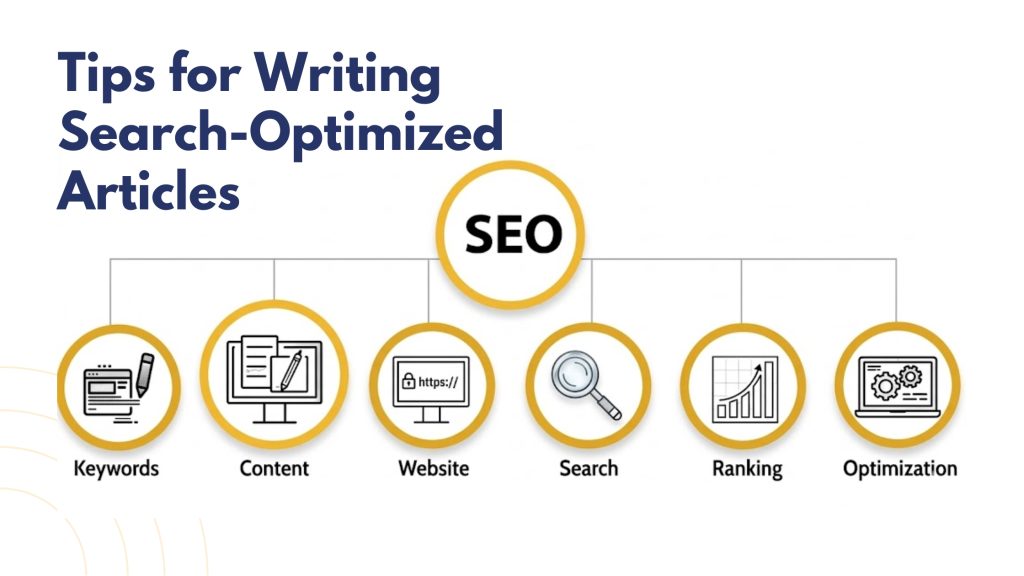
Tips for Writing Search-Optimized Articles
Tip 1: Start With Keyword Research — Every Single Time
There is no shortcut here. Every piece of SEO writing needs a clearly defined primary keyword before a single word is drafted. That keyword shapes your headline, your structure, your meta details, and your content depth.
What to Do?
Start by identifying what your audience is actually typing into search engines — not what you assume they are searching for.
Use tools like Google Search Console, Ahrefs, or Semrush to find terms with realistic search volume and manageable competition. Prioritize long-tail keywords that signal clear intent. “SEO writing tips for B2B companies” will outperform a broad, competitive term like “SEO” for most businesses.
One primary keyword per page. That is the rule.
Tip 2: Match Your Content To Search Intent
Ranking is not just about keyword placement — it is about giving searchers exactly what they came to find. Search intent is the reason behind a query: are they trying to learn something, compare options, or make a purchase? If your content type does not match that intent, you will not rank, regardless of how well your on-page SEO is executed.
What to Do?
Before writing anything, search your target keyword and study the top five results. Are they listicles, how-to guides, landing pages, or comparison articles?
The dominant format is a direct signal from Google about what it considers most relevant. Match it. Address the searcher’s core question early — within the first two paragraphs — and build depth from there.
Intent alignment is the most underrated of all SEO writing tips, and one of the highest-impact ones.
Tip 3: Place Your Primary Keyword Strategically
Where your keyword appears matters as much as how often it appears. Search engines weigh keyword placement heavily — they use it to determine relevance from the very first lines of your content.
What to Do?
Your primary keyword should appear in the first 100 words of your content, in your H1 page title, in at least one H2 subheading, and in your meta title and meta description. After that, use it naturally throughout the body — not on a schedule, not forcefully. If it sounds awkward in context, rephrase around it.
Keyword stuffing has not worked in over a decade. One well-placed, naturally used keyword is worth more than ten clumsy insertions.
Tip 4: Write Headlines That Serve Readers And Search Engines
Your H1 and H2 subheadings do two jobs at once: they help human readers navigate your content, and they tell crawlers exactly what each section covers. Weak headlines undermine both.
What to Do?
Your H1 should include your primary keyword and make a clear, specific promise about what the reader will get. H2 subheadings should incorporate secondary keywords naturally — not forced — and be descriptive enough to stand alone as useful navigational markers. Avoid vague or clever headlines that sacrifice clarity for creativity. In SEO writing, clarity wins.
A strong headline structure is one of the most consistently effective tips for writing SEO friendly content — and one of the easiest to overlook.
Tip 5: Optimize Your Meta Title And Meta Description
Your meta details do not directly change your ranking position. But they directly influence whether someone clicks on your result when it ranks. A well-written meta description is essentially a paid ad you never have to pay for.
What to Do?
Keep your meta title under 60 characters and lead with your primary keyword. Write a meta description between 150 and 160 characters that summarizes what the page delivers and includes your keyphrase naturally. Make it specific — generic descriptions get ignored. The goal of your meta description is to earn the click, not just satisfy a technical requirement.
If you are working with a professional SEO content writing agency, meta optimization should always be part of the deliverables. If it is not, ask why.
Tip 6: Structure Your Content For Readability
Google increasingly rewards content that people actually read. High bounce rates and short time-on-page send negative signals — and poor structure is one of the primary causes of both. Content that is dense, unbroken, or hard to scan loses readers before they finish the first section.
What to Do?
Write in short paragraphs — two to three sentences is the practical standard. Use subheadings to break up long sections and make the content scannable. Numbered lists and bullet points work well for steps, comparisons, and grouped information. Use transition sentences to pull readers from one section to the next.
Good SEO friendly content writing services always account for structure. Readability and optimization are not competing priorities — they reinforce each other.
Tip 7: Write For People First, Then Optimize
Over-optimized content is easy to spot — and Google’s Helpful Content system is specifically designed to penalize it. Content that reads like it was written for an algorithm rather than a human fails both audiences. It drives readers away and, increasingly, draws ranking penalties.
What to Do?
Write your first draft as if SEO did not exist — focused entirely on genuinely answering the question your content is built around. Once the draft is complete, layer in your keyword strategy: confirm placement, check subheadings, and finalize your meta details. Ask yourself honestly: would this article be useful even if it were never indexed? If the answer is yes, you are producing content that will hold up long-term.
This principle is what separates quality SEO blog writing services from content mills. Volume without quality is a short-term strategy with diminishing returns.
Tip 8: Build Internal Links Intentionally
Internal links help search engines discover and understand the relationship between your pages. They distribute authority across your site, improve crawlability, and give readers a logical path to related content — all at zero additional cost.
What to Do?
Every new piece of content should link to at least two or three relevant existing pages on your site. Use descriptive, keyword-rich anchor text — not “click here” or “read more.” Revisit older content periodically and add links to newer related pages where they fit naturally.
For any SEO content writing company producing content at scale, a structured internal linking strategy is not optional. It is foundational to the long-term performance of every page on the site.
Tip 9: Refresh And Update Content Regularly
Publishing content is not the finish line — it is the starting point. Search engines favor content that is current and accurate. A well-ranking blog post from eighteen months ago may be losing ground today because competitors have published fresher, more comprehensive content on the same topic.
What to Do?
Review your top-performing content every six to twelve months. Update outdated statistics, refresh examples, expand thin sections, and fix broken links. Update the published date only when the changes are substantive — not cosmetic.
Refreshing existing content is one of the most time-efficient SEO writing tips available because the page already has authority. You are building on an existing foundation, not starting over.
SEO Writing Checklist — Quick Reference
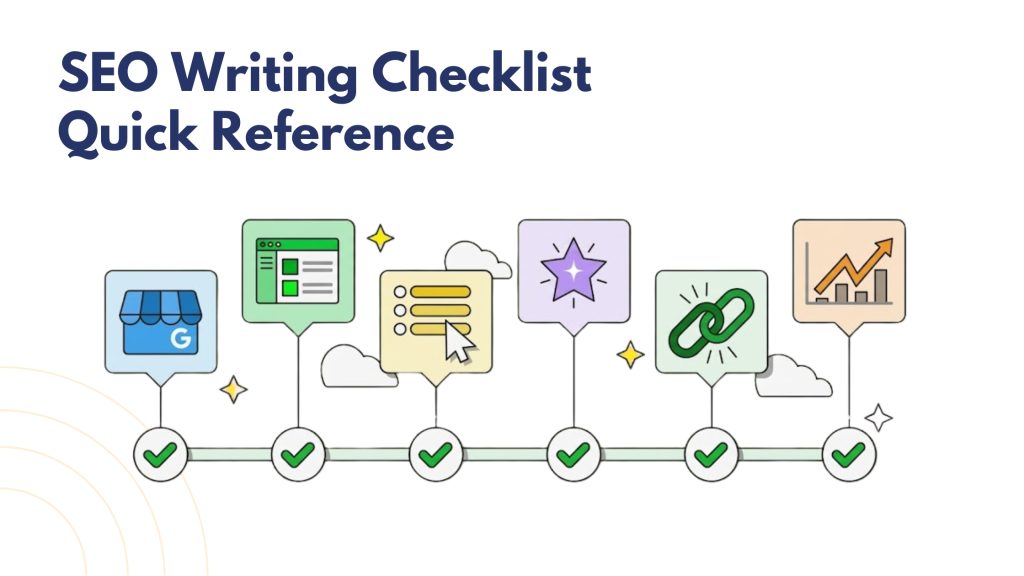
- Primary keyword in first 100 words, H1, at least one H2, meta title, and meta description
- Content type matches the dominant format for your target keyword
- Short paragraphs and clear subheading structure throughout
- Meta title under 60 characters | Meta description 150–160 characters
- Internal links to two or three relevant existing pages
- Content written for the reader first, then optimized for search
- Top-performing content reviewed and refreshed every six to twelve months
The Importance of Professional SEO Writing
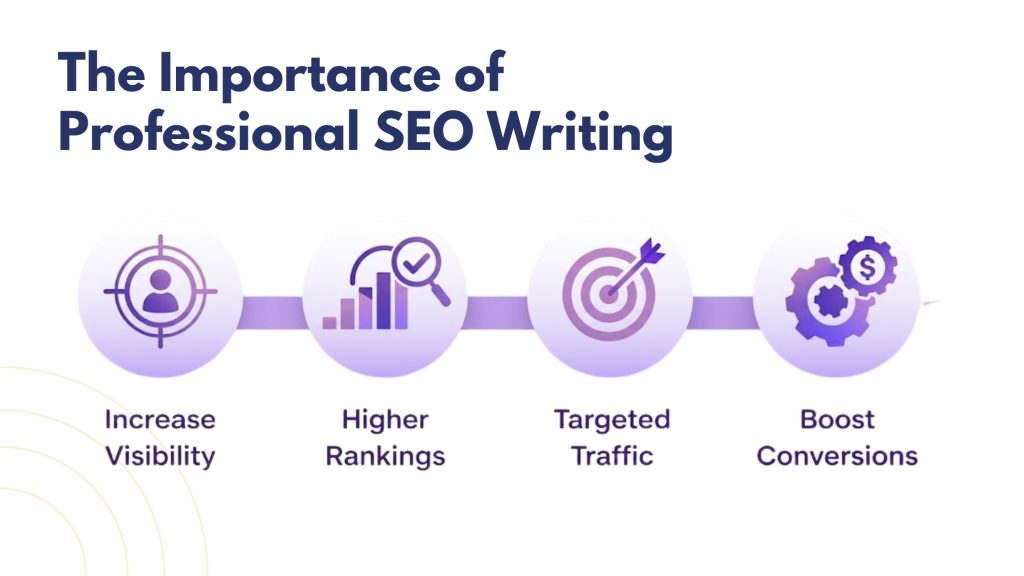
Businesses that invest in expert support often gain better results. A structured SEO content writing company ensures that strategy, optimization, and messaging align with business goals.
Working with experienced providers of SEO content writing services and SEO blog writing services reduces guesswork and improves consistency.
A reliable SEO content writing agency focuses on measurable outcomes rather than unnecessary complexity.
How Directory One Supports SEO Writing

At Directory One, we provide strategic SEO writing services tailored to business objectives. As a professional SEO content writing company, we develop structured content aligned with search intent and ranking factors.
Our team delivers:
- Targeted SEO content writing services
- Consistent SEO blog writing services
- Performance-focused SEO friendly content writing services
As an experienced SEO content writing agency, we apply proven SEO writing tips and practical SEO tips for content writing to produce measurable growth.
Partner With Experts in SEO Writing
Effective SEO Writing requires planning, technical knowledge, and consistent execution. If your content is not ranking, it is not working. Directory One can change that. We offer structured SEO writing services designed to improve visibility and strengthen your digital presence.
If you need a reliable SEO content writing company or a results-driven SEO content writing agency, our team is ready to support your growth.
Call us today at 713.269.3094 or visit www.directoryone.com.
About The Author
