





International PPC Campaigns: Common PPC Mistakes To Avoid (2026 Guide)
Running International PPC Campaigns can open the door to global growth — but only if they’re set up correctly. Many businesses expand paid search into new countries, expecting quick wins, only to face poor conversions, wasted ad spend, and confusing performance data.
According to Google, advertisers who localize targeting, messaging, and bidding strategies see significantly higher engagement and ROI in international markets. To help advertisers achieve this success, it’s essential to recognize potential pitfalls in their approach.
This guide breaks down the most common PPC mistakes to avoid — and explains, step by step, how to fix them.
Why International PPC Campaigns Are Different From Local PPC?
An international PPC campaign is not just a local campaign with more countries added. The differences run deeper than most beginners expect:
- Language and search behavior vary significantly by market
- Time zones affect when your ads should — and shouldn’t — run
- Currency differences complicate conversion tracking and ROI reporting
- Cultural intent and buying patterns shift how users respond to ad copy
Understanding these differences is the foundation of successful PPC campaign optimization for global markets. Skipping this step is also one of the most consistent reasons why PPC campaigns fail — and why agencies spend so much time rebuilding campaigns that were launched without a proper international structure.
Common Mistakes In PPC Campaign Setup?
Mistake #1: Using the Same Campaign Structure for Every Country
One of the most widespread common mistakes in PPC campaign setup is running multiple countries under a single campaign. It feels efficient. It isn’t.
Why this fails:
- No control over country-level budgets
- Blended performance data
- Inaccurate ROI tracking
How to fix it:
- Create separate campaigns by country or region
- Set country-specific budgets and bids
- Track performance individually
This separation is the first thing any experienced PPC campaign optimization team implements when inheriting a global account. Without it, no amount of bid adjustments or copy testing will produce clean results.
Mistake #2: Poor or Incorrect PPC Geo-Targeting
PPC geo-targeting mistakes are one of the fastest ways to drain a budget. Google has confirmed that ads shown outside the intended location significantly reduce conversion rates — yet this mistake appears repeatedly in beginner-managed accounts.
Common PPC geo-targeting issues:
- Targeting “presence or interest” instead of “presence”
- Forgetting to exclude non-relevant regions
- Ignoring language-based location settings
Best geo-targeting strategies for PPC campaigns?:
- Target users physically located in the country
- Align language settings with the audience
- Use location exclusions aggressively
Applying the best geo-targeting strategies for PPC campaigns from day one prevents the most common form of international ad waste.
Mistake #3: Translating Instead of Localizing Ad Copy & PPC Landing Pages
This is where many businesses make a critical international advertising mistake: they translate their ads word-for-word and expect them to convert. They don’t.
Localization vs. translation is not a semantic argument — it’s a performance issue. Localized content doesn’t just change the language; it adapts the message, tone, trust signals, and value propositions to match local buyer expectations. HubSpot research shows that localized content increases conversion rates by over 40% compared to generic messaging.
What localization really means:
- Local terminology and phrasing
- Country-specific value propositions
- Cultural tone and trust signals
This applies equally to your PPC landing pages. A localized ad pointing to a generic English-language landing page breaks the experience at the most critical point. To properly analyze PPC landing pages for international campaigns, ask: does this page reflect the culture, language, and expectations of someone in that specific country?
Working with a multilingual PPC agency or investing in multilingual PPC services ensures this is handled at both the copy and landing page level — not just in the ad itself.
Mistake #4: Ignoring Time Zones and Ad Scheduling
Running ads 24/7 across multiple time zones sounds like maximum coverage. In practice, it means paying for clicks at 3 a.m. local time when no one is ready to buy.
How to avoid this:
- Schedule ads to run during local business hours in each target market
- Adjust bids upward during peak conversion windows
- Review hourly performance data per country — not aggregated across all markets
Proper international PPC strategies account for when buyers in each market are most active, not just when your team is awake to monitor performance.
Mistake #5: Skipping Proper Conversion Tracking
Without accurate tracking, international PPC campaigns fail silently. You may see clicks. You may even see form submissions. But without proper PPC conversion tracking in place, you cannot tell which markets are profitable and which are quietly burning budgets.
Google is direct on this: conversion tracking is not optional for automated bidding — it’s required for the system to optimize toward any meaningful outcome.
Common tracking mistakes in international accounts:
- Using a single conversion action for all countries — this blends data and hides underperformers
- Not accounting for currency differences in revenue tracking
- Tracking volume (form fills) without tracking quality (lead qualification)
How to set up conversion tracking for PPC ads across international campaigns:
- Create separate conversion actions per country or region
- Set the correct currency for each market in Google Ads
- Use Google Tag Manager to deploy tracking without developer delays
- Connect CRM data where possible to track lead quality beyond the click
- Review conversion lag — international buyers often take longer to convert due to time zone and decision-cycle differences
Directory One routinely identifies conversion tracking gaps during PPC audits — particularly in global accounts where this setup has been copied from a domestic campaign without adjustment.
Mistake #6: Focusing on Clicks Instead of ROI
High click-through rates feel like momentum. They’re not. Especially internationally, where click costs, conversion rates, and lead quality vary dramatically by market, clicks are a vanity metric.
Metrics that actually matter for international campaigns:
- Cost per qualified lead by country
- Conversion rate segmented by market
- Return on ad spend (ROAS) at the campaign level
Shifting to this mindset is central to how to optimize PPC campaigns that operate across multiple countries. It’s also the difference between a campaign that looks busy and one that generates a profitable pipeline.
PPC Landing Page Best Practices for International Campaigns
Your ad gets the click. Your landing page closes — or loses — the lead. For international campaigns, PPC landing page best practices must account for more than just design.
When you analyze PPC landing pages for international performance, verify:
- Language match: The page language matches the ad language exactly
- Localized social proof: Testimonials, case studies, and trust badges from the target market — not just the US
- Local contact options: Phone numbers in local format, local business hours, regional support references
- Currency and pricing: Displayed in local currency where relevant
- Load speed: Pages optimized for local network conditions — particularly important in markets with slower average connection speeds
- Mobile experience: Many international markets have higher mobile-first usage rates than the US
The gap between a well-targeted ad and a poorly localized landing page is where most international PPC campaigns’ budgets disappear.
Localization vs. Translation: Why It Matters for Multilingual PPC
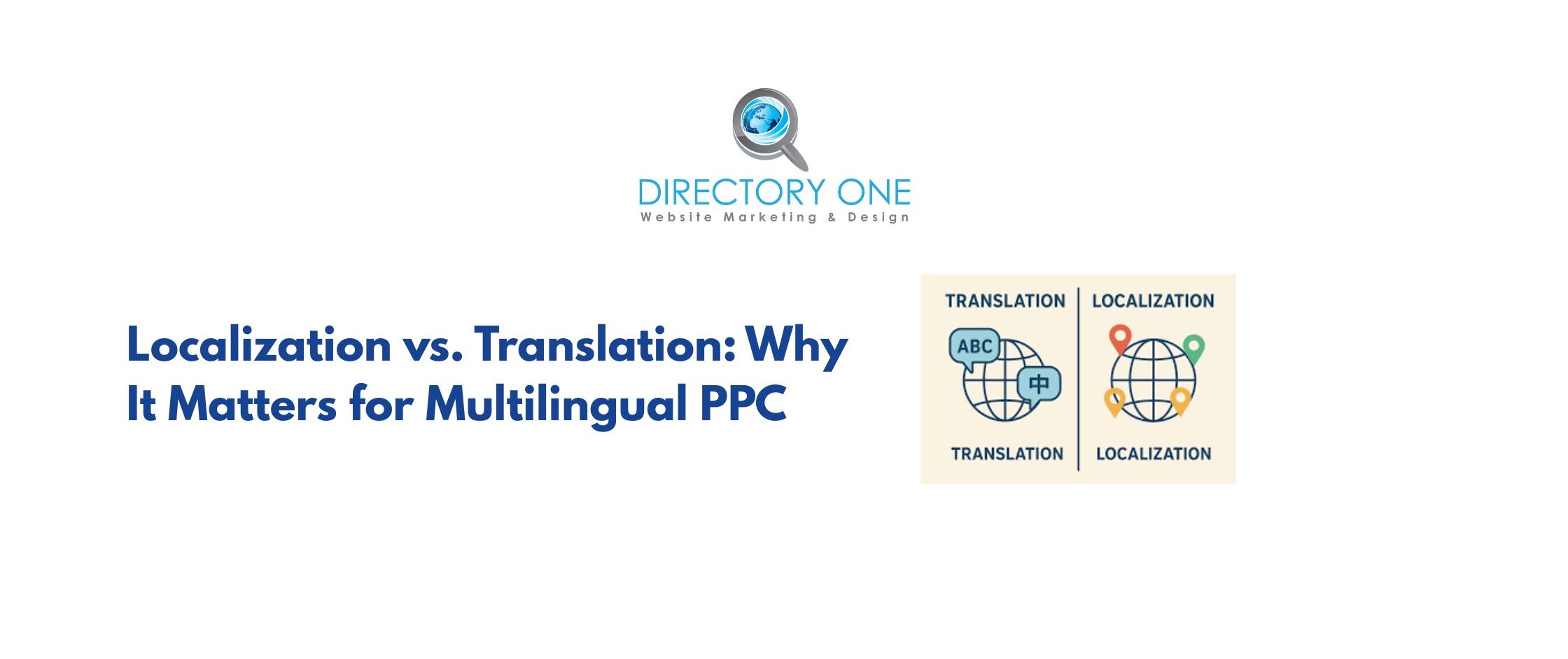
If your business is targeting non-English-speaking markets, multilingual PPC is not just a language exercise — it’s a strategy. And website localization vs. translation is the distinction that separates campaigns that convert from campaigns that confuse.
Translation changes the words. Localization changes the experience.
A multilingual PPC agency with experience in international markets will build campaigns where the keyword research, ad copy, landing page content, and even the offer itself are adapted for each language and culture — not just converted through a translation tool.
Multilingual PPC services typically include:
- Native-language keyword research (search behavior differs by language, not just by geography)
- Culturally adapted ad copy reviewed by in-market speakers
- Localized landing pages with market-appropriate messaging and CTAs
- Separate tracking per language to measure true performance
Simple Framework for Successful International PPC Campaigns
| Step | Action |
| 1 | Separate campaigns by country |
| 2 | Apply strict geo-targeting |
| 3 | Localize ads and landing pages |
| 4 | Schedule ads by time zone |
| 5 | Track conversions correctly |
| 6 | Optimize weekly based on ROI |
Why PPC Campaigns Fail — And How Agencies Fix Them
Understanding why PPC campaigns fail and how agencies fix them comes down to one consistent finding: most international PPC failures are structural, not strategic. The ideas are sound. The execution is broken.
The 3 common PPC mistakes beginners make in international campaigns are:
- One campaign for all countries — no budget control, no clean data
- No localization — translated copy that doesn’t convert in local markets
- No conversion tracking — optimizing blind, with no signal to guide bidding
Agencies fix these by rebuilding the account architecture first — before touching bids, copy, or budgets. Without a clean foundation, optimization has nowhere to land.
Conclusion
International PPC campaigns can drive high-quality global leads — but only when built with the right structure, targeting, and tracking. Beginners consistently fail by treating international advertising like a scaled-up local campaign, which leads to wasted spend, poor conversion data, and campaigns that can’t be meaningfully optimized.
The common PPC mistakes to avoid outlined in this guide — from geo-targeting errors and localization gaps to broken conversion tracking — are all fixable. But they require intentional setup from the start, not patches applied after the budget has already been lost.
For expert-level PPC campaign optimization, international account audits, and full-service multilingual PPC services, Directory One provides structured global PPC strategies backed by data, experience, and ongoing performance management.To explore further or get expert guidance, call 713.269.3094 or visit directoryone.com.
About The Author
