





Google Voice Search Optimization Strategy & Tips
Google voice search optimization is now a business-critical SEO priority. With over 1 billion voice searches conducted every month (Google), the way people find businesses, products, and answers has fundamentally shifted. If your content is not built for spoken queries, you are invisible to a rapidly growing segment of search traffic.
This guide covers exactly how to optimize for voice searches — with data, examples, and a ready-to-use checklist.
What Is Voice Search SEO: An Overview
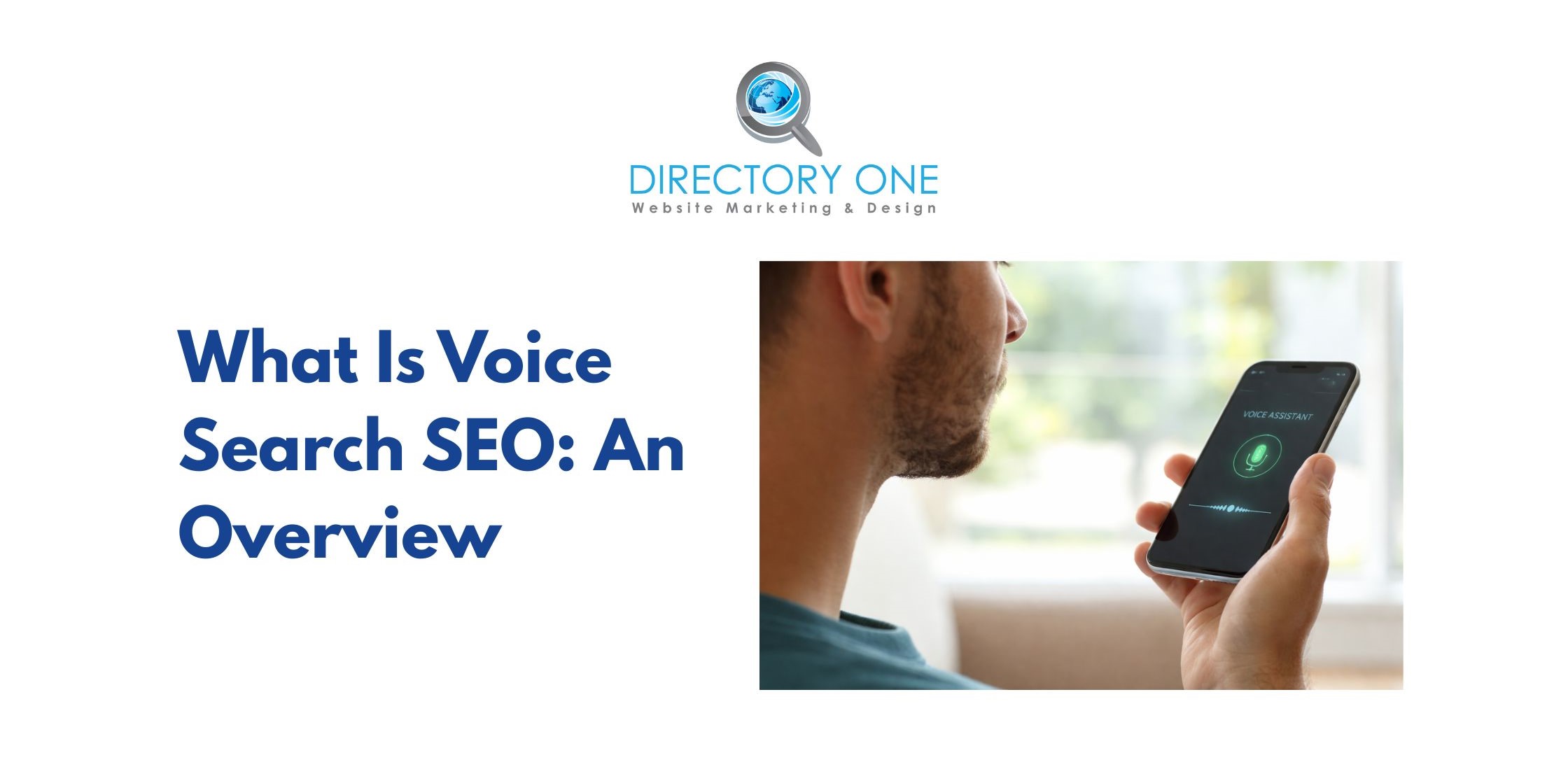
What is voice search SEO? It is the practice of structuring your content, technical setup, and local listings so that voice assistants — Google Assistant, Siri, Alexa, and Cortana — select your content as the spoken answer to a user’s query.
Traditional SEO optimizes for typed keywords. Voice search SEO strategy optimizes for natural, conversational questions. The difference matters enormously because voice queries are structurally different from text queries:
- A typed query looks like: best pizza near me
- A voice query looks like: “Hey Google, what’s the best pizza place open right now near me?”
The voice version is longer, more specific, local, and intent-loaded. Your content must be written to match that natural phrasing.
Voice Search Impact On SEO Strategy? in 2026

The voice search impact on SEO strategy is no longer theoretical — it is measurable and growing. Here is why every business needs to act now:
- Mobile-first behavior is accelerating.
According to Statista, mobile devices account for over 60% of all global web traffic in 2024. Voice search is predominantly a mobile behavior, meaning optimizing for voice directly supports your mobile SEO performance.
- Featured Snippets are the voice answer.
Google reads the Featured Snippet — Position Zero — as its voice response in the majority of queries. If your content earns a Featured Snippet, it becomes the spoken answer heard by millions of users. That is a visibility level no paid ad can replicate.
- Local intent dominates voice.
According to Google, “near me” searches have grown over 500% in the last two years. The overwhelming majority of those searches are voice-initiated. For any business with a physical location, failing to optimize local business listings for voice search means losing customers who are actively ready to visit or buy.
- AI is amplifying the voice.
The rise of AI-powered assistants and AI agent voice search optimization tools has made voice interfaces smarter and more widely adopted. AI agents now answer complex, multi-step queries through voice — which means your content must be authoritative, structured, and comprehensive enough to be trusted by AI systems, not just indexed by crawlers.
Google Voice Search Optimization vs Traditional SEO: Key Differences
Understanding the gap between SEO voice search strategy and conventional SEO is essential before making changes to your content.
| Factor | Traditional SEO | Voice Search SEO Strategy |
| Query format | Short, fragmented keywords | Full conversational questions |
| Query length | 1–3 words average | 7–9 words average |
| Search intent | Mixed: informational, navigational, transactional | Predominantly immediate and local |
| Result format | List of ranked links | Single spoken answer (Position Zero) |
| Device | Desktop and mobile | Primarily mobile and smart speaker |
| Content format | Long-form, keyword-dense | Concise, question-answer structured |
| Local signals | Helpful but optional | Critical — Google My Business is essential |
The most important takeaway: in traditional SEO, you compete for top-10 positions. In voice search, there is only one winner — the single answer the assistant reads aloud. Your SEO voice search strategy must aim for Position Zero, or it aims for nothing.
How to Optimize Content for Voice Search: Step-by-Step
This is the actionable core of Google voice search optimization. Follow these steps to restructure your content and technical setup for spoken queries.
Step 1 — Write in Natural, Conversational Language
Read your content aloud. If it sounds unnatural when spoken, rewrite it. Voice queries are full sentences — your content should answer them in full sentences. Avoid jargon-dense paragraphs. Use plain language, short sentences, and direct answers.
Actionable tip: For every major section of a page, add a one- to two-sentence “direct answer” at the top, before your longer explanation. This is the structure Google extracts for Featured Snippets and reads as voice responses.
Step 2 — Target Question-Based Keywords
How to optimize content for voice search begins with the right keywords. Voice searchers use question words constantly: who, what, where, when, why, and how. Build your content around these question formats.
Use tools like Google’s People Also Ask, Answer the Public, and Semrush’s Keyword Magic Tool to identify the exact questions your audience is asking. Then answer each one directly and concisely — in 40 to 60 words, which is the average length of a voice answer according to Backlinko’s analysis of 10,000 Google Home results.
Step 3 — Optimize for Featured Snippets
Featured Snippets are the gateway to voice. Structure your content with:
- A direct answer in the first 1–2 sentences after a subheading
- A supporting explanation of 50–100 words
- Supporting lists, tables, or steps where relevant
- Schema markup to reinforce the structure (see Step 5)
Step 4 — Optimize Local Business Listings for Voice Search
If your business has a physical location or serves a specific area, local optimization is non-negotiable. Optimize local business listings for voice search by doing the following:
- Claim and fully complete your Google Business Profile. Name, address, phone, hours, categories, photos, and services must all be filled in. Google Assistant pulls local answers directly from GBP data.
- Ensure NAP consistency. Your Name, Address, and Phone number must be identical across your website, GBP, Yelp, Bing Places, Apple Maps, and every directory listing. Inconsistencies suppress local voice results.
- Add location-specific FAQ content to your website. Pages that answer “Is [Business Name] open on Sunday?” or “Where is [Business Name] located?” directly match voice queries about your business.
- Earn and respond to reviews. Google weighs review quality and recency in local ranking. According to BrightLocal’s 2023 Local Consumer Review Survey, 98% of consumers read online reviews for local businesses — and Google uses review signals in voice answer selection.
Step 5 — Implement Structured Data (Schema Markup)
Schema markup is the technical language that tells Google exactly what your content is — a FAQ, a local business, a product, a how-to guide, or an article. Voice assistants rely heavily on structured data to identify trustworthy, well-organized answers.
Priority schema types for voice optimization:
- FAQPage schema — marks up question-and-answer content for Featured Snippet eligibility
- LocalBusiness schema — signals your business name, address, phone, hours, and coordinates
- HowTo schema — structures step-by-step guides that voice assistants can read sequentially
- Speakable schema — explicitly tells Google which sections of a page are optimized for audio playback
Step 6 — Improve Page Speed and Mobile Performance
Google requires pages that compete for voice answers to load fast. According to Google’s own research, 53% of mobile users abandon a page that takes more than 3 seconds to load. Run your pages through Google PageSpeed Insights and aim for a mobile score above 90. Core Web Vitals — LCP, FID, and CLS — all influence voice answer eligibility.
Step 7 — Build Topical Authority
Google’s voice algorithm favors sources it trusts. Build topical authority by creating comprehensive, interlinked content clusters around your core topics. A single optimized FAQ page is not enough — you need supporting pillar pages, related blog posts, and internal links that signal depth of expertise to Google’s systems.
Get Found: Google Voice Search Optimization Tips and Tricks
A strong SEO voice search strategy requires action across four distinct areas. Work through each category systematically — do not skip to advanced steps before the foundations are solid.
Content & Copy
- Rewrite key pages in conversational, natural language — read them aloud to test.
- Add a 40 to 60-word direct answer at the top of every major section.
- Use question-based H2/H3 headings (Who, What, Where, When, Why, How).
- Build a FAQ section with 5–10 naturally phrased questions on every key page.
Local Optimization
- Complete your Google Business Profile 100% — hours, photos, services, description.
- Match NAP (Name, Address, Phone) exactly across Google, Yelp, Bing, and Apple Maps.
- Add location-specific FAQ content — “Are you open Sundays?”, “Do you serve [City]?”
- Request and respond to Google reviews consistently.
Technical & Schema
- Add FAQPage schema to all Q&A sections.
- Add the LocalBusiness schema to the homepage and contact page.
- Add the HowTo schema to all step-by-step content.
- Confirm the site runs on HTTPS — Google will not serve HTTP pages as voice answers.
Speed & Mobile
- Score 90+ on Google PageSpeed Insights (mobile).
- Pass Core Web Vitals — LCP under 2.5s, CLS under 0.1, FID under 100ms.
- Test key pages on a real mobile device, not just a desktop.
Tools for Google Voice Search Optimization Success
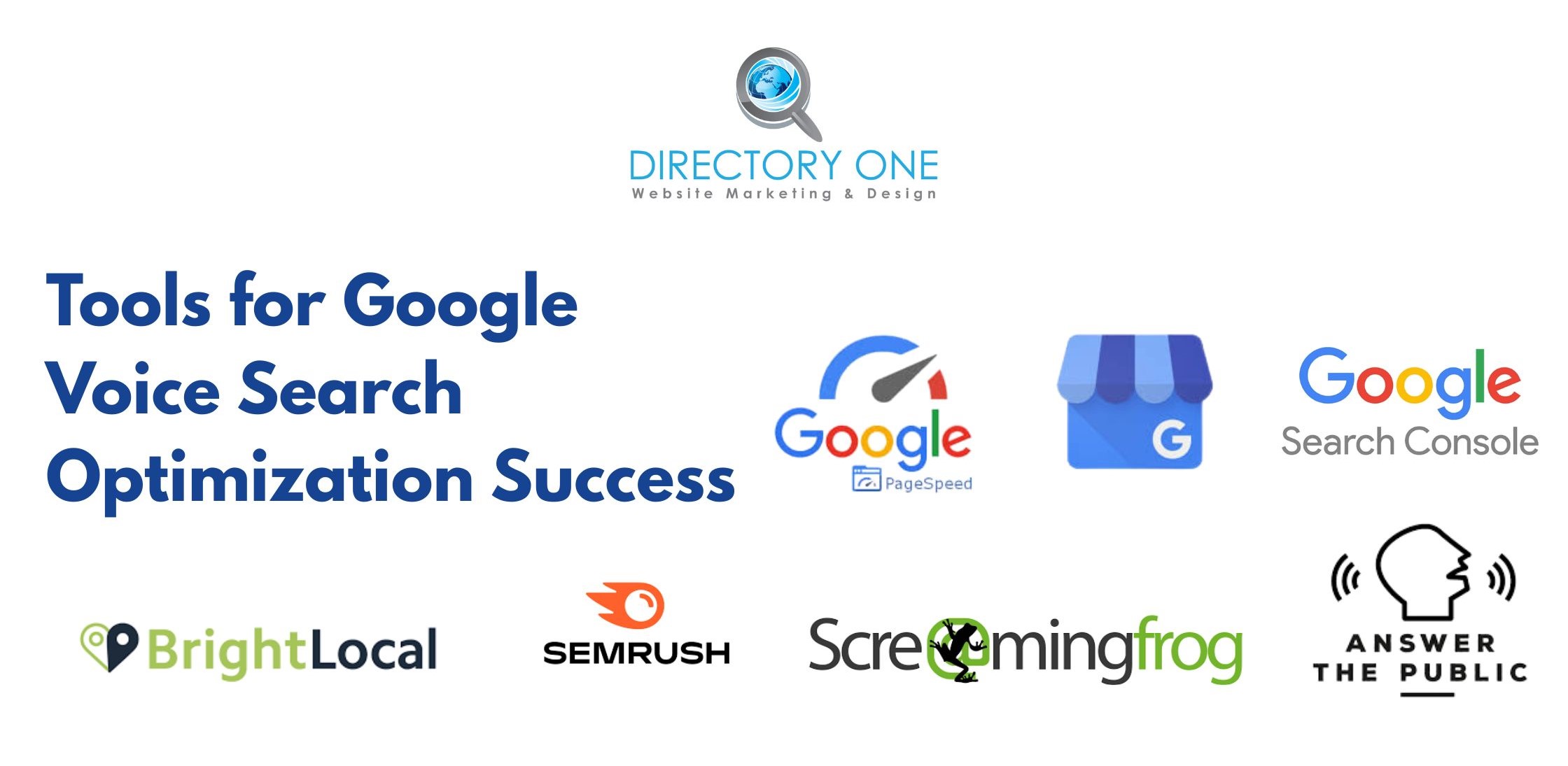
These tools support an end-to-end Google voice search optimization workflow — from keyword discovery to technical validation:
| Tool | Type | Best For |
| Google Search Console | Free | Monitor which queries trigger your pages; track Featured Snippet wins |
| Google PageSpeed Insights | Free | Audit mobile speed and Core Web Vitals scores |
| Google Business Profile | Free | Local voice optimization — the single most important local signal |
| Answer the Public | Free / Paid | Discover question-format keywords your audience is asking |
| Google People Also Ask | Free (native) | Identify high-priority voice questions directly from Google’s SERP |
| Semrush | Paid | Keyword research, position tracking, and Featured Snippet gap analysis |
| Schema Markup Validator | Free (Google) | Validate that your structured data is correctly implemented |
| Screaming Frog | Free / Paid | Crawl your site to audit schema, speed issues, and mobile flags |
| BrightLocal | Paid | Local citation tracking and NAP consistency audit across directories |
Typical Voice Search Optimization Errors to Avoid
Even businesses investing in voice search optimization services often make these errors:
- Targeting head keywords only.
Voice search is long-tail by nature. Optimizing for “pizza Chicago” instead of “what pizza places are open late in Chicago tonight” misses the majority of voice traffic. Shift your keyword strategy toward full questions.
- Ignoring mobile performance.
Voice and mobile are inseparable. A slow, poorly structured mobile experience eliminates you from voice results entirely — regardless of how strong your content is.
- Incomplete Google Business Profile.
Missing hours, no photos, inconsistent addresses, or unclaimed listings are the most common reasons local businesses fail to appear in voice results. This is the easiest fix with the highest return.
- No FAQ or Q&A content.
Most websites have zero question-formatted content. Adding a single, well-structured FAQ page with schema markup can generate Featured Snippet captures within weeks.
- Writing for bots, not speakers.
Keyword-dense, unnatural copy does not get selected as a voice answer. Google’s voice algorithm specifically evaluates readability and conversational tone. If it does not sound like something a helpful person would say, it will not be read by a voice assistant.
- Skipping schema markup.
Without structured data, Google has to guess what your content is. Schema markup removes the guesswork and significantly improves your eligibility for voice answer selection.
How a Voice Search Optimization Agency Can Accelerate Your Results
For businesses competing in high-stakes local markets or managing large content libraries, partnering with a voice search optimization agency compresses the time from implementation to results. A qualified voice search optimization agency brings three capabilities that are difficult to build in-house: systematic schema implementation at scale, a Featured Snippet strategy based on competitive gap analysis, and local citation management across dozens of directories simultaneously.
Directory One specializes in exactly this work. As an established voice search optimization expert with deep experience in local SEO, schema strategy, and content restructuring, Directory One helps businesses move from invisible to spoken — across Google Assistant, Siri, Alexa, and beyond.
Ready to dominate voice search in your market? Call Directory One today or visit our website to get a free voice search audit for your business. Our team is available to answer your questions and build a custom ai agent voice search optimization roadmap tailored to your industry and location.
Make Google Voice Search Optimization Your First Priority
Google voice search optimization is not a future-state strategy — it is a present-day competitive advantage that most businesses are still ignoring. The data is unambiguous: voice search volume is growing, local voice queries are converting, and AI-powered assistants are making voice the default interface for an expanding share of the population.
Start with the checklist in this guide. Fix your Google Business Profile first. Add question-based content with schema markup. Improve mobile speed. Each step compounds the next — and every week you wait is a week a competitor can claim the spoken answer that should be yours.
If you need expert support with “how to optimize for voice searches” implementation, Directory One is one call away. To build a future-proof SEO voice search strategy for you today, contact our senior strategists at 713.269.3094.
About The Author
