Search Engine Marketing & Optimization BlogDirectory One2026-10-07T17:28:36Zhttps://www.directoryone.com/blog/feed/atomWordPresshttps://www.directoryone.com/blog/wp-content/uploads/directory-one-icon-50x50.jpgDirectoryone<![CDATA[Organic Instagram Marketing to Grow Followers Without Paid Ads]]>https://www.directoryone.com/blog/?p=71512026-10-07T17:28:36Z2026-10-07T17:28:35ZWinning on Instagram today does not require a massive advertising budget. While algorithm updates and pay-to-play options dominate the conversation, organic Instagram marketing remains one of the most reliable ways to build an authentic, highly engaged customer base. Relying strictly on Instagram marketing without paid ads forces your business to focus on what matters most: high-value visual content, community engagement, and algorithmic alignment. An effective Instagram marketing strategy helps small businesses and B2B brands turn casual scrollers into loyal customers. What Is Organic Instagram Marketing? Organic Instagram marketing refers to any activity performed on the platform without paid promotion. This includes publishing posts, Reels, and Stories, writing keyword-rich captions, engaging with followers in comments and direct messages, and optimizing your profile for search. Unlike paid campaigns that deliver temporary reach, organic marketing builds long-term brand equity, fosters true community trust, and generates sustainable inbound leads. 7 Proven Instagram Marketing Techniques for Organic Growth Learning how to do organic marketing on Instagram requires moving away from static promotional images and shifting toward value-driven storytelling. 1. Leverage Instagram Reels Marketing for Non-Follower Reach Short-form vertical video is the single most effective tool for organic reach. The Instagram algorithm actively serves Instagram Reels
]]>Winning on Instagram today does not require a massive advertising budget. While algorithm updates and pay-to-play options dominate the conversation, organic Instagram marketing remains one of the most reliable ways to build an authentic, highly engaged customer base.
Relying strictly on Instagram marketing without paid ads forces your business to focus on what matters most: high-value visual content, community engagement, and algorithmic alignment. An effective Instagram marketing strategy helps small businesses and B2B brands turn casual scrollers into loyal customers.
What Is Organic Instagram Marketing?
Organic Instagram marketing refers to any activity performed on the platform without paid promotion. This includes publishing posts, Reels, and Stories, writing keyword-rich captions, engaging with followers in comments and direct messages, and optimizing your profile for search.
Unlike paid campaigns that deliver temporary reach, organic marketing builds long-term brand equity, fosters true community trust, and generates sustainable inbound leads.
7 Proven Instagram Marketing Techniques for Organic Growth
Learning how to do organic marketing on Instagram requires moving away from static promotional images and shifting toward value-driven storytelling.
1. Leverage Instagram Reels Marketing for Non-Follower Reach
Short-form vertical video is the single most effective tool for organic reach. The Instagram algorithm actively serves Instagram Reels marketing content to non-followers via the Reels tab and Explore page.
Focus on the First 3 Seconds: Start with a strong visual hook or text overlay to stop scrollers instantly.
Deliver Fast Value: Share actionable industry tips, behind-the-scenes processes, or quick solutions to common pain points.
Use Trending Audio Wisely: Pair educational commentary with trending audio tracks to boost distribution signals.
2. Design High-Value, Saveable Carousel Posts
Carousel posts generate higher engagement rates than single static images. When users swipe through multiple slides, it signals strong dwell time to the algorithm.
Create multi-slide tutorials, step-by-step checklists, or industry breakdowns.
End the carousel with a clear call-to-action (CTA) encouraging users to Save the post for later or Share it with a colleague.
3. Optimize Your Profile for Instagram Search (SEO)
Instagram functions like a visual search engine. Users search for services using location and industry terms rather than exact handle names.
Name Field: Include your primary offering and city (e.g., “Houston Commercial Contractor” or “B2B Marketing Consultant”).
Bio Line: Define who you help, how you help them, and what action they should take next.
Link in Bio: Direct users to high-converting landing pages, booking calendars, or lead magnets.
4. Build Community Through Direct Engagement
Organic algorithms favor accounts that foster genuine human interaction. You cannot post and ghost.
The 10-Minute Pre/Post Rule: Spend 10 minutes before and after publishing engaging with comments on your page and commenting on target community accounts.
Use Stories for Daily Retention: Share daily interactive Stories (polls, Q&A stickers, slider ratings) to keep existing followers engaged and move warm leads into DMs.
5. Master Hyper-Local Hashtags and Location Tags
For localized businesses, tagging your precise city and region ensures your content lands on localized Explore feeds.
Combine broad industry hashtags (e.g., #DigitalMarketingStrategy) with targeted local tags (e.g., #HoustonBusiness or #HoustonSmallBusiness).
Always tag your physical location or target service zone on every Reel and post.
6. Collaborate via the Collab Feature
Partnering with complementary, non-competing local brands or industry voices instantly doubles your organic reach.
Use the Invite Collaborator feature when posting a joint project, event, or co-branded piece of content.
The post will display on both profiles simultaneously, pooling engagement and exposing your brand to an established, relevant audience.
7. Maintain a Consistent Content Cadence
Algorithm favorability depends heavily on regular posting signals.
Publish 3 to 4 Reels per week for net-new discovery.
Share 2 to 3 Carousel posts per week for audience retention and saves.
Post 3 to 5 Stories daily to nurture active connections.
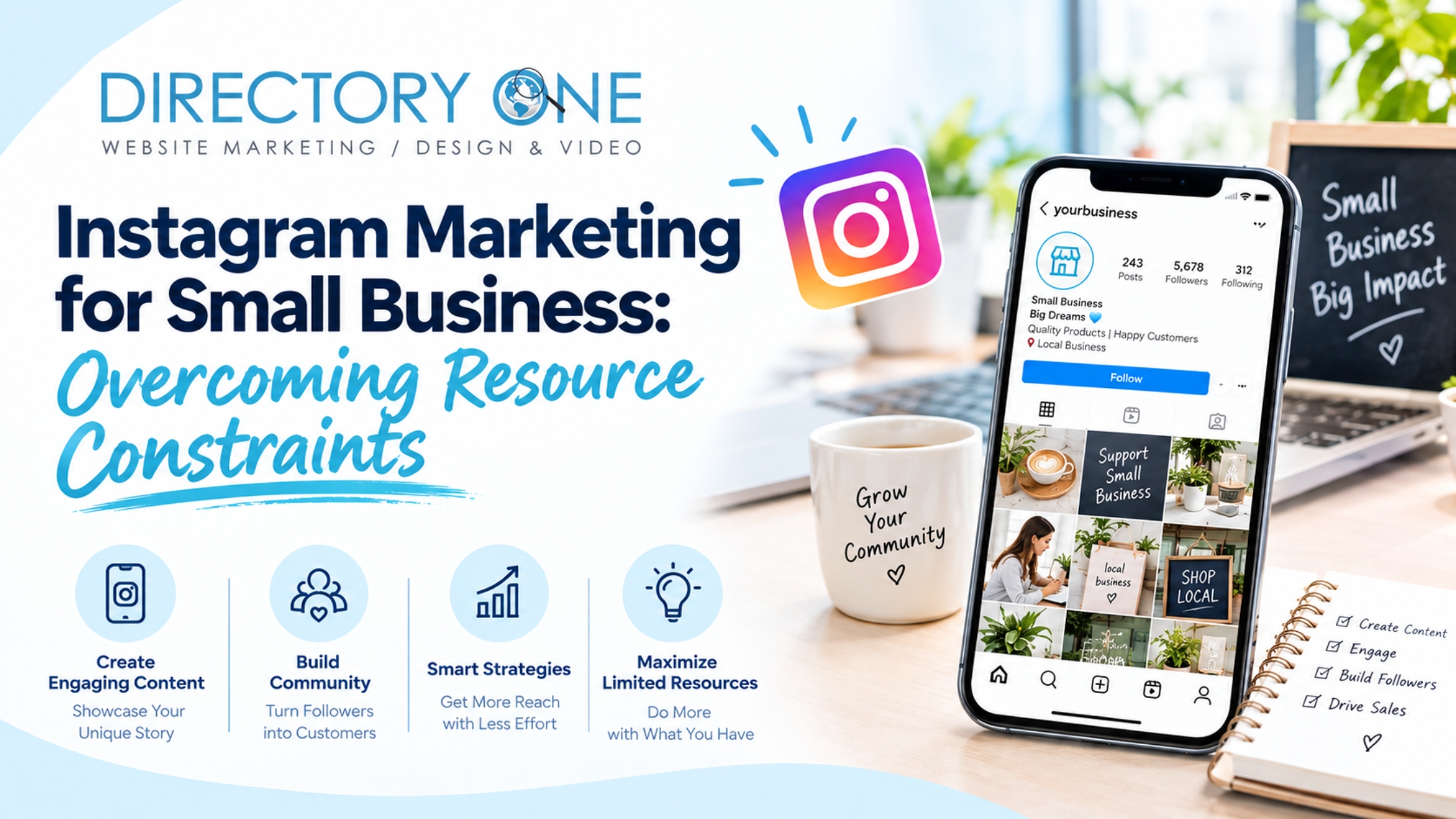
Instagram Marketing for Small Business: Overcoming Resource Constraints
Executing Instagram marketing for small business success requires consistency over high-budget production. Small teams can maximize output by repurposing core assets:
Turn long-form blog posts or client FAQs into 5-slide carousel graphics.
Record short video snippets during daily fieldwork or client operations to build authentic Reels.
Document real customer results and case studies rather than designing polished sales flyers.
Scale Your Reach with Directory One: Houston Social Media Marketing Services
Managing consistent content creation, profile optimization, and community engagement takes dedicated time and strategic precision. Partnering with a dedicated social media agency in Houston accelerates your brand’s growth without wasting hours on ineffective tactics.
At Directory One, we provide complete Houston social media marketing services and organic growth strategies tailored for local businesses. As a leading Houston Instagram advertising agency, our team builds custom visual campaigns, structures high-converting Reels, and handles complete social channel management so you can focus on running your business.
Ready to elevate your Instagram presence and capture qualified leads organically?
Contact Directory One today at 713-465-0051 or visit Directory One to request your custom social media growth strategy.
]]>Directoryone<![CDATA[Houston LinkedIn Marketing Strategies for B2B Companies]]>https://www.directoryone.com/blog/?p=71282026-07-13T13:23:56Z2026-07-13T13:23:55ZFor B2B companies looking to build relationships, generate qualified leads, and establish industry authority, LinkedIn is one of the most effective digital marketing platforms available today. It has quietly become the most powerful platform for B2B growth in every industry, from energy and oil and gas to professional services and startups. But simply having a company page is not enough. What actually moves the needle is a focused, well-executed set of LinkedIn marketing strategies for B2B that connects your brand to the right decision-makers at the right moment. This guide breaks down exactly what works and how Houston companies can put it into practice today. What Is LinkedIn B2B Marketing? Many business owners ask, ” What is LinkedIn B2B marketing and why does it matter?” LinkedIn B2B marketing involves using LinkedIn’s professional network to attract, engage, and convert business decision-makers. Unlike consumer-focused social platforms, LinkedIn is designed specifically for professional networking, making it ideal for lead generation, brand awareness, and relationship building. For organizations seeking effective LinkedIn marketing for B2B companies, the platform provides direct access to executives, procurement managers, business owners, and industry influencers across Houston and throughout Texas. Why LinkedIn Is the B2B Platform Houston Companies Cannot Ignore
]]>For B2B companies looking to build relationships, generate qualified leads, and establish industry authority, LinkedIn is one of the most effective digital marketing platforms available today. It has quietly become the most powerful platform for B2B growth in every industry, from energy and oil and gas to professional services and startups. But simply having a company page is not enough. What actually moves the needle is a focused, well-executed set of LinkedIn marketing strategies for B2B that connects your brand to the right decision-makers at the right moment.
This guide breaks down exactly what works and how Houston companies can put it into practice today.
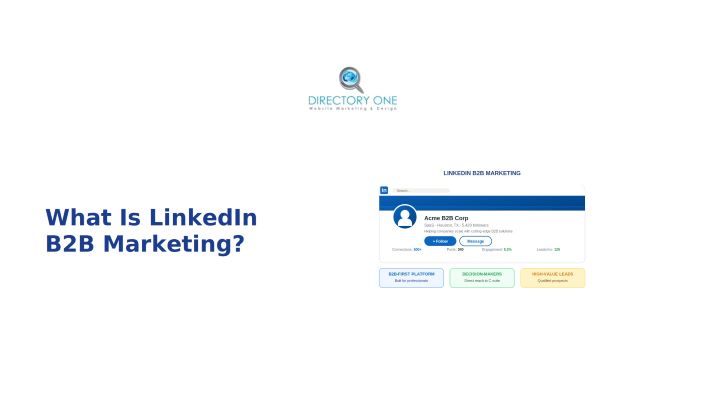
What Is LinkedIn B2B Marketing?
Many business owners ask, ” What is LinkedIn B2B marketing and why does it matter?”
LinkedIn B2B marketing involves using LinkedIn’s professional network to attract, engage, and convert business decision-makers. Unlike consumer-focused social platforms, LinkedIn is designed specifically for professional networking, making it ideal for lead generation, brand awareness, and relationship building.
For organizations seeking effective LinkedIn marketing for B2B companies, the platform provides direct access to executives, procurement managers, business owners, and industry influencers across Houston and throughout Texas.
Why LinkedIn Is the B2B Platform Houston Companies Cannot Ignore
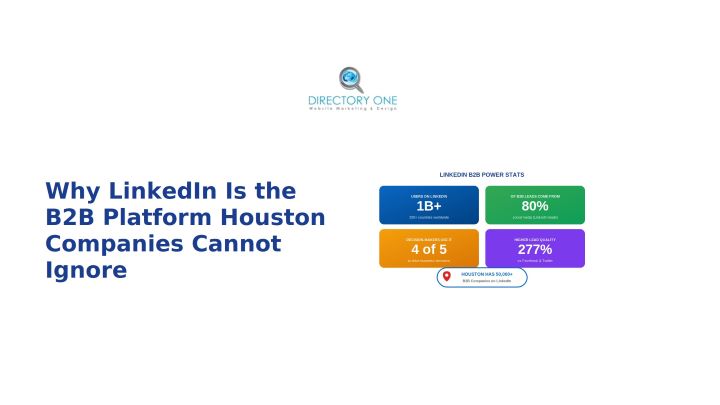
With over 1 billion members globally and a user base that skews heavily toward professionals, executives, and procurement teams, LinkedIn is where B2B buying decisions begin. For Houston businesses, that translates into a direct line to energy sector leaders, healthcare administrators, logistics decision-makers, and C-suite professionals spread across the fourth-largest city in the country.
LinkedIn B2B marketing is not just about running ads. It is about building credibility, nurturing relationships, and creating a consistent presence that keeps your brand top of mind long before a prospect is ready to buy. When done right, LinkedIn becomes your highest-converting digital channel.
Companies investing in LinkedIn marketing for Houston businesses can benefit from:
Improved brand credibility
Access to highly targeted audiences
Increased website traffic
Better lead quality
Stronger professional relationships
Enhanced recruitment opportunities
Many organizations partner with a LinkedIn marketing agency in Houston that businesses trust to create and manage campaigns that consistently generate results.
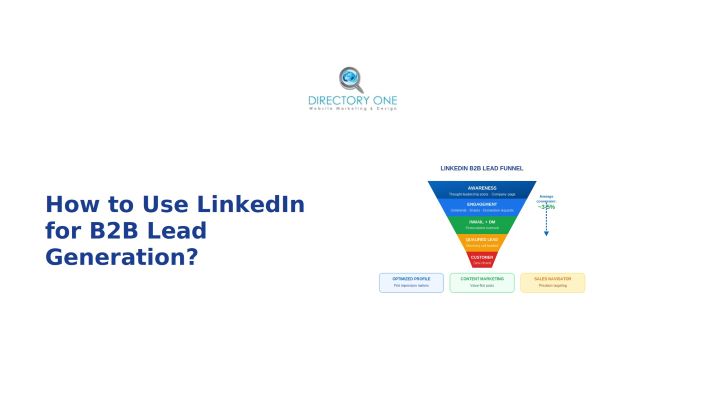
How to Use LinkedIn for B2B Lead Generation?
Understanding how to use LinkedIn for B2B lead generation begins with identifying your ideal audience and creating content that addresses their challenges. Successful LinkedIn marketing strategies for B2B typically include:
Start with LinkedIn Company Page Optimization
Before any campaign or content effort pays off, your company page needs to be working for you. LinkedIn company page optimization means filling every section completely: a compelling tagline that speaks to your target client, a detailed “About” section loaded with the services you offer and the industries you serve in Houston and across Texas, and a consistent visual identity that reflects your brand professionalism.
Treat your company page like a landing page. Every visitor should immediately understand who you serve, what you do, and why they should contact you. For Houston B2B companies in sectors like oil and gas, construction, or professional services, specificity here matters more than anywhere else.
Publish Industry-Focused Content
An effective LinkedIn content strategy for B2B should include educational content, industry updates, case studies, project highlights, and thought leadership articles.
Businesses across Houston frequently use content marketing to demonstrate expertise and maintain visibility among decision-makers. Consistent publishing also supports B2B social media marketing on LinkedIn by encouraging engagement and sharing.
Build a LinkedIn Content Strategy That Drives Engagement
A strong LinkedIn content strategy for B2B does two things at once: it educates your audience, and it positions your brand as the authority in your space. The most effective content mix for Houston B2B companies typically includes industry insights and local market commentary, behind-the-scenes looks at projects and processes, thought leadership articles from company executives, client results and case studies, and quick-hit tips that solve common pain points for your target buyer.
Consistency is what separates companies that grow a LinkedIn company page from those that stall. Posting two to four times per week, using native documents and video alongside standard posts, and engaging in the comments of your own content all signal to the LinkedIn algorithm that your page deserves reach.
Combining content with strategic outreach creates effective B2B LinkedIn lead generation opportunities while keeping prospects engaged throughout the sales cycle.
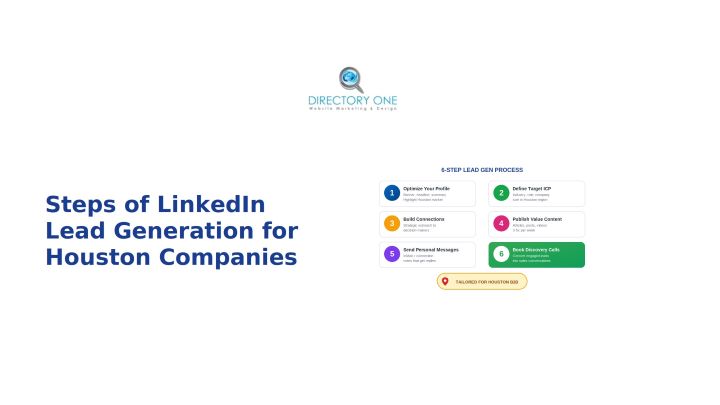
Steps of LinkedIn Lead Generation for Houston Companies
One of the most important LinkedIn marketing strategies for B2B is building a lead generation funnel directly on the platform. LinkedIn lead generation for Houston companies is most effective when combined with both organic outreach and targeted paid campaigns.
On the organic side, Sales Navigator allows your team to identify and connect with key decision-makers based on title, industry, company size, and even geography, making it easier to reach buyers in specific Houston industries like energy, healthcare, or commercial real estate. On the paid side, LinkedIn Lead Gen Forms cut friction from the conversion process by letting prospects share their contact info without ever leaving the platform.
For Houston startups and emerging B2B brands, LinkedIn lead generation campaigns can accelerate pipeline in ways that traditional digital channels simply cannot match, because you are reaching buyers in a professional mindset, not a consumer one.
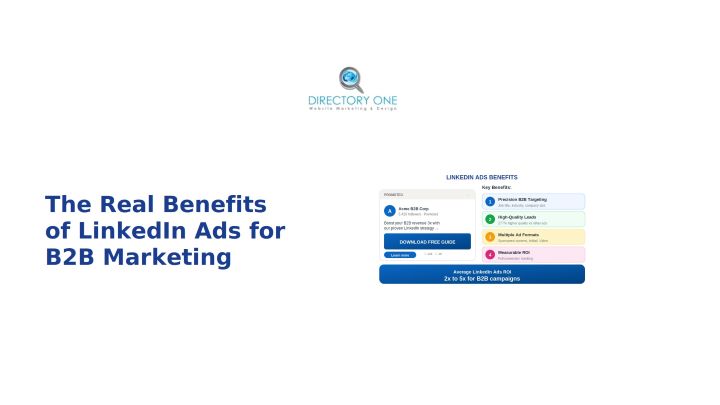
The Real Benefits of LinkedIn Ads for B2B Marketing
The benefits of LinkedIn ads for B2B marketing go well beyond basic brand awareness. LinkedIn’s targeting capabilities are unmatched in the social media world. You can serve Sponsored Content and Message Ads to specific job titles, company sizes, seniority levels, and even LinkedIn member groups. It means your ads reach the VP of Operations at a Houston energy firm, not a general consumer audience.
Houston LinkedIn advertising works especially well for account-based marketing (ABM), retargeting website visitors, and promoting gated content like whitepapers and webinars. For B2B companies with longer sales cycles, staying in front of warm audiences through consistent LinkedIn advertising keeps your brand relevant through every stage of the buying journey.
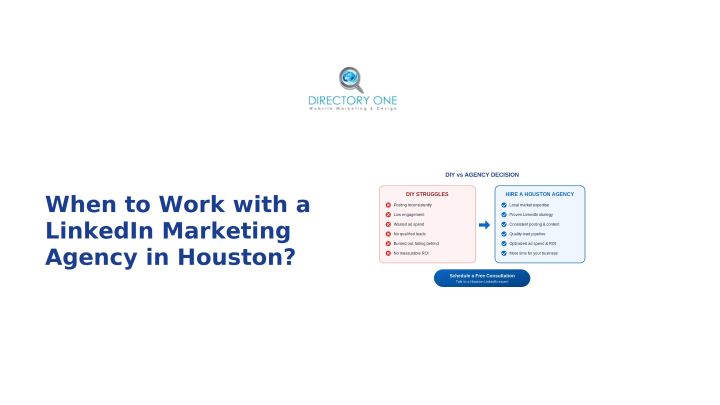
When to Work with a LinkedIn Marketing Agency in Houston?
Executing effective LinkedIn marketing strategies for B2B at scale takes more than occasional posting. It requires strategic planning, consistent execution, data analysis, and constant optimization. Many Houston companies find that partnering with a LinkedIn marketing agency in Houston delivers results faster and more predictably than trying to manage everything in-house.
A B2B social media agency in Houston, Texas, brings dedicated expertise in LinkedIn campaign management, copywriting, targeting, and reporting, so your team can focus on closing the leads that come in rather than managing the platform itself.
Whether you are a growing startup or an established B2B brand looking to expand your reach across Houston and Texas, the right agency partnership can be the difference between a stagnant presence and a lead-generating machine.
Ready to Put These Strategies to Work?
LinkedIn is no longer optional for Houston B2B companies that want to grow. The platform offers unmatched access to the exact buyers, partners, and decision-makers your business needs to reach, but only if you are showing up with the right strategy, the right content, and the right message.
Directory One specializes in LinkedIn marketing strategies for B2B businesses across Houston and Texas. From full LinkedIn management and content strategy to paid advertising and lead generation, our team handles every piece of the puzzle so you can focus on what you do best. Contact us today to learn how we can help your Houston business grow on LinkedIn.
]]>Directoryone<![CDATA[SEO Conversion Rate Optimization (CRO) Guide for Beginners]]>https://www.directoryone.com/blog/?p=71092026-06-11T14:44:27Z2026-06-12T11:43:00ZYou have invested in SEO. Your website is attracting visitors. Traffic reports look promising. Yet sales, leads, and inquiries remain disappointingly low. This is one of the most common challenges businesses face today. The problem often is not traffic; it is what happens after visitors arrive. This is where SEO conversion rate optimization becomes essential. Many businesses focus solely on rankings and clicks while overlooking the actions users take on their website. The truth is that even a modest increase in conversions can generate more revenue than a significant increase in traffic. Understanding SEO conversion rate optimization helps bridge the gap between attracting visitors and turning them into customers. What Is SEO Conversion Rate Optimization? Before implementing improvements, it is important to understand the conversion rate optimization CRO definition. Conversion Rate Optimization (CRO) is the process of increasing the percentage of website visitors who complete a desired action, such as: A comprehensive guide to conversion rate optimization focuses on improving user experience, reducing friction, and encouraging visitors to take action. The importance of conversion rate optimization CRO becomes clear when businesses realize that higher traffic alone does not guarantee better results. A website that converts effectively can generate significantly more
]]>You have invested in SEO. Your website is attracting visitors. Traffic reports look promising. Yet sales, leads, and inquiries remain disappointingly low. This is one of the most common challenges businesses face today. The problem often is not traffic; it is what happens after visitors arrive. This is where SEO conversion rate optimization becomes essential.
Many businesses focus solely on rankings and clicks while overlooking the actions users take on their website. The truth is that even a modest increase in conversions can generate more revenue than a significant increase in traffic. Understanding SEO conversion rate optimization helps bridge the gap between attracting visitors and turning them into customers.
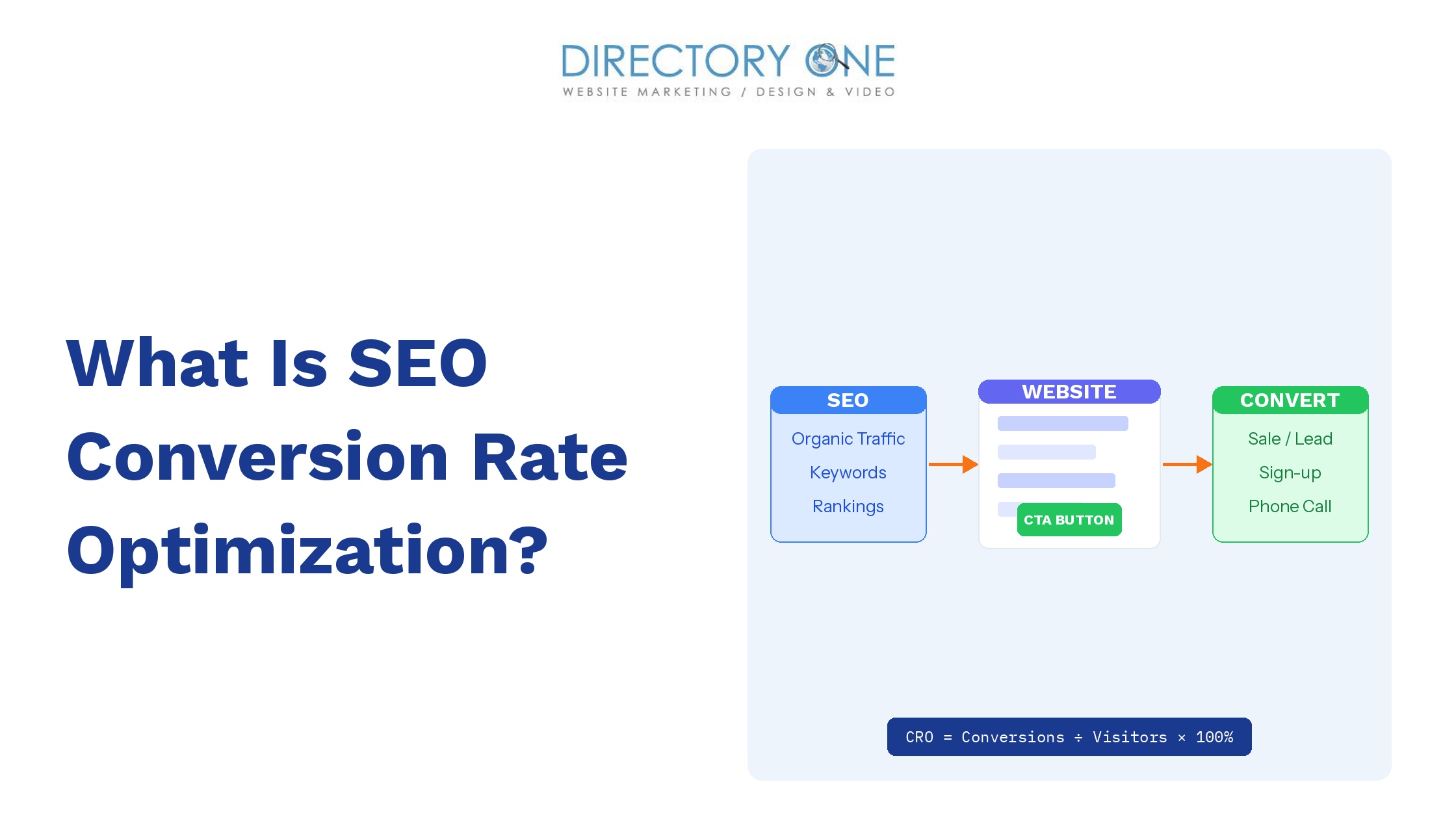
What Is SEO Conversion Rate Optimization?
Before implementing improvements, it is important to understand the conversion rate optimization CRO definition.
Conversion Rate Optimization (CRO) is the process of increasing the percentage of website visitors who complete a desired action, such as:
Filling out a contact form
Requesting a quote
Making a purchase
Calling your business
Scheduling a consultation
Downloading a resource
A comprehensive guide to conversion rate optimization focuses on improving user experience, reducing friction, and encouraging visitors to take action.
The importance of conversion rate optimization CRO becomes clear when businesses realize that higher traffic alone does not guarantee better results. A website that converts effectively can generate significantly more revenue from the same number of visitors.
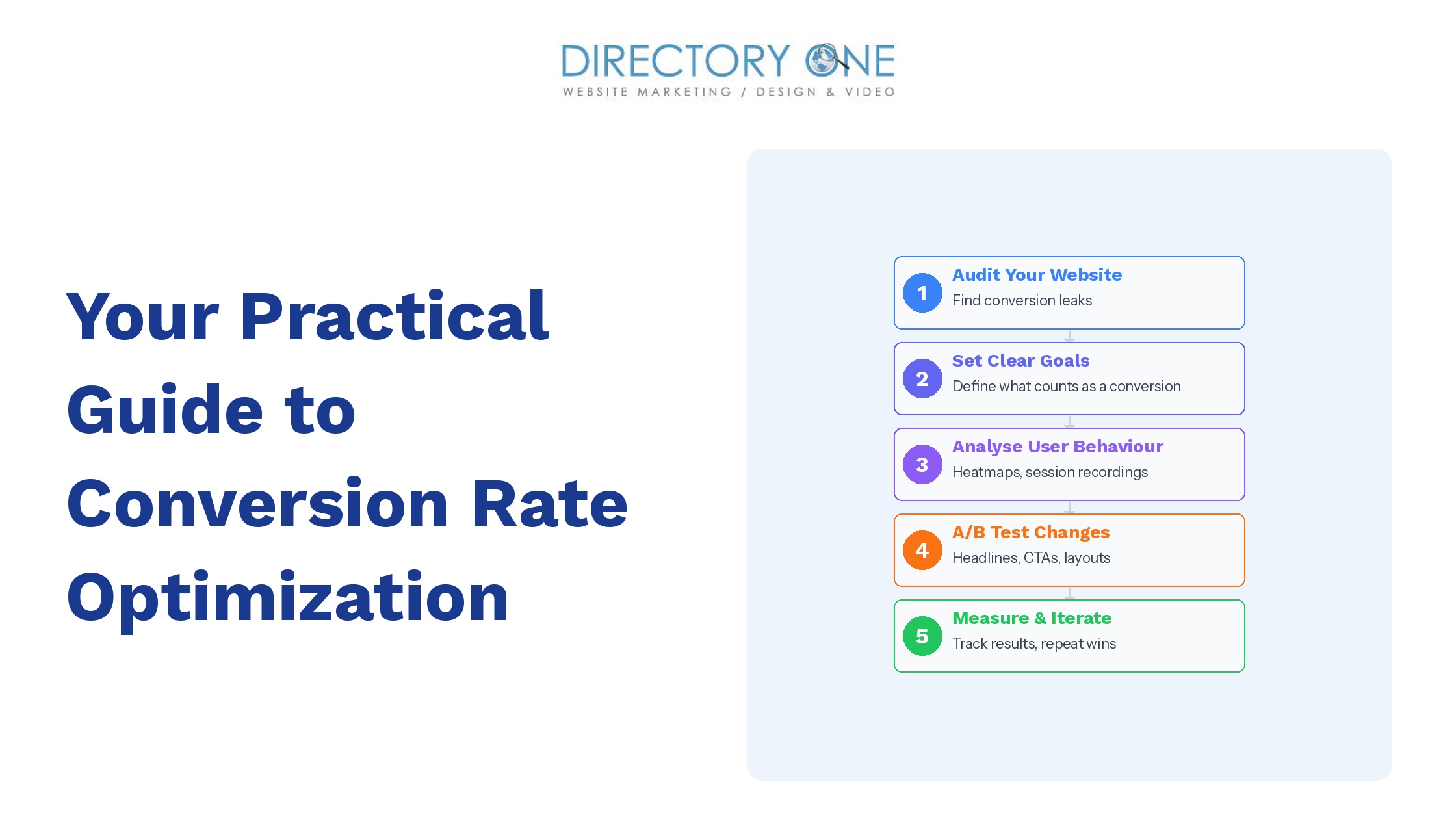
Your Practical Guide to Conversion Rate Optimization
Conversion Rate Optimization (CRO) is a crucial strategy for enhancing the effectiveness of your website or marketing funnel. It is a systematic process aimed at increasing the percentage of visitors who complete a desired action, such as making a purchase, signing up for a newsletter, or filling out a form. Here are some practical steps to get started:
Start With a Conversion Rate Optimization Audit
Before making any changes, you need to know where your funnel is leaking. A conversion rate optimization audit reviews your current pages, user behavior, load speeds, form usability, and calls to action.
Tools like Google Analytics, Hotjar, and Microsoft Clarity show you exactly where visitors are dropping off. This step is non-negotiable if you want your improvements to be strategic rather than guesswork.
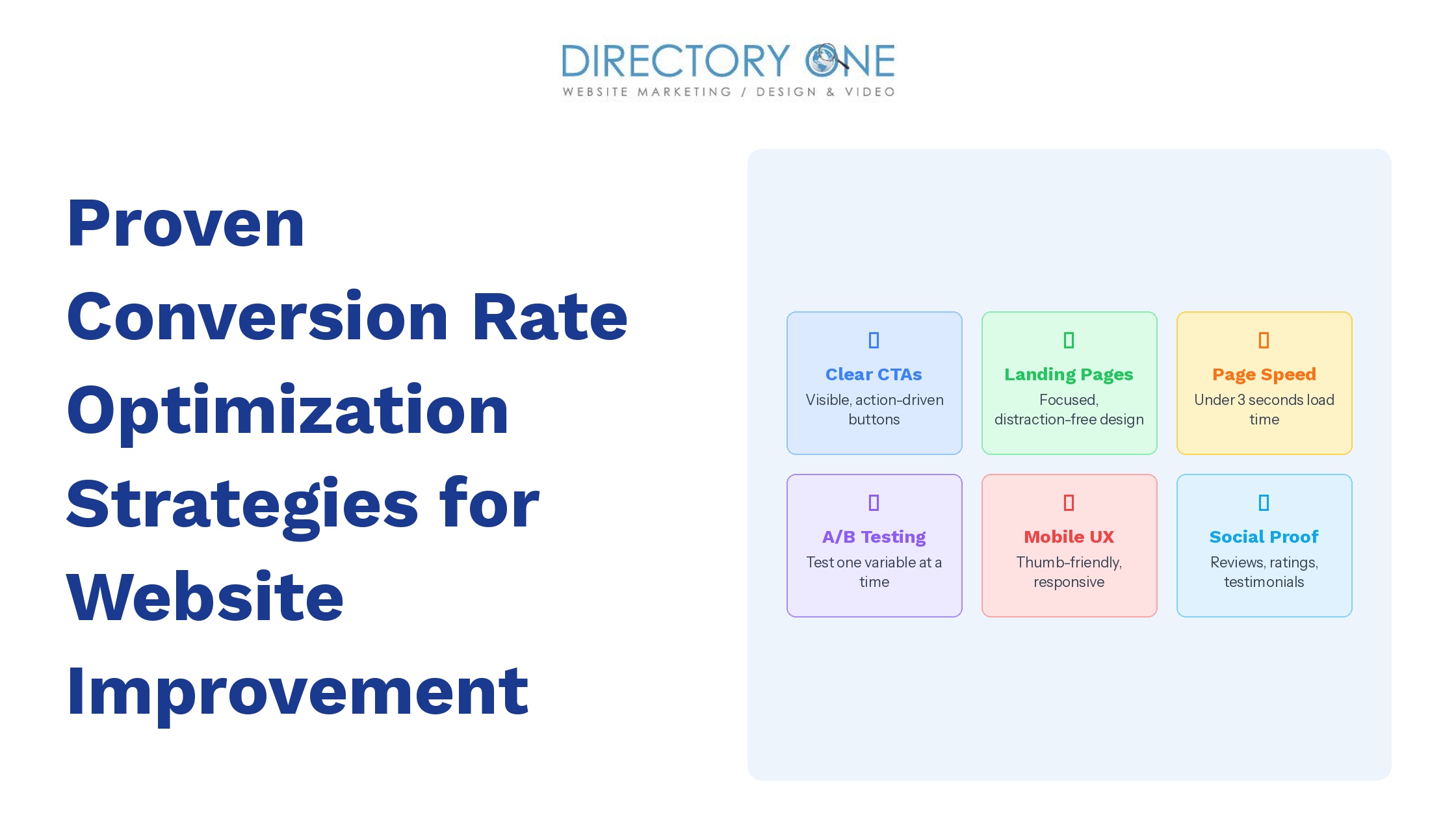
Apply Proven Conversion Rate Optimization Strategies for Website Improvement
Once you understand the gaps, the real work begins. Here are some of the most effective conversion rate optimization strategies for website improvement you can implement right away:
First, clarify your headline. Visitors decide within seconds whether your page is relevant to them, so your headline needs to communicate your value immediately.
Second, reduce friction on your forms. The fewer fields, the more completions you’ll see.
Third, add trust signals such as reviews, certifications, and client logos near your calls to action.
Finally, make sure your primary CTA stands out visually on every page and is repeated throughout longer content.
Use the Right Conversion Rate Optimization Tools
You don’t have to guess your way through this. Several excellent conversion rate optimization tools make the process data-driven. Google Optimize and VWO handle A/B testing. Hotjar records session replays. Unbounce and Instapage help build high-converting landing pages. Using these tools consistently is one of the most underrated conversion rate optimization tips you’ll find anywhere.
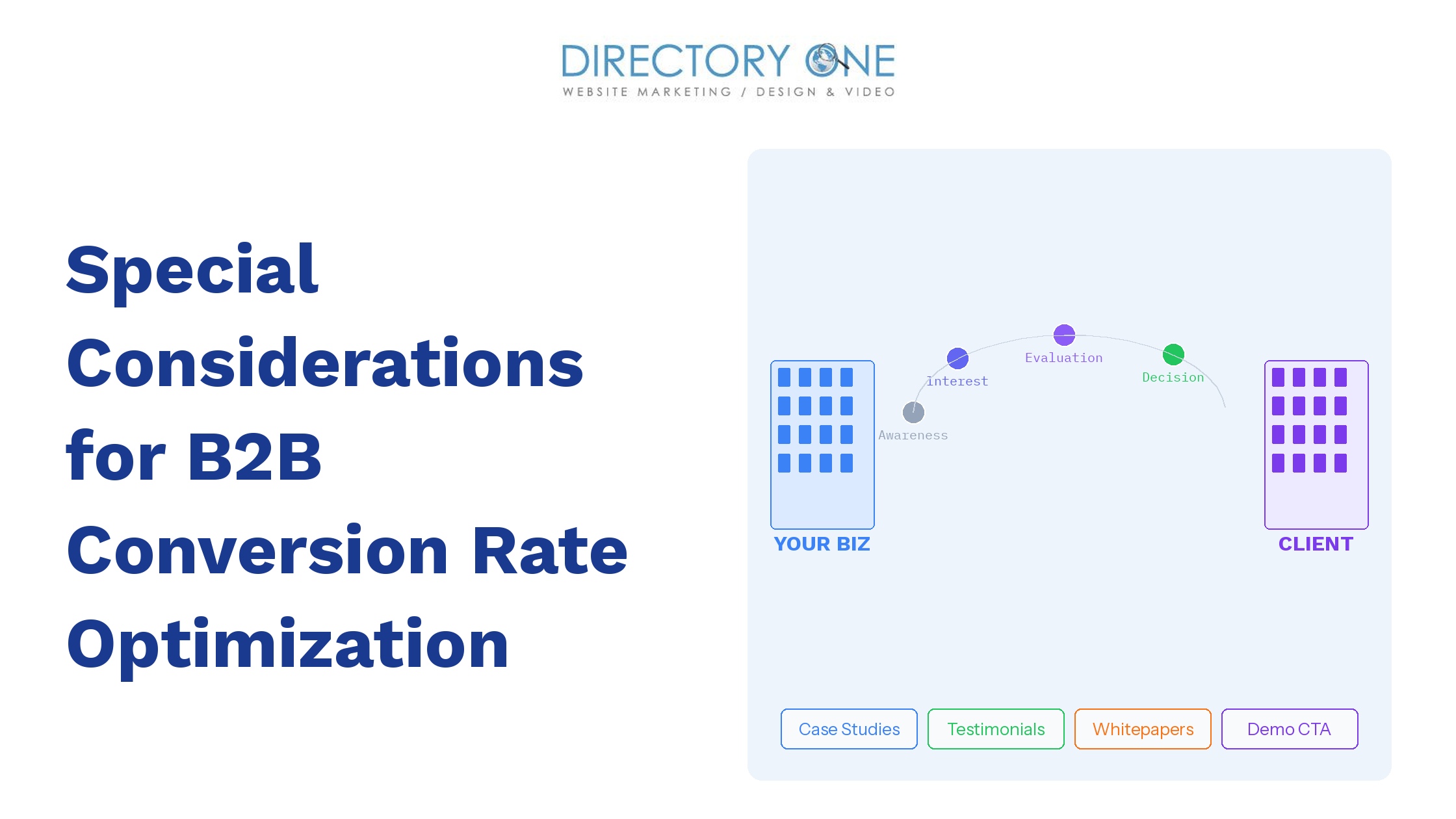
Special Considerations for B2B Conversion Rate Optimization
If you serve other businesses rather than consumers, the approach shifts a bit. B2B conversion rate optimization requires longer nurture sequences, clear ROI messaging, and content that speaks to decision-makers, not just general audiences.
Case studies, ROI calculators, and demo requests tend to outperform generic contact forms in B2B environments. The trust bar is higher, so your proof needs to be stronger.
Proven Conversion Rate Optimization Strategies for Website Improvement
The best conversion rate optimization strategies for website improvement focus on removing barriers that prevent visitors from taking action.
Simplify User Navigation
Visitors should immediately understand:
Who you are
What you offer
Why should they trust you
What action should they take next
Confusing navigation often leads to higher bounce rates and lost opportunities.
These elements reassure visitors and reduce hesitation during the decision-making process.
Use Data to Guide Decisions
Leading conversion rate optimization experts rely on analytics rather than assumptions. Popular conversion rate optimization tools often help businesses evaluate:
User behavior
Heat maps
Session recordings
Form abandonment
Click tracking
Conversion funnels
These insights help identify opportunities for ongoing improvement.
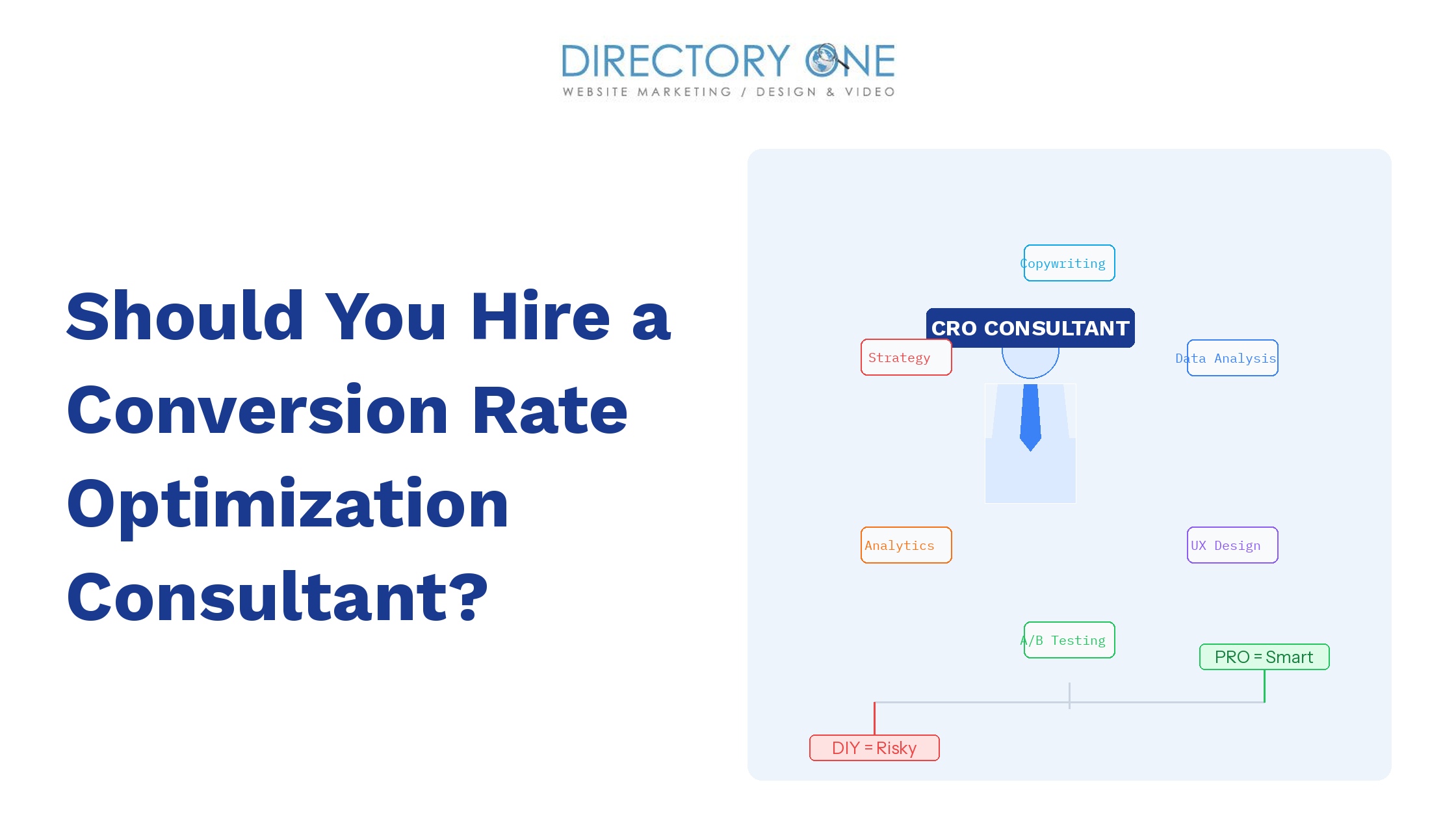
Should You Hire a Conversion Rate Optimization Consultant?
There comes a point where doing this in-house hits a ceiling. A qualified conversion rate optimization expert or conversion rate optimization consultant brings an outside perspective, tested frameworks, and proprietary tools that most businesses don’t have internally.
When evaluating conversion rate optimization services pricing, think about it as an investment rather than an expense. A well-executed CRO engagement can generate returns that dwarf the cost in a matter of months. Website conversion rate optimization services typically include audits, testing strategies, landing page redesigns, and ongoing performance tracking.
Likewise, partnering with a conversion rate optimization CRO services agency gives your team access to the strategy, creative, and analytics expertise that most small businesses simply can’t keep on staff full-time.
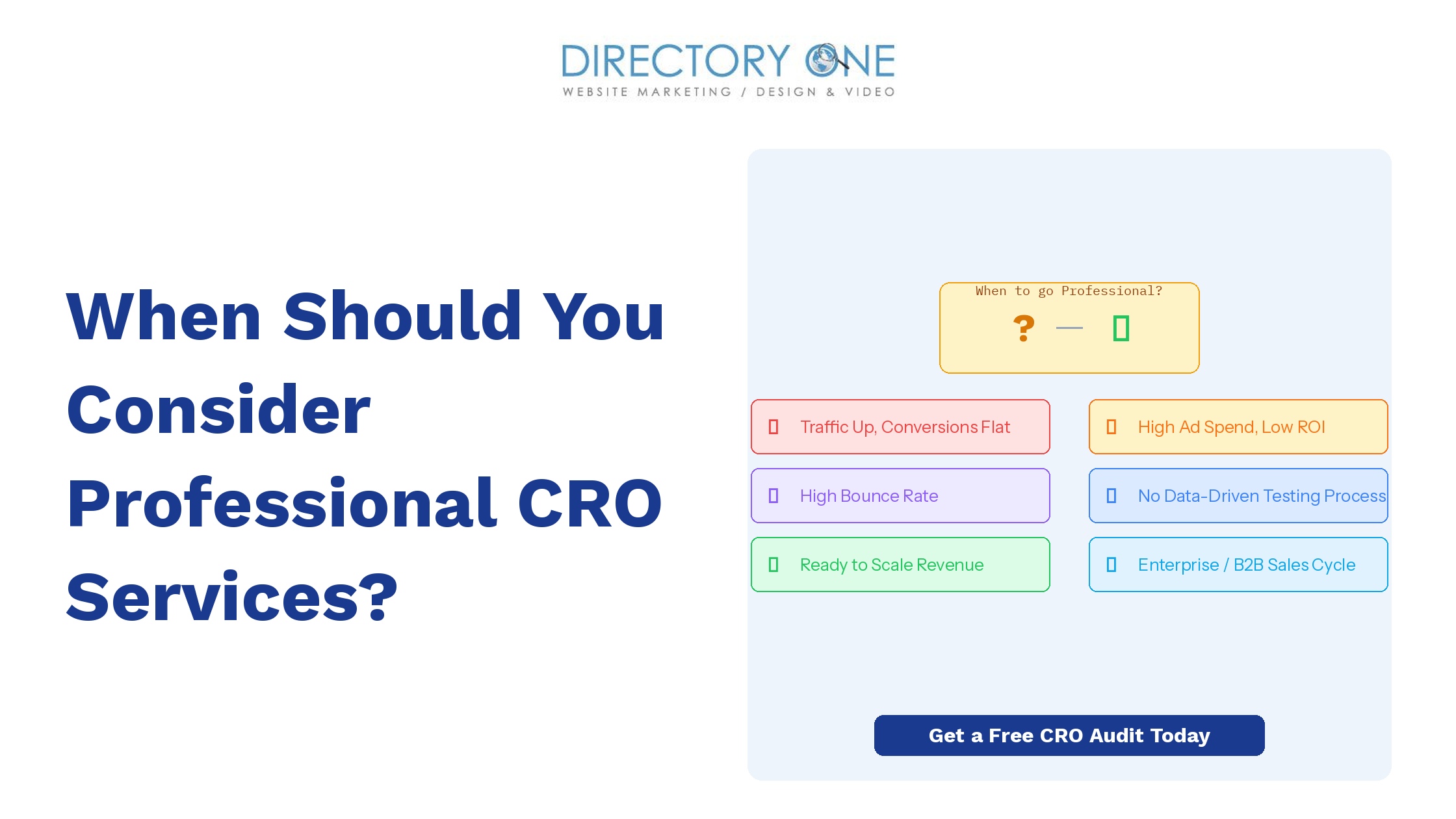
When Should You Consider Professional CRO Services?
Many businesses attempt optimization independently, but eventually reach a point where professional guidance becomes valuable. A qualified conversion rate optimization consultant can identify issues that internal teams often overlook.
Professional services typically include:
User experience analysis
Landing page optimization
A/B testing
Funnel analysis
Technical recommendations
Conversion tracking implementation
A thorough conversion rate optimization audit often uncovers hidden performance issues.
At Directory One, we help businesses improve both visibility and conversion performance through integrated digital marketing strategies. As a trusted Houston conversion rate optimization agency, our team combines SEO expertise, user experience insights, and data-driven testing to help businesses generate more leads from existing traffic.
The reality is simple: more traffic does not always mean more customers. Effective SEO conversion rate optimization ensures your website is designed to turn visitors into opportunities.
Wrapping Up
Ready to stop leaving money on the table? If you’re searching for a certified Houston conversion rate optimization agency that combines deep SEO expertise with proven CRO strategies, Directory One is ready to help. Call us today at 713.269.3094 or visit directoryone.com to get a free consultation and find out exactly what your website is leaving behind.
]]>Directoryone<![CDATA[How to Build a Digital Marketing Strategy from Scratch?]]>https://www.directoryone.com/blog/?p=71032026-06-11T14:34:17Z2026-06-11T14:34:16ZMost businesses don’t fail at digital marketing because they lack effort. They fail because they start without a clear plan. As a result, they waste time, budget, and opportunities. The difference between random marketing efforts and sustainable growth often comes down to one thing: STRATEGY. If you’ve been posting here, running ads there, and wondering why nothing sticks, the issue usually comes back to strategy. Knowing how to build a digital marketing strategy gives you a clear direction so every action you take has a purpose and every dollar you spend has a job to do. Why Do You Need a Digital Marketing Plan Matters Before Anything Else? It’s tempting to jump straight into tactics. Launch a Google Ads campaign, start posting on Instagram, and maybe redesign the website. But without a digital marketing plan in place, those individual efforts rarely connect into something that builds over time. A plan gives you a foundation. It tells you who you’re trying to reach, what you want them to do, and which channels are actually worth your time and budget. It is especially true for smaller operations. Online marketing strategies for small business owners need to be focused because resources are limited.
]]>Most businesses don’t fail at digital marketing because they lack effort. They fail because they start without a clear plan. As a result, they waste time, budget, and opportunities. The difference between random marketing efforts and sustainable growth often comes down to one thing: STRATEGY. If you’ve been posting here, running ads there, and wondering why nothing sticks, the issue usually comes back to strategy. Knowing how to build a digital marketing strategy gives you a clear direction so every action you take has a purpose and every dollar you spend has a job to do.
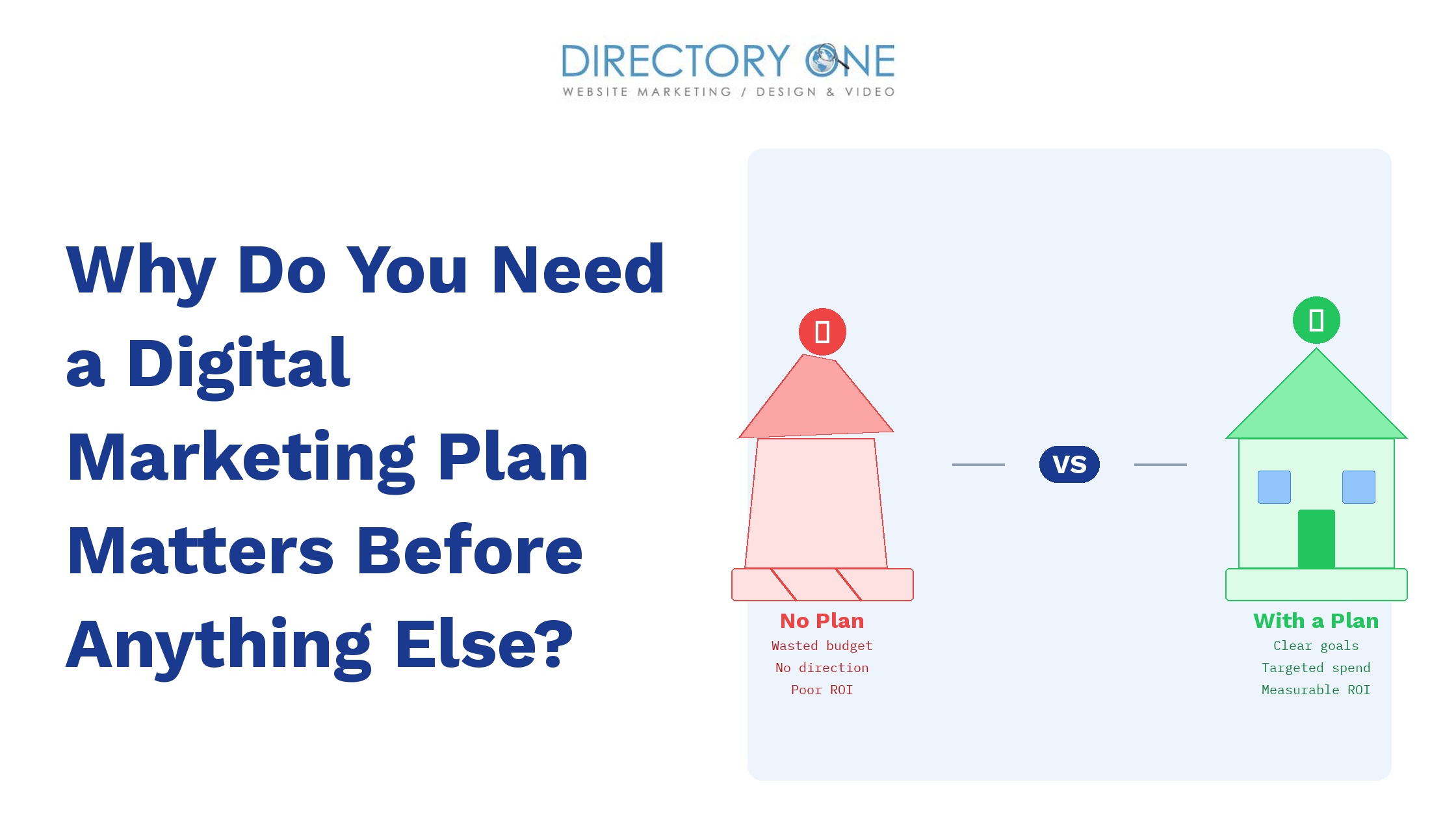
Why Do You Need a Digital Marketing Plan Matters Before Anything Else?
It’s tempting to jump straight into tactics. Launch a Google Ads campaign, start posting on Instagram, and maybe redesign the website. But without a digital marketing plan in place, those individual efforts rarely connect into something that builds over time. A plan gives you a foundation. It tells you who you’re trying to reach, what you want them to do, and which channels are actually worth your time and budget.
It is especially true for smaller operations. Online marketing strategies for small business owners need to be focused because resources are limited. You can’t be everywhere at once, so the strategy has to tell you where to be and why.
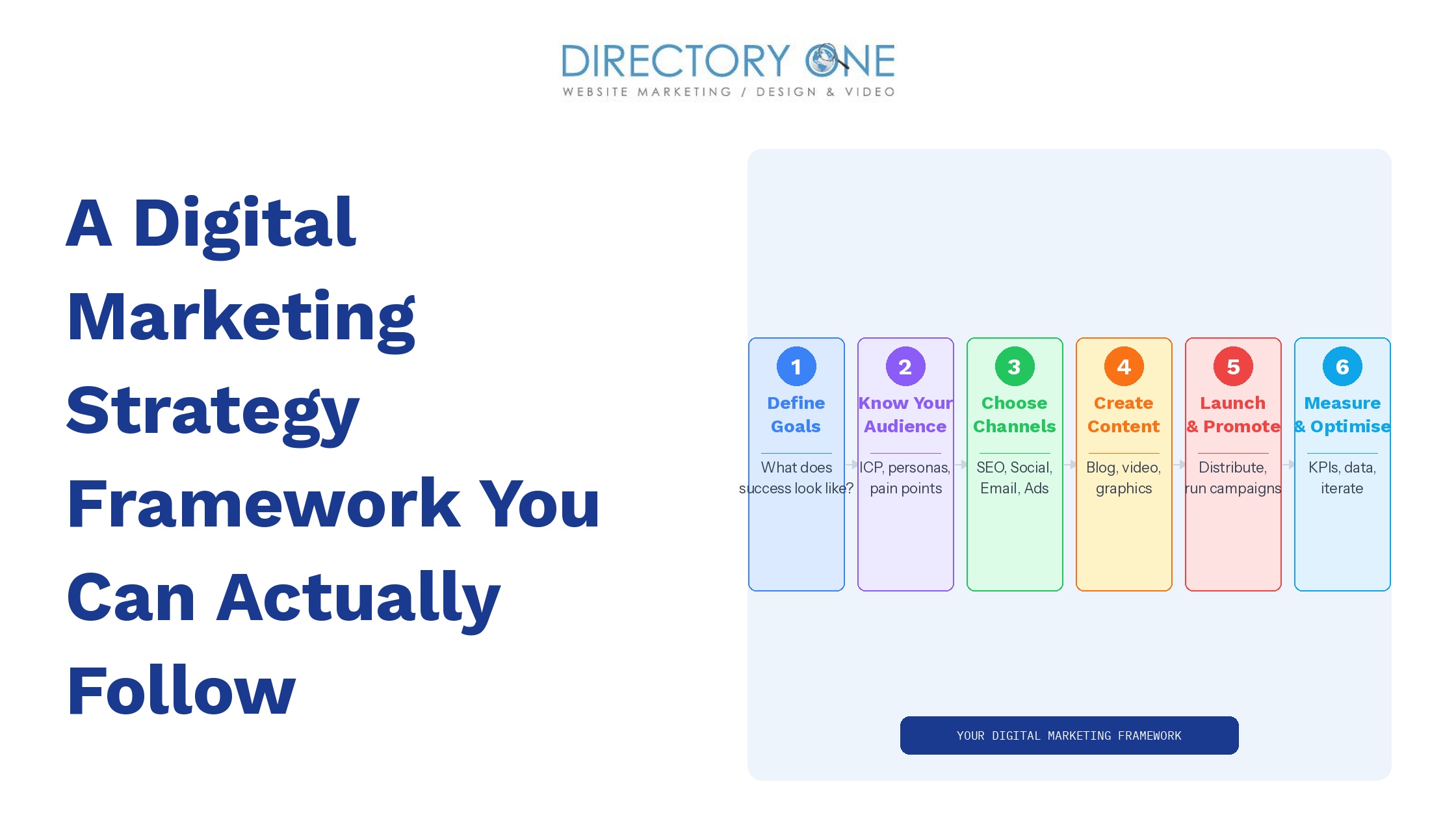
A Digital Marketing Strategy Framework You Can Actually Follow
Step 1: Define Your Goals and Know Your Audience
Everything starts here. What does success look like for your business? More leads, more online sales, better brand awareness in your city? Get specific.
Then figure out exactly who you’re talking to. The more clearly you understand your audience, their problems, and how they search for solutions, the easier it becomes to create content and campaigns that actually reach them. This step is the backbone of any solid digital marketing strategy framework.
In fact, analyzing competitors can reveal valuable insights into:
Many successful digital marketing campaigns succeed because they identify gaps competitors have overlooked.
Step 2: Build the Right Foundation With Websites and Digital Marketing
Your website is where everything lands. Ads, social posts, search results, all of it points back to your site. If the site is slow, confusing, or not built to convert, the rest of your marketing is working against itself. Website design and digital marketing go hand in hand. A well-built site with clear messaging, fast load times, and strong calls to action will make every other channel perform better. Don’t skip this step or treat it as an afterthought.
Step 3: Choose Your Channels Strategically
This is where a lot of beginners get overwhelmed when learning how to build a digital marketing strategy. They try to be everywhere at once – SEO, paid search, social media, email marketing, and content marketing. You don’t need all of them on day one. Instead, focus on the channels most likely to reach your audience.
As part of your digital marketing strategies for beginners, pick two or three channels that align with where your audience spends their time and what fits your current budget. Get traction there before expanding. Spreading yourself thin across every platform is one of the fastest ways to burn out and see no results.
1. Optimize Your Website First
Your website serves as the foundation of your digital presence.
Effective websites and digital marketing strategies work together to support lead generation, customer education, and conversion. Key website considerations include:
Many online marketing strategies for small business focus on these channels because they offer scalable growth opportunities while maximizing budget efficiency. When considering how to build a digital marketing strategy, choose channels based on audience behavior rather than trends.
Step 4: Create Content That Serves a Purpose
Content is how you show up when people are searching, scrolling, and comparing options. Good content answers real questions, builds trust, and moves people closer to a decision. When you look at successful digital marketing campaigns, almost all of them are built on content that genuinely helps the audience first and sells second. That approach takes more patience, but it builds something that lasts.
Step 5: Measure, Adjust, and Keep Going
Set up tracking from the start. Google Analytics, Search Console, and your ad platform dashboards will tell you what’s working and what’s wasting money. Review your numbers regularly and be willing to adjust. A digital marketing strategy is not something you set once and forget. The businesses that win online are the ones that keep showing up, keep testing, and keep refining based on real data.
Building a B2B Digital Marketing Plan Is a Different Process
If your customers are other businesses, your strategy needs to reflect how B2B buyers actually make decisions. They take longer, involve more people, and need more proof before they commit. A strong B2B digital marketing plan leans heavily on SEO, LinkedIn, case studies, and lead nurturing through email. Working with a specialized b2b digital marketing agency in Houston can shorten the learning curve considerably, especially if you’re trying to reach other businesses across a specific industry or region.
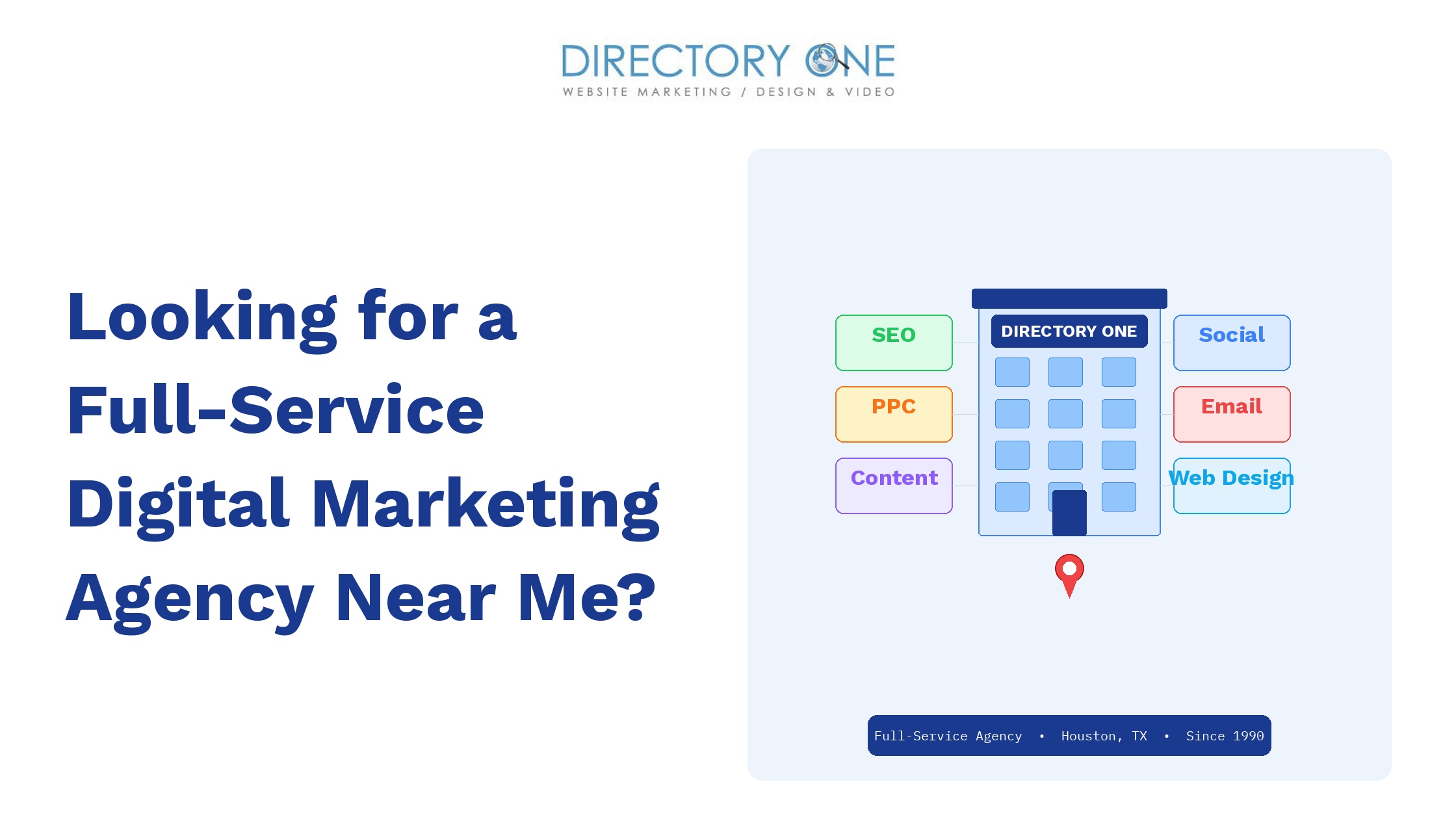
Looking for a Full-Service Digital Marketing Agency Near Me?
At some point, doing all of this in-house becomes difficult to sustain. Strategy, content, SEO, paid ads, web updates. It adds up fast. That’s when businesses start browsing for a digital marketing agency near me in Houston or a full-service digital marketing agency near me that can handle it all under one roof. Having one team that understands how your channels connect means less miscommunication, more consistency, and better results across the board.
A good Houston digital marketing service won’t just execute tasks. At Directory One, our team helps you think through the strategy, identify the gaps, and build a plan that fits your goals and your budget. That kind of partnership makes a real difference, especially for businesses that are growing and don’t have time to figure everything out on their own.
Partner With Directory One
Are you ready to stop relying on luck and start building a strategy that truly delivers results? Look no further than Directory One for expert assistance. We’re a Houston digital marketing service with years of experience in helping businesses grow online through SEO, paid advertising, web design, and more. Call us at 713-269-3094 or visit directoryone.com to schedule your free consultation and kickstart your digital marketing strategy today.
]]>Directoryone<![CDATA[On-Page SEO vs Off-Page SEO: What Matters More?]]>https://www.directoryone.com/blog/?p=70952026-06-10T13:12:33Z2026-06-10T13:12:32ZMany business owners invest in SEO but struggle to understand which efforts actually move the needle. One of the most common questions is whether on-page SEO vs off-page SEO matters more when trying to improve rankings, increase traffic, and generate leads. The reality is that both play important roles in search visibility. However, understanding how they work together can help you prioritize your marketing efforts and avoid wasting time and money on strategies that deliver limited results. If you have been trying to figure out why your website is not showing up on Google, you are probably asking the right question. On-page SEO vs off-page SEO is one of the most common debates in digital marketing, and honestly, it is not about picking a winner. It is about understanding how both work together so your site can actually rank. Let us break it down. What Is On-Page vs Off-Page SEO? Before deciding which is more important, it helps to understand the difference between on-page and off-page SEO. What Is On-Page SEO? On-page SEO refers to all optimization activities performed directly on your website. These improvements help search engines understand your content while creating a better experience for visitors. Common on
]]>Many business owners invest in SEO but struggle to understand which efforts actually move the needle. One of the most common questions is whether on-page SEO vs off-page SEO matters more when trying to improve rankings, increase traffic, and generate leads. The reality is that both play important roles in search visibility. However, understanding how they work together can help you prioritize your marketing efforts and avoid wasting time and money on strategies that deliver limited results.
If you have been trying to figure out why your website is not showing up on Google, you are probably asking the right question. On-page SEO vs off-page SEO is one of the most common debates in digital marketing, and honestly, it is not about picking a winner. It is about understanding how both work together so your site can actually rank. Let us break it down.
What Is On-Page vs Off-Page SEO?
Before deciding which is more important, it helps to understand the difference between on-page and off-page SEO.
What Is On-Page SEO?
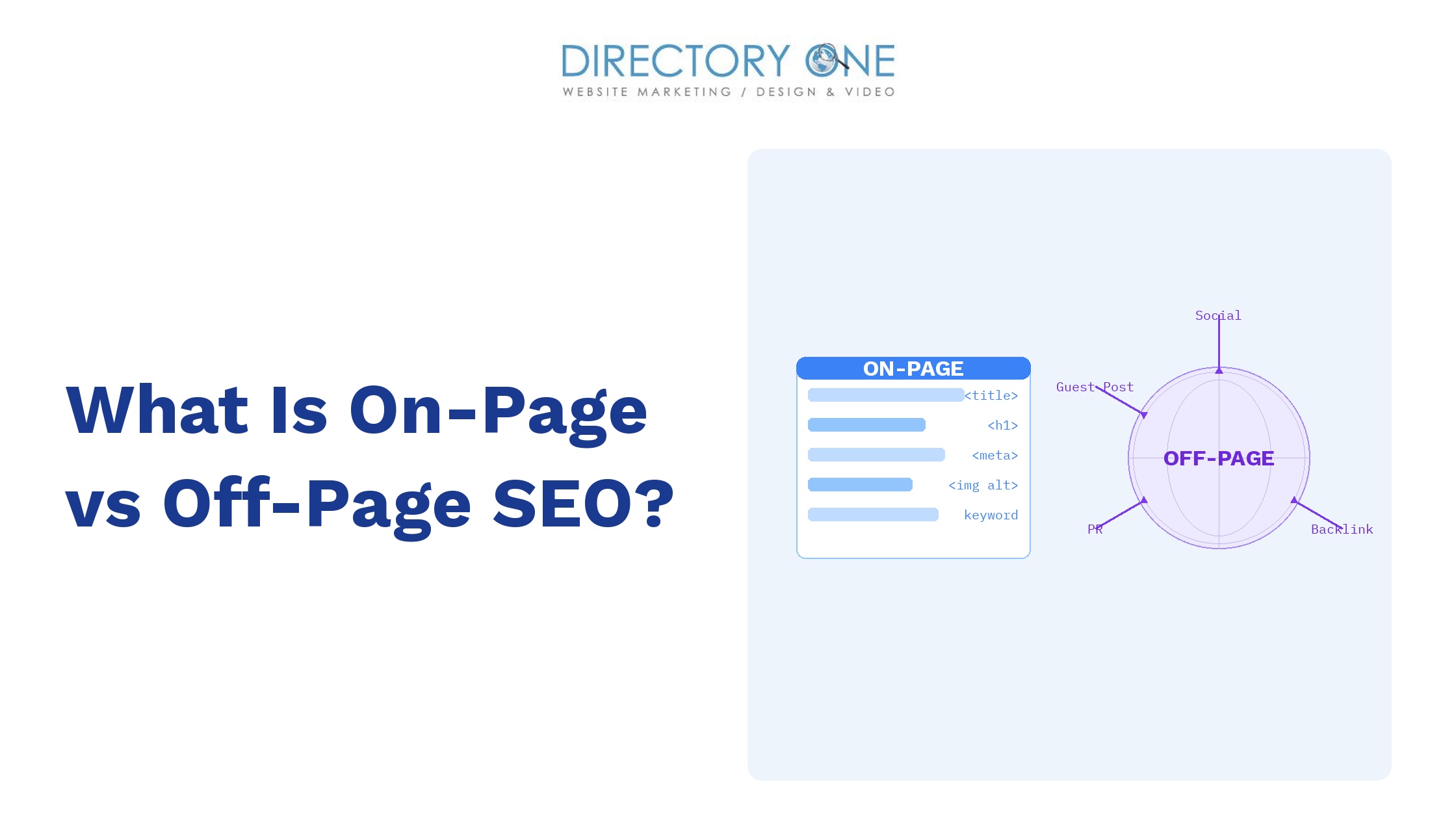
On-page SEO refers to all optimization activities performed directly on your website. These improvements help search engines understand your content while creating a better experience for visitors. Common on page and off page SEO techniques on the on-page side include:
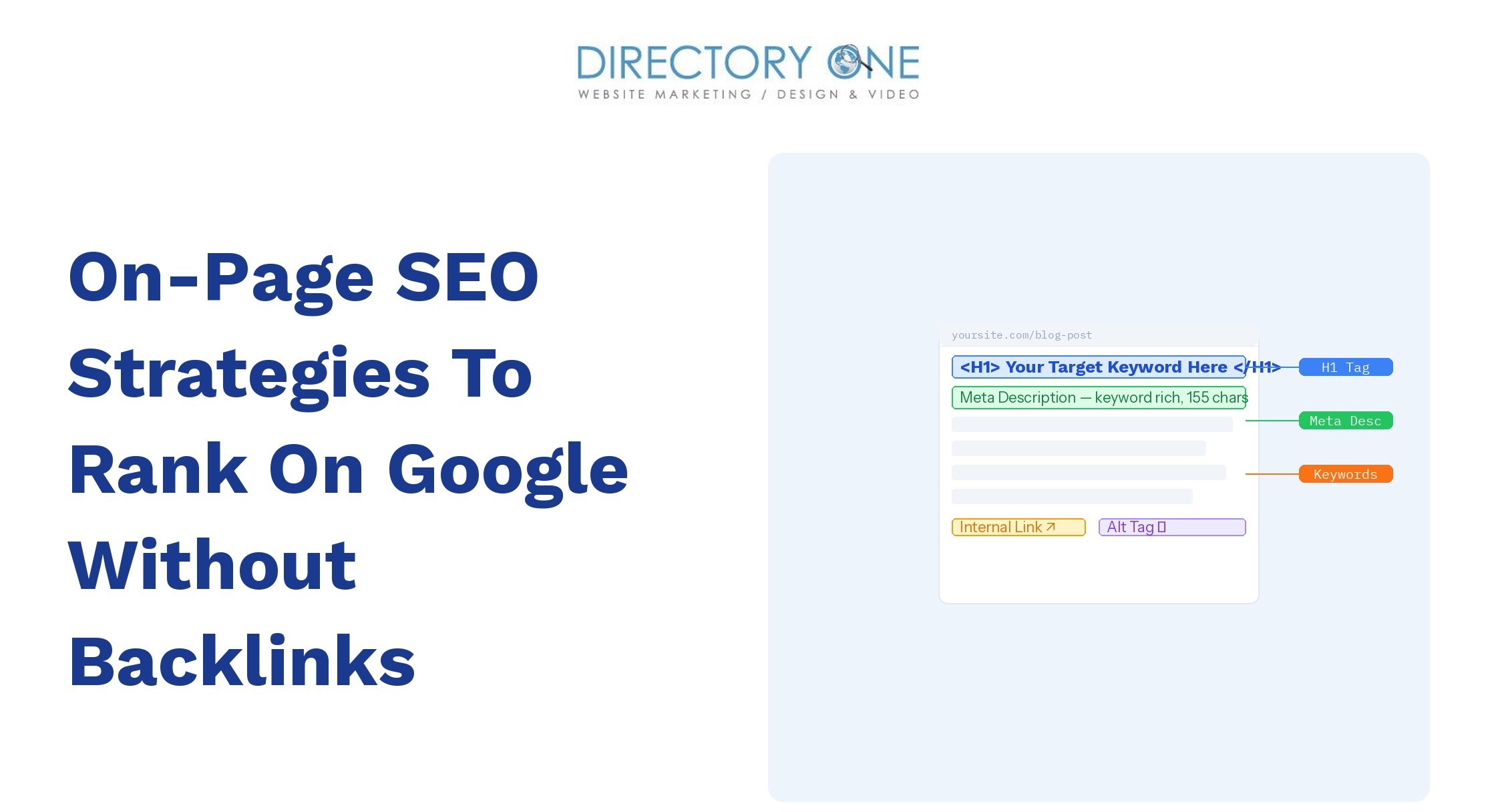
Optimizing title tags and meta descriptions
Improving website content
Internal linking
Header tag optimization
Image optimization
Keyword targeting
User experience improvements
Many businesses seeking professional on-page SEO services focus on these foundational elements because they are fully within their control.
What Is Off-Page SEO?
When discussing “what is on-page vs off-page SEO”, off-page SEO includes activities that occur outside your website and help build authority and trust.
Examples include:
Backlink acquisition
Brand mentions
Local citations
Online reviews
Social media engagement
Digital PR campaigns
The debate around off page vs on page SEO often begins because backlinks have historically been among the most influential ranking signals.
The Role of Technical SEO
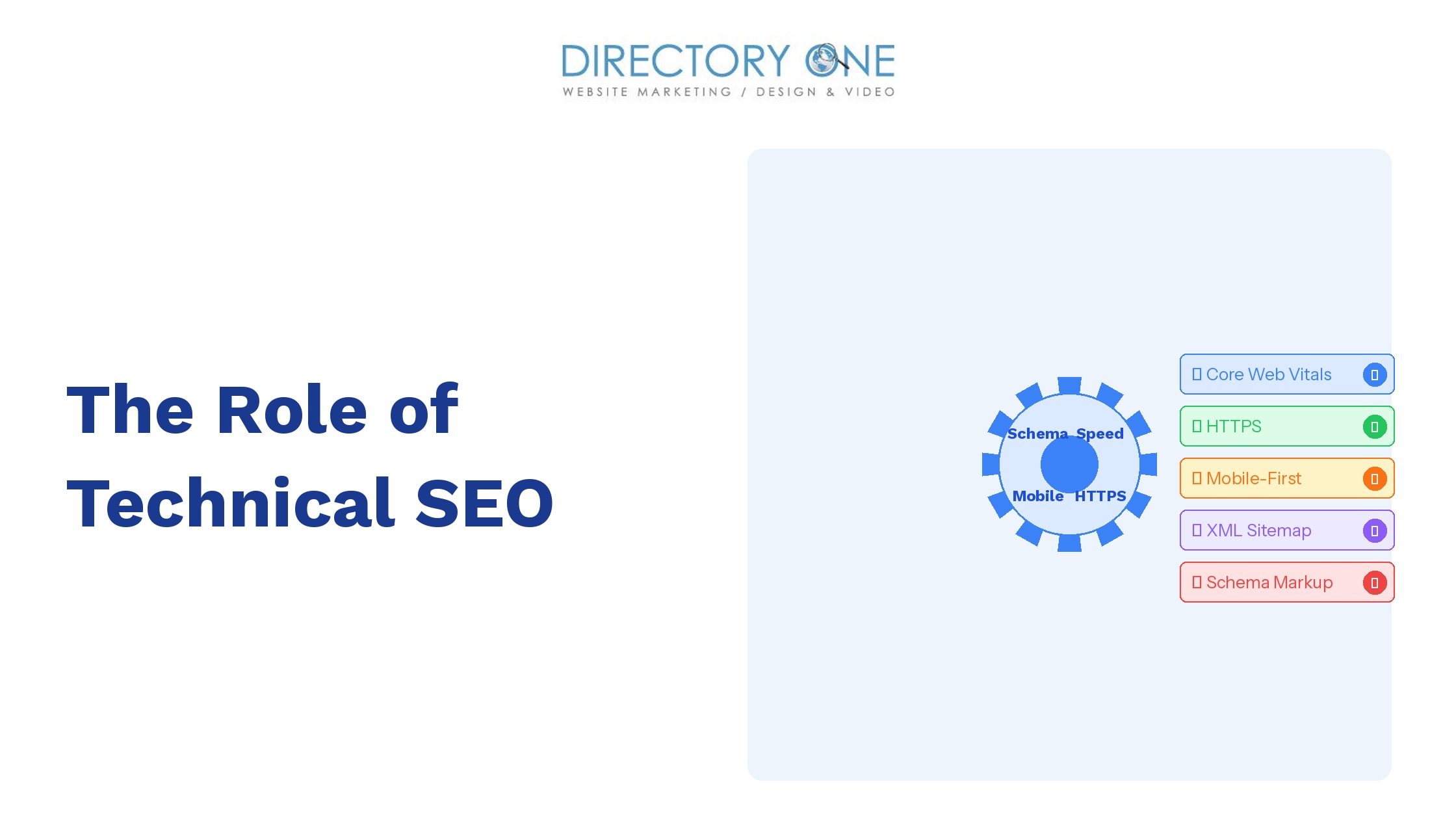
When people ask about on-page SEO vs off-page SEO vs technical SEO, technical SEO deserves its own mention. It covers the behind-the-scenes health of your website, including crawlability, site speed, mobile responsiveness, structured data, and indexation. Think of it as the foundation that makes everything else work. A technically broken site will struggle to rank, no matter how strong your content or backlink profile is.
Technical SEO focuses on:
Website crawlability
Indexing issues
Core Web Vitals
Site architecture
Structured data
Mobile usability
Security and HTTPS implementation
Even the best content and strongest backlinks can struggle if technical problems prevent search engines from accessing your website effectively. This is why many organizations partner with a technical on-page seo company to identify hidden issues that may be limiting growth.
The Difference Between On-Page and Off-Page SEO: Which One Should You Focus On First
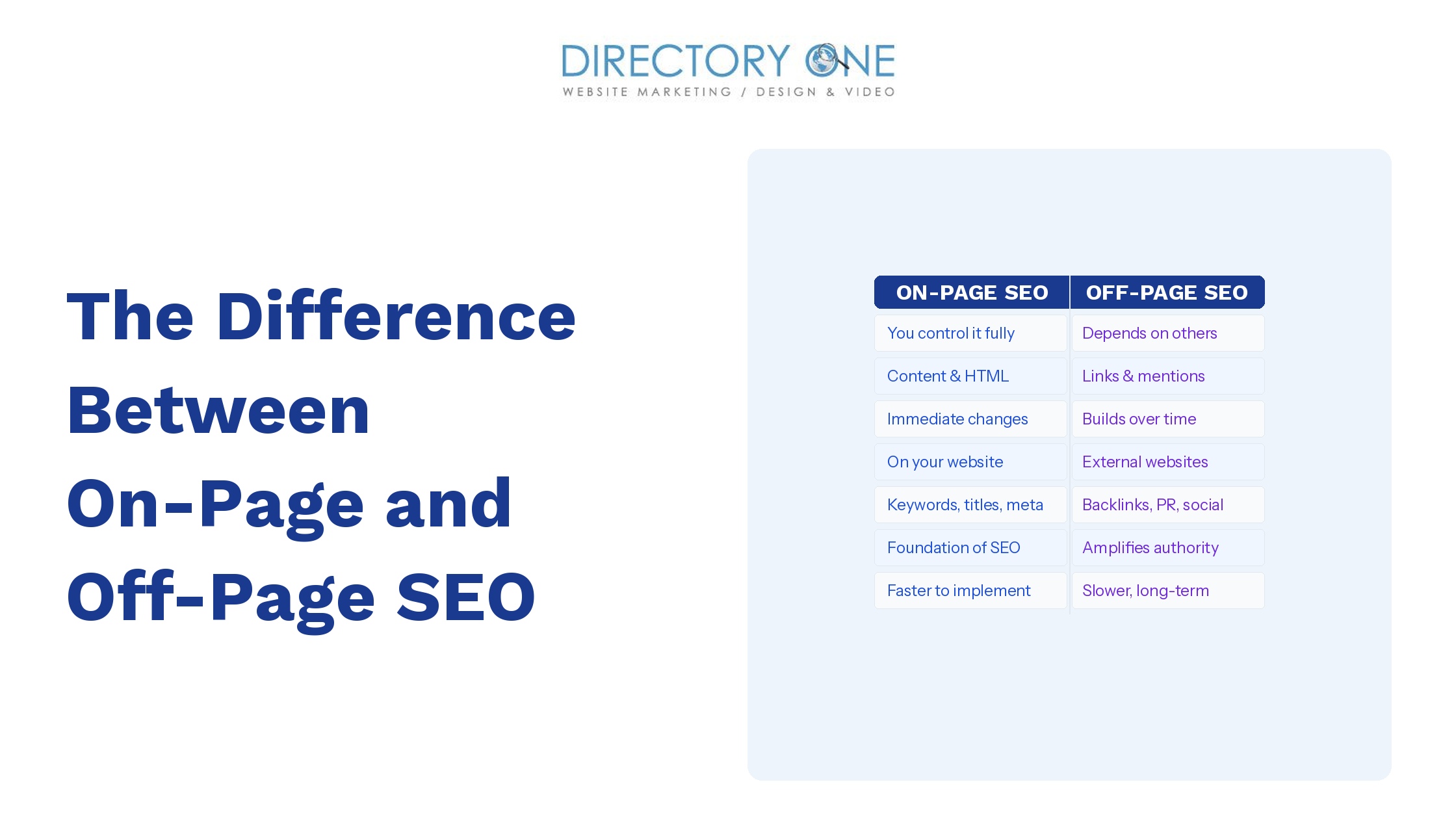
Here is the honest answer most agencies will not give you. If your on-page SEO is weak, no amount of link building will save you. The difference between on-page and off-page SEO comes down to this: on-page is what Google reads to understand your content, and off-page is what Google uses to decide whether to trust it.
So if you are starting from scratch or trying to figure out why your rankings have stalled, on-page SEO is almost always where the problem lives.
How Many Keywords Should You Optimize For
This is a question that comes up constantly. How many keywords should you optimize for on a single page? The general answer is one primary keyword and two to four closely related secondary keywords per page. Trying to force too many unrelated keywords into one page confuses search engines and weakens your relevance signal. Each page on your site should have a clear, focused purpose.
On-Page and Off-Page SEO Techniques That Actually Work
On the on-page side, the techniques that move the needle include writing content that genuinely answers what your audience is searching for, using your primary keyword in the title tag, H1, and naturally throughout the body, optimizing meta descriptions to improve click-through rates, building a clean internal link structure, and making sure your pages load fast on mobile.
On the off-page side, what works is earning backlinks from relevant and authoritative websites in your industry, keeping your Google Business Profile updated, getting consistent mentions of your brand across the web, and building a reputation that Google can verify through multiple sources.
SEO Google Ranking Factors You Cannot Afford to Overlook
Google uses hundreds of SEO Google ranking factors to determine where your site shows up. But when you strip it all back, the ones that carry the most weight are content relevance, page experience, backlink quality, and technical health. None of these exists in isolation. A page with excellent content but zero backlinks will struggle. A page with strong backlinks but thin, poorly structured content will plateau. Both sides of the on-page vs. off-page SEO equation have to be working together.
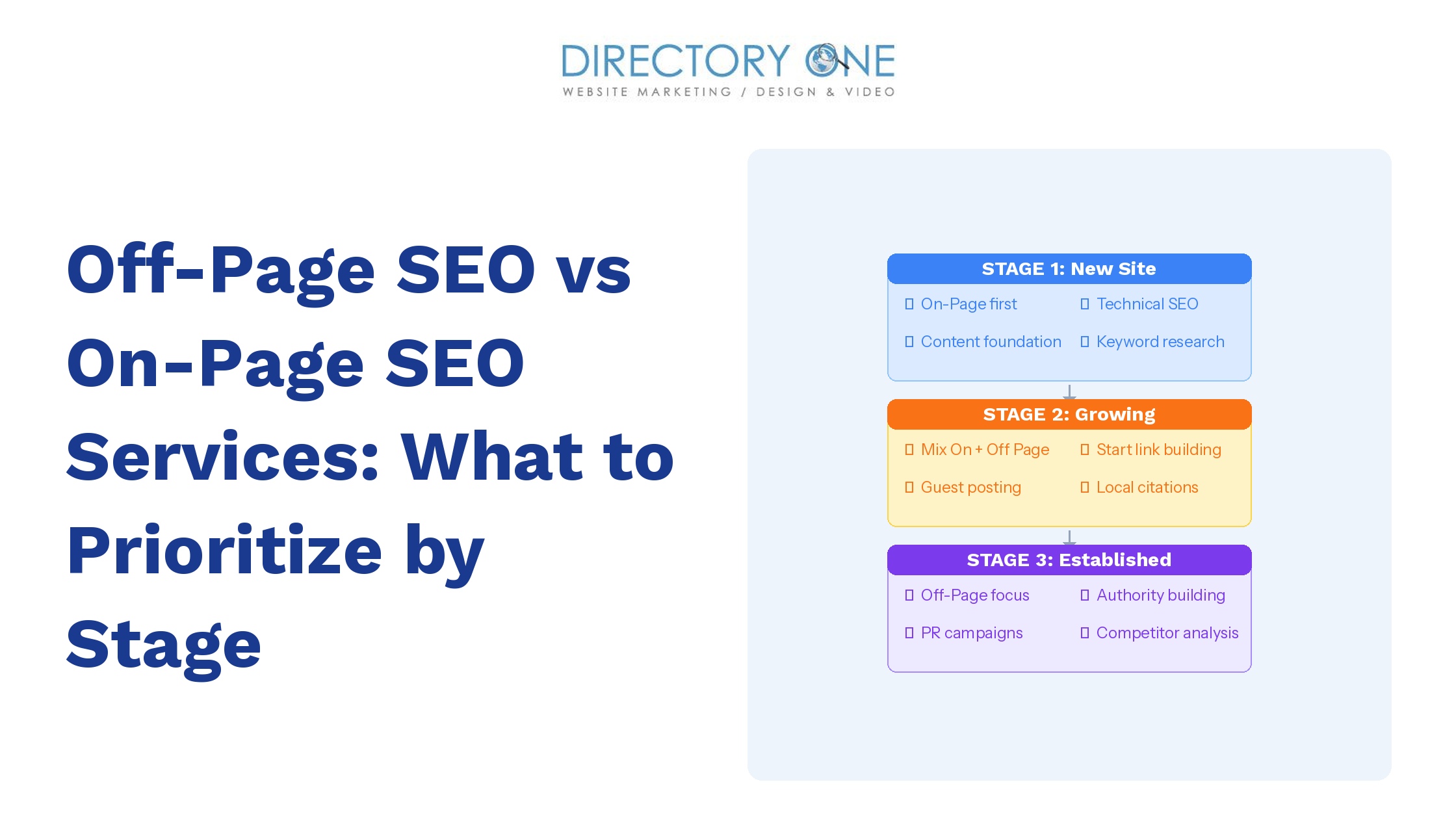
Off-Page SEO vs On-Page SEO Services: What to Prioritize by Stage
If your site is brand new, prioritize on-page SEO services first. Get your content right, your structure clean, and your technical foundation solid. Once that is in place, off page seo vs on page seo services becomes more of a scaling conversation. You build authority through links and reputation after you have something worth linking to.
For businesses that have been around for a while but are not ranking, the answer is almost always a combination of advanced on-page SEO services to fix what is broken and a focused off-page strategy to start building authority in a more intentional way.
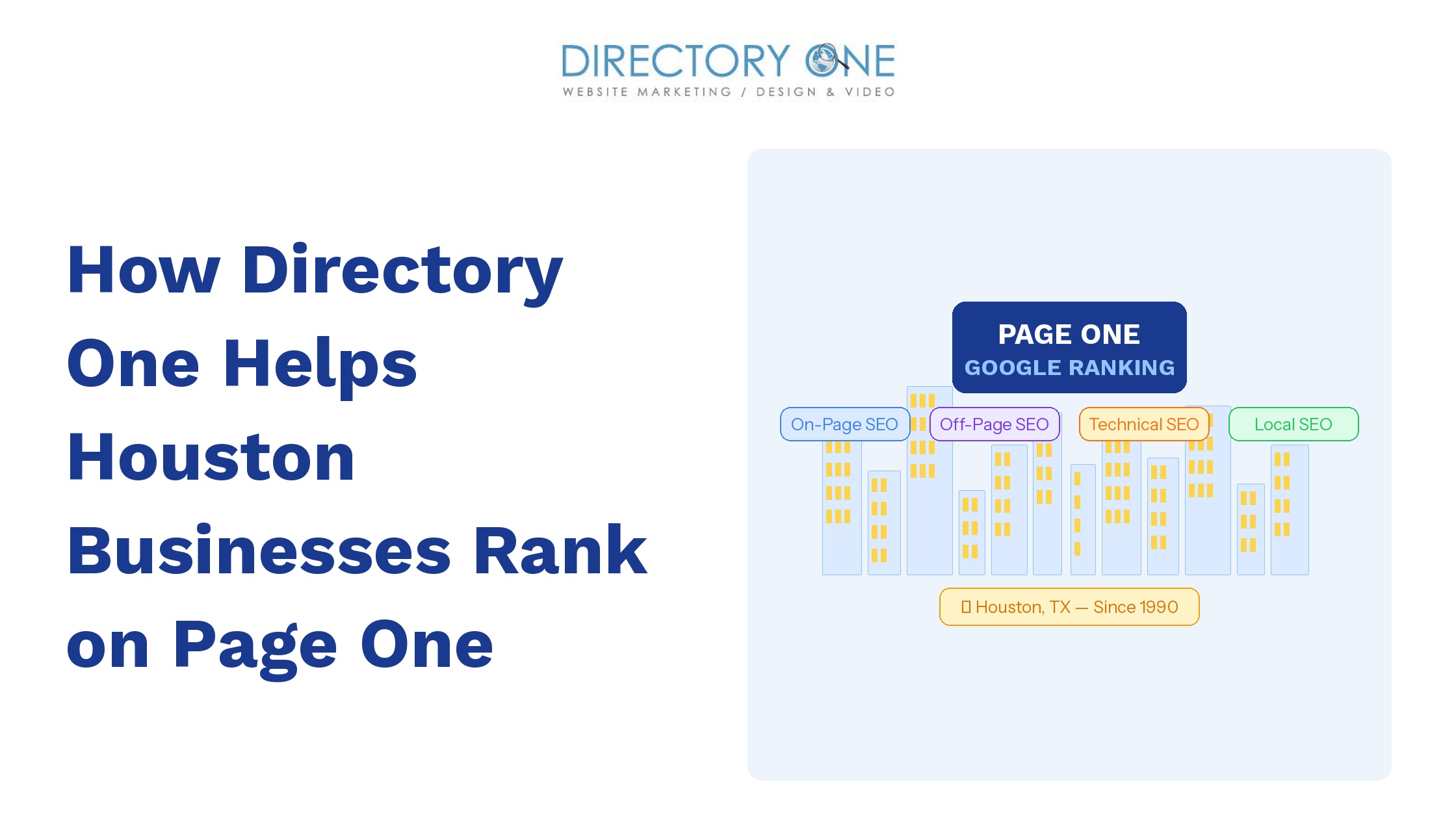
How Directory One Helps Houston Businesses Rank on Page One
This is where strategy meets execution. At Directory One, a search engine marketing agency based in Houston, Texas, we have helped businesses across industries cut through the noise and show up where their customers are actually searching.
As a trusted on-page SEO company in Houston, we do not take a one-size-fits-all approach. Every engagement starts with a full audit of where your site stands across on-page, off-page, and technical factors. From there, we build a plan that addresses the real reasons your site is not ranking, not just the surface-level symptoms.
Why Our Technical On-Page SEO Company Makes All the Difference
Working with our technical on-page SEO company means you are not just getting content tweaks and keyword suggestions. You are getting a team that understands how Google crawls and indexes your site, what signals are holding you back, and what changes will have the biggest impact on your rankings quickly.
Whether you are a local business trying to dominate search results in Houston or a growing company looking to expand your reach, on-page SEO vs off-page SEO does not have to feel overwhelming. With the skilled Directory One team behind you, it becomes a clear, manageable process.
Ready to start ranking? To learn how your website can improve visibility and generate more qualified leads, contact Directory One today at 713.269.3094 for a personalized SEO consultation. You can also explore our on-page SEO services? to get a free SEO assessment and find out exactly what your site needs to climb Google.
]]>Directoryone<![CDATA[Organic SEO vs PPC: Which Is Better for Your Business?]]>https://www.directoryone.com/blog/?p=70412026-06-01T19:24:39Z2026-06-05T12:24:00ZYou want more leads. You want more traffic. But you are not sure whether to invest in organic SEO vs PPC. This is one of the most common questions business owners ask. And the truth is — both can work. The real question is: which one works better for your business right now? At Directory One, a trusted Houston local SEO marketing agency and Houston PPC management agency, we help businesses across Houston decide where to put their dollars. This guide explains SEO vs PPC, which is better, based on your goals, budget, and timeline. What Is Organic SEO? Organic SEO (Search Engine Optimization) is the process of improving your website so it ranks higher in Google’s unpaid search results. It includes: Organic SEO helps websites get indexed by search engines and rank based on relevance and quality. There are no guaranteed search engine rankings, but a well-executed SEO strategy builds lasting visibility. Once your pages rank, traffic keeps coming in without paying for every click. For a deeper look at content-driven SEO, read our guide on SEO Writing: 9 Proven Tips to Create Search-Optimized Content. What Is PPC Advertising? PPC (Pay-Per-Click) advertising means paying for ad placements in search
]]>You want more leads. You want more traffic. But you are not sure whether to invest in organic SEO vs PPC. This is one of the most common questions business owners ask. And the truth is — both can work. The real question is: which one works better for your business right now?
At Directory One, a trusted Houston local SEO marketing agency and Houston PPC management agency, we help businesses across Houston decide where to put their dollars. This guide explains SEO vs PPC, which is better, based on your goals, budget, and timeline.
What Is Organic SEO?
Organic SEO (Search Engine Optimization) is the process of improving your website so it ranks higher in Google’s unpaid search results. It includes:
Keyword research and optimization
Content creation
Technical SEO improvements
On-page optimization
Link building
Organic SEO helps websites get indexed by search engines and rank based on relevance and quality. There are no guaranteed search engine rankings, but a well-executed SEO strategy builds lasting visibility. Once your pages rank, traffic keeps coming in without paying for every click.
PPC (Pay-Per-Click) advertising means paying for ad placements in search results for visibility on search engines. Common platforms include:
Google Ads
Bing Ads
Social media ads
You bid on keywords, write ad copy, set a budget, and your ad appears at the top of search results immediately.
The moment your budget stops, so does your visibility. But while it runs, PPC delivers fast, targeted traffic. Our Houston PPC services are built to maximize every dollar you spend on paid search.
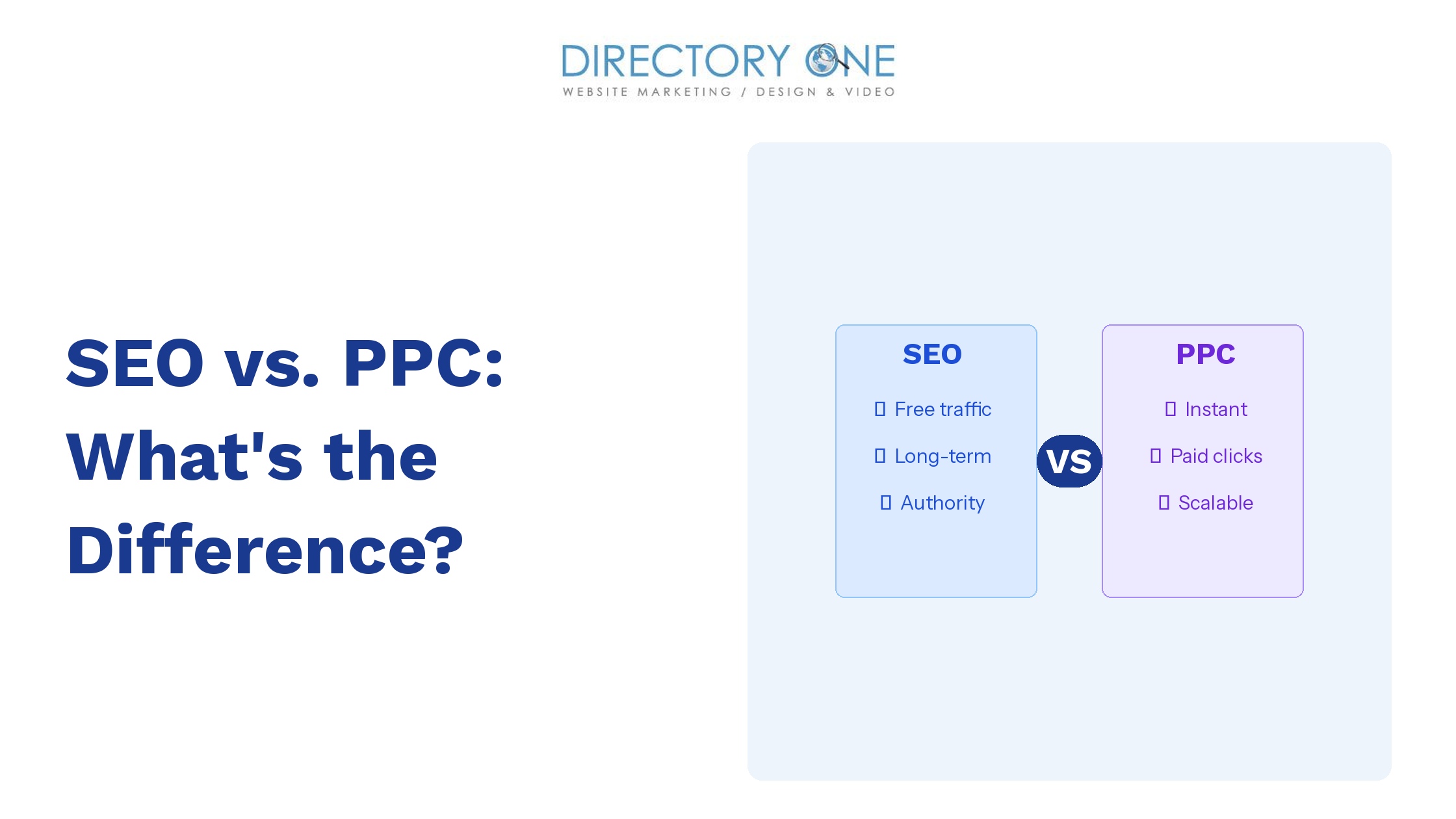
Organic SEO vs PPC: What’s the Difference??
Understanding the difference between PPC advertising vs. SEO? comes down to three things: speed, cost, and sustainability.
SEO generates organic traffic over time
PPC provides instant visibility through ads
SEO builds long-term authority
PPC offers quick lead generation
Factor
Organic SEO
PPC Advertising
Speed
3–6 months to see results
Immediate traffic
Cost Model
Upfront investment; compounds over time
Pay per click; stops when budget stops
Sustainability
Long-lasting rankings
Ends when ads are paused
Trust
Higher user trust (organic)
Lower user trust (ads)
Click-Through Rate
~27.6% for #1 organic result
Lower; ~70–80% of users skip ads
Best For
Long-term brand growth
Quick wins, promotions, launches
PPC vs SEO Marketing?: Which Is Better for Your Business Goals?
The answer depends on your timeline, budget, and goals. Here is a simple guide:
Choose organic SEO if you want sustainable growth, lower long-term costs, and brand authority.
Choose PPC if you need fast results, are launching a product, or want to target specific audiences immediately.
Choose both if you want the strongest digital marketing strategy possible.
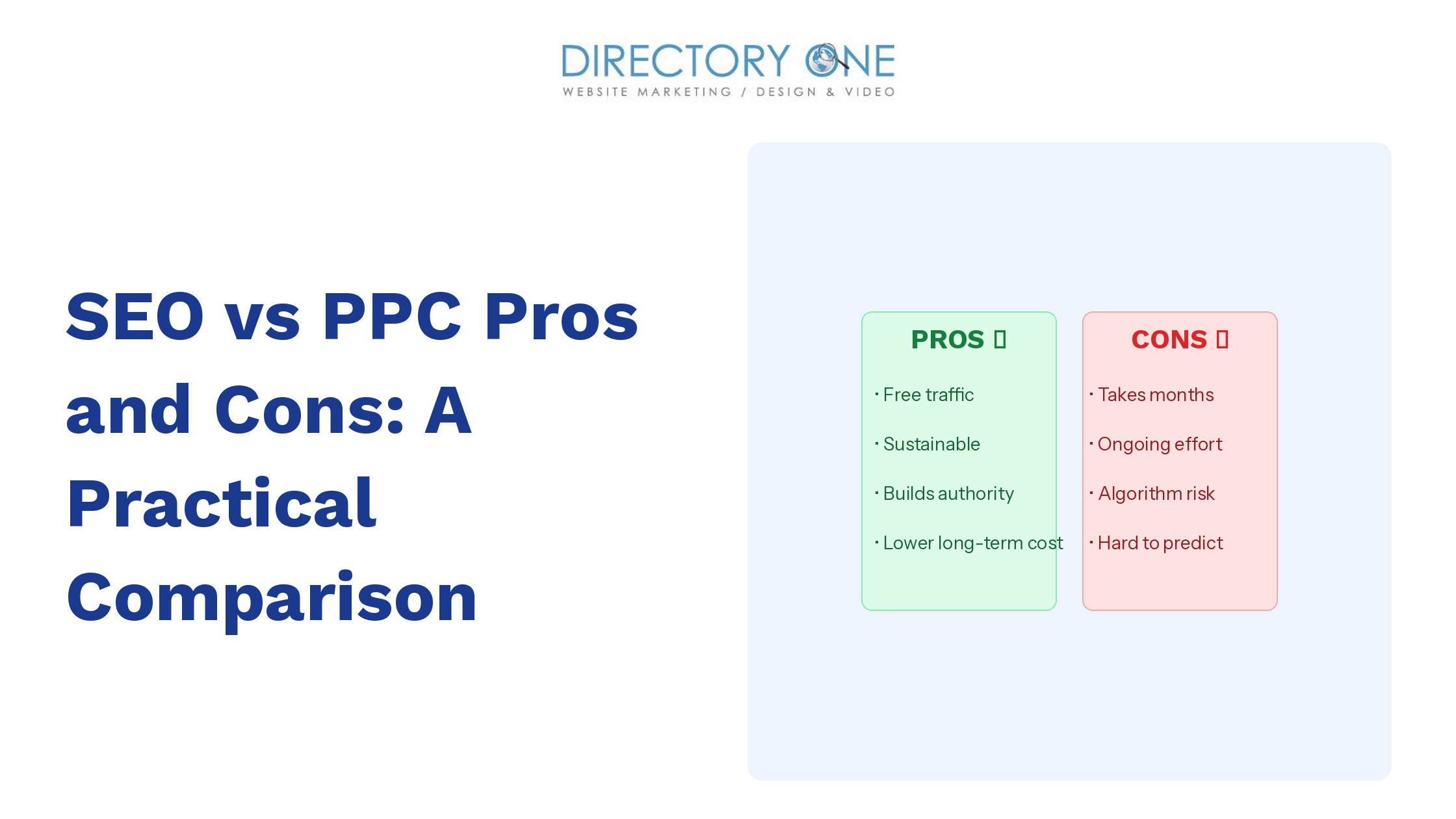
Pro: Traffic compounds over time; you don’t pay per click
Pro: Builds brand trust and authority
Pro: Higher conversion rates in most industries
Con: Takes 3–6 months to see significant results
Con: Requires ongoing content and technical work
PPC Pros and Cons
Pro: Immediate visibility and traffic
Pro: Precise targeting by location, device, and demographics
Pro: Easy to test and measure quickly
Con: Costs rise in competitive industries
Con: Zero traffic the moment you stop spending
SEO vs PPC ROI: Which Delivers Better Long-Term Results?
When comparing SEO vs PPC ROI, the numbers strongly favor organic SEO over time.
SEO delivers an average ROI of 748% vs. 200% for PPC (Source: First Page Sage, 2026)
Organic leads cost around $31 each. PPC leads average $181 each, a 5.8x cost difference (Source: First Page Sage / HubSpot)
SEO maintains roughly 25% higher ROI than PPC over time (Source: SeoProfy, 2026)
70% of marketers rank SEO as their most effective long-term growth driver
SEO compounds. Every page that ranks keeps earning without additional cost. PPC resets the moment your budget runs dry.
How Is Ranking Different When Comparing PPC vs. SEO?
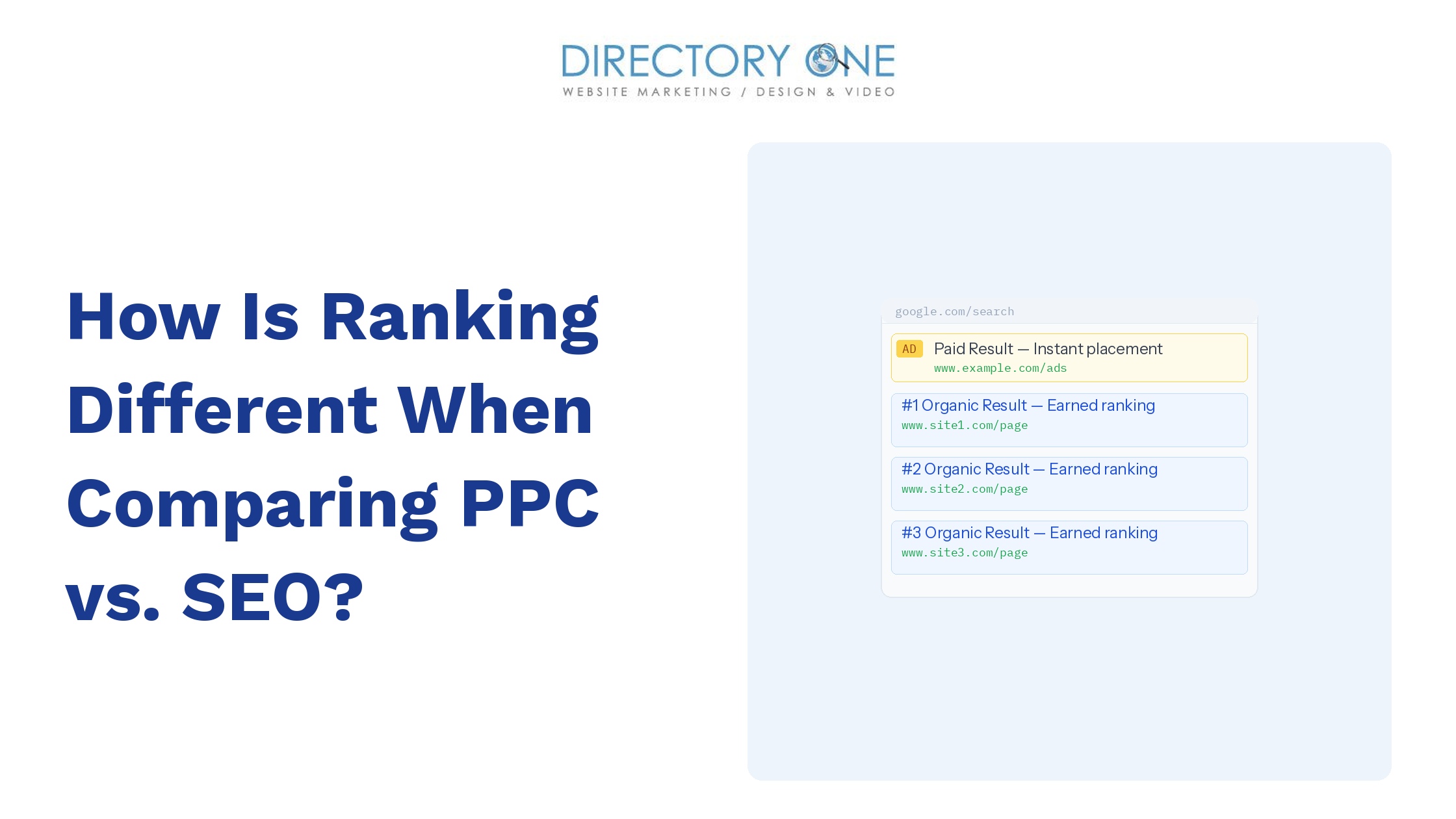
This is a great question. When comparing Organic SEO vs PPC, ranking works very differently.
In PPC:
Your position is determined by your bid amount, Quality Score, and ad relevance. The highest bidder generally wins the top ad spot, but not always. Ad quality matters too.
In Organic SEO:
Rankings are earned through content quality, domain authority, backlinks, site speed, mobile optimization, and user experience. No amount of money directly buys an organic ranking.
This is why organic rankings are far more trusted by users. In fact, 70–80% of users skip paid ads and click organic results instead.
Cost Comparison: Is SEO Cheaper Than PPC in the Long Run?
Yes. SEO is significantly more cost-effective over time. Here is why:
The average Google Ads CPC is $4.22. In competitive industries like Legal, it can exceed $8.67 per click.
Small and medium businesses spend 7x more on PPC than on SEO on average.
SEO’s costs are upfront — content, links, and technical work. After that, traffic is essentially free.
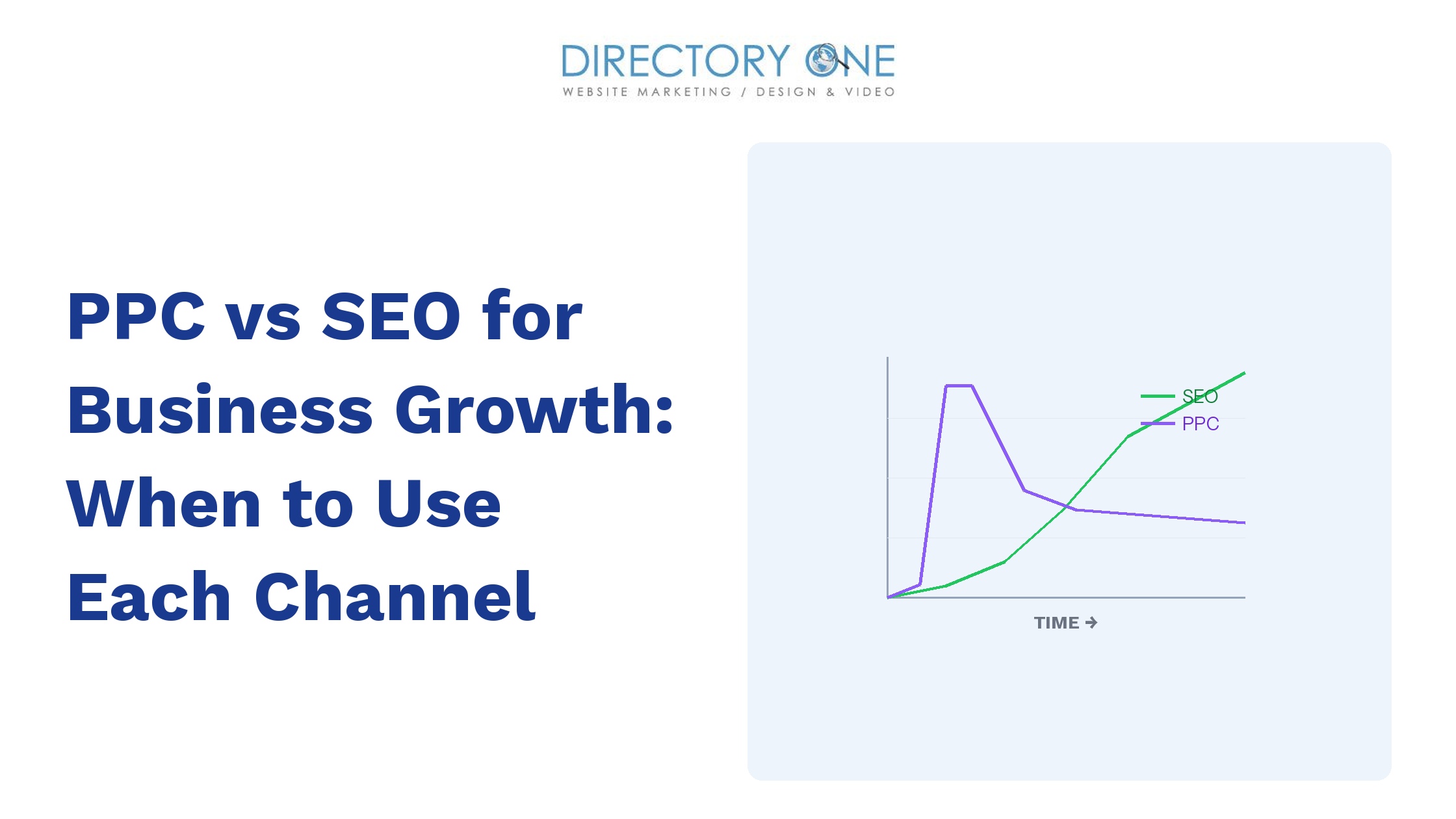
PPC vs SEO for Business Growth: When to Use Each Channel
Use Pay-Per-Click When:
You have a new business and need immediate traffic
You are running a time-sensitive promotion or event
You want to test new offers or landing pages quickly
You are in a highly competitive market and need top-of-page presence now
Use Organic SEO When:
You want sustainable, long-term lead generation
You are building brand authority in your market
You want to reduce your cost per acquisition over time
You are targeting local customers in Houston and the surrounding areas
Our Houston PPC agency and Houston local SEO marketing agency teams work together to align your paid and organic strategies.
SEO and PPC Strategy: How to Combine Both for Maximum Results
The smartest businesses don’t choose one. They run a combined SEO and PPC strategy that uses PPC for immediate wins while SEO builds long-term authority.
Here is how an integrated approach works:
Use PPC data (top-converting keywords) to inform your SEO content strategy.
Run PPC ads on your most competitive keywords while SEO rankings develop.
Use retargeting ads to re-engage organic visitors who did not convert.
Let SEO reduce your overall PPC spend over time as organic rankings take hold.
Google itself recommends testing keyword performance through paid ads before committing to full SEO campaigns. Learn more at Google’s Search Central.
B2B Marketing: Why SEO Usually Wins the Long Game
In B2B marketing, organic SEO is especially powerful. According to BrightEdge, organic search drives 44.6% of all B2B revenue, more than any other digital channel.
B2B buyers do extensive research before contacting a vendor. They read blog posts, compare services, and look at reviews. If your content shows up consistently in organic search, you build trust long before a sales conversation happens.
SEO converts at 14.6% vs 10% for PPC on average.
In financial services, SEO converts at 7.3x the rate of PPC.
In legal services, SEO converts at 3.4x the rate of PPC.
For B2B brands in Houston, our SEO marketing agency Houston services are specifically designed to build this kind of trust-driven visibility.
When to Invest in Both Services?
The answer is simple: invest in both when you are ready to grow fast and grow smart. A combined approach works best when:
You have a moderate to strong marketing budget
You want to dominate both paid and organic search results
You are competing in a market where competitors are running both channels
You want short-term leads while building long-term brand equity
So, SEO vs PPC: which is better? For long-term business growth, organic SEO wins. For fast results, PPC wins. For the strongest possible strategy, both win together. The real question is not which channel is better. It is which channel or combination of channels is right for your business, your budget, and your goals right now.
At Directory One, we have been helping Houston businesses navigate this decision for over 20 years. Whether you need a Houston PPC agency to launch ads today or a local SEO marketing agency in Houston to build rankings that last, we have you covered.
To build custom SEO strategies that deliver real results, call us today at 713.269.3094.
]]>Directoryone<![CDATA[How to Rank on Google Without Backlinks (2026 SEO Guide)]]>https://www.directoryone.com/blog/?p=70022026-06-01T19:33:42Z2026-06-04T12:36:00ZLet’s be honest. Building backlinks takes time, budget, and a lot of hustle. But here’s a question most business owners are quietly asking: can you rank without backlinks? The short answer is yes, in many cases, you can rank on Google without backlinks?. According to Backlinko, the #1 result on Google earns 27.6% of all clicks. And while backlinks are still a ranking signal, Google has shifted its focus heavily toward content quality, search intent, and user experience. This guide breaks down the exact on-page SEO strategies and Google ranking factors 2026 that you can use right now with or without a single backlink. What Are Backlinks? Backlinks, or inbound links, occur when one website links to another. In the eyes of search engines, these act as digital votes of confidence. When a high-authority site like Google or Facebook links to you, it signals that your content is credible and authoritative. While SEO link building services traditionally focus on gathering these “votes,” the 2026 landscape allows for topical authority to bridge the gap. Understanding this helps you decide when to pursue a Houston link building company versus focusing on quality content writing to earn visibility. Can You Rank On Google
]]>Let’s be honest. Building backlinks takes time, budget, and a lot of hustle. But here’s a question most business owners are quietly asking: can you rank without backlinks? The short answer is yes, in many cases, you can rank on Google without backlinks?.
According to Backlinko, the #1 result on Google earns 27.6% of all clicks. And while backlinks are still a ranking signal, Google has shifted its focus heavily toward content quality, search intent, and user experience.
This guide breaks down the exact on-page SEO strategies and Google ranking factors 2026 that you can use right now with or without a single backlink.
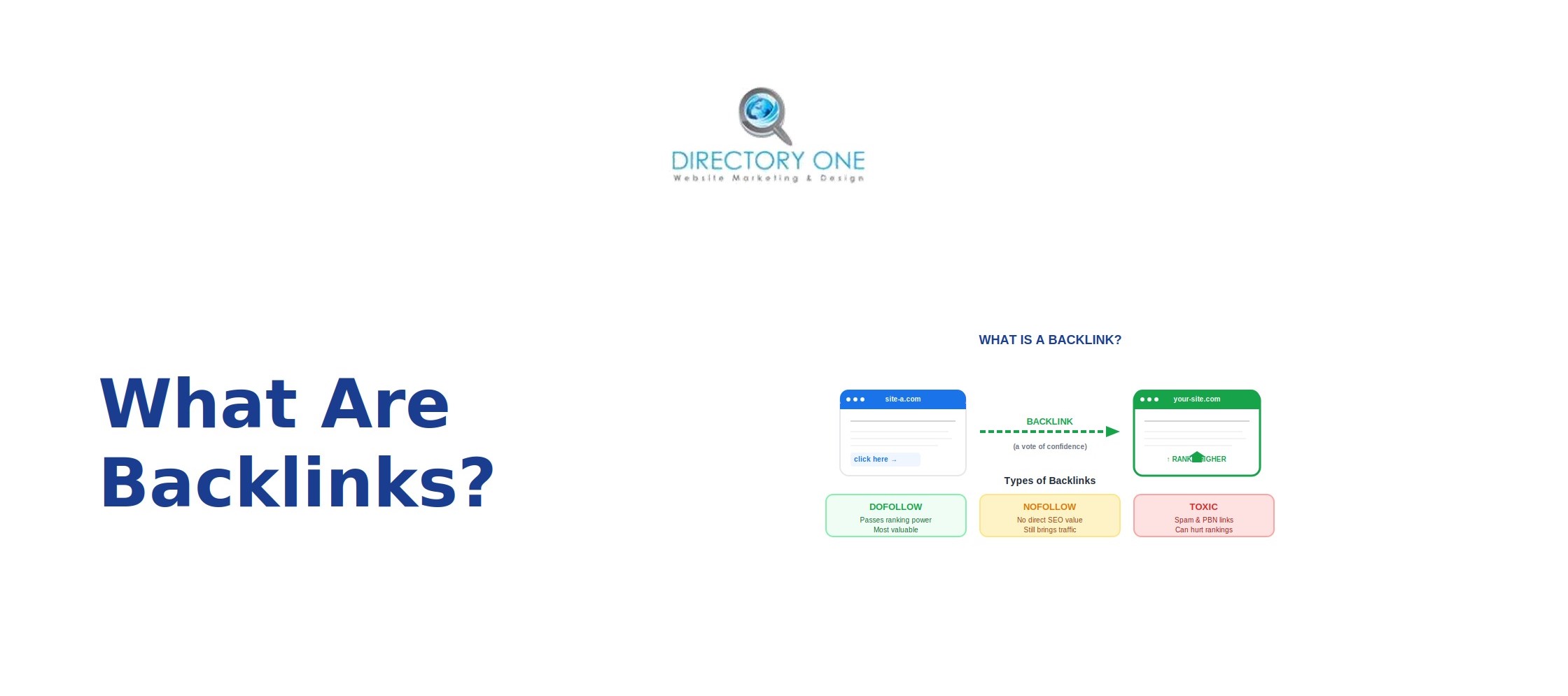
What Are Backlinks?
Backlinks, or inbound links, occur when one website links to another. In the eyes of search engines, these act as digital votes of confidence. When a high-authority site like Google or Facebook links to you, it signals that your content is credible and authoritative.
While SEO link building services traditionally focus on gathering these “votes,” the 2026 landscape allows for topical authority to bridge the gap. Understanding this helps you decide when to pursue a Houston link building company versus focusing on quality content writing to earn visibility.
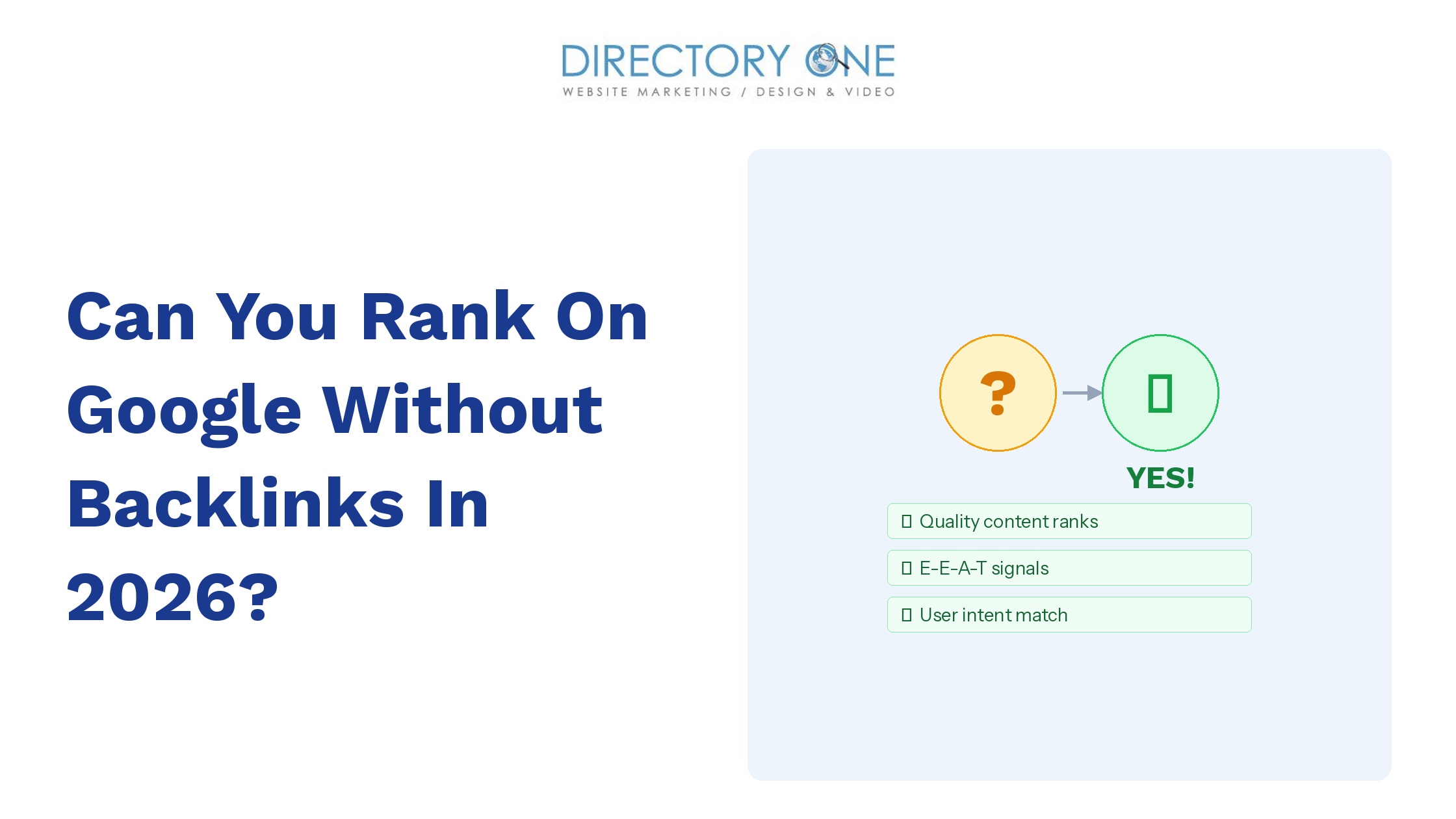
Can You Rank On Google Without Backlinks In 2026?
Yes, but with a practical understanding of the landscape.
Google’s own representatives have stated that backlinks are no longer among the top three ranking factors. Content quality and user experience now carry more weight. That’s a game-changer for newer websites and small businesses.
Still, it depends on competition. Low-competition keywords and local searches? Absolutely rankable without backlinks. Highly competitive national terms? You’ll eventually want a link-building strategy. But getting started? You don’t need a single backlink to make progress.
Here’s a stat worth noting: according to Semrush, over 50% of qualified pages without any backlinks never reach the first page of Google. So while it’s possible, the strategy has to be sharp.
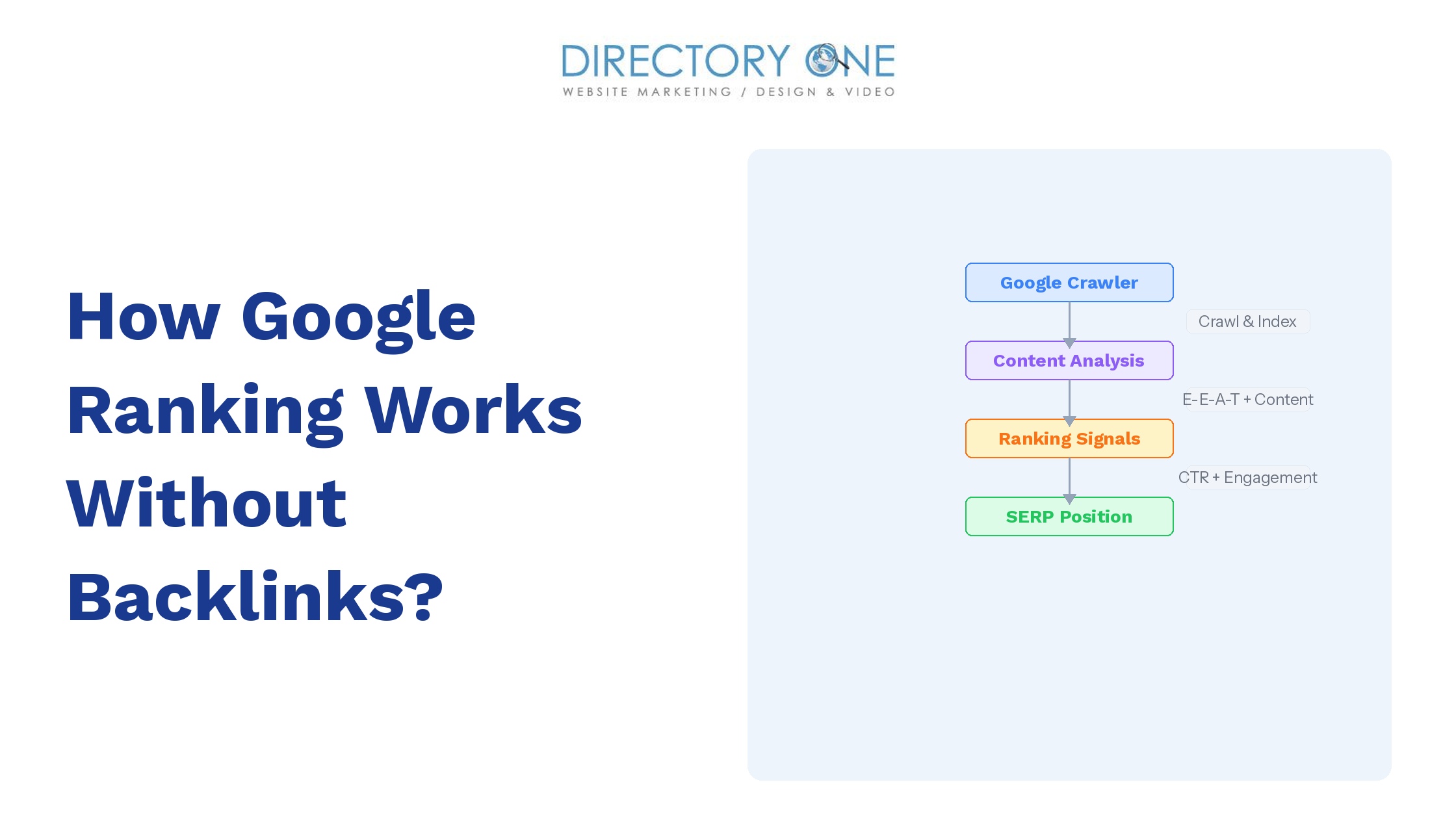
How Google Ranking Works Without Backlinks?
Google’s algorithm evaluates hundreds of signals. When backlinks are limited, other signals carry more weight. The core ones include:
E-E-A-T (Experience, Expertise, Authoritativeness, Trustworthiness) — Google uses this to evaluate content credibility.
Search intent alignment — Does your content actually answer what the user is looking for?
Core Web Vitals — Page speed, visual stability, and interactivity directly impact rankings.
Topical authority — How comprehensively does your site cover a given topic?
On-page SEO — Title tags, headings, internal links, and meta descriptions still matter enormously.
According to Google Search Central, helpful, people-first content is the foundation of every ranking system. This is SEO without backlinks done right.
On-Page SEO Strategies To Rank On Google Without Backlinks
On-page SEO is your most powerful lever when you’re not building links. Here’s what moves the needle most.
1. Target Long-Tail Keywords
Long-tail keywords make up about 70% of all searches, according to Semrush. They have lower competition and higher intent. This makes it far easier to rank on Google without backlinks on these terms.
Title tags containing a target keyword get a significantly higher click-through rate. According to Backlinko, title tags with 40–60 characters earn about 8.9% higher CTR. Short and descriptive wins.
Pro tip: Include your primary keyword near the front of the title tag, not buried at the end.
3. Use Header Tags Strategically
Your H1 should contain your focus keyword. H2s and H3s should include related keywords naturally. This signals topical relevance to Google without requiring any links.
This is one of the foundational on-page SEO strategies that quality content writing services use to improve rankings fast.
4. Internal Linking Done Right
Internal links distribute authority across your site. According to research, URLs with 40 to 44 internal links received about four times more clicks than pages with just a handful. That’s significant.
A good rule of thumb: include 3–5 relevant internal links per blog post. This is how many internal links per page most SEO professionals recommend for content-heavy blogs.
For example, if you’re writing about local SEO, link to relevant content like Mobile SEO Best Practices and your SEO Writing Tips guide to create strong content clusters.
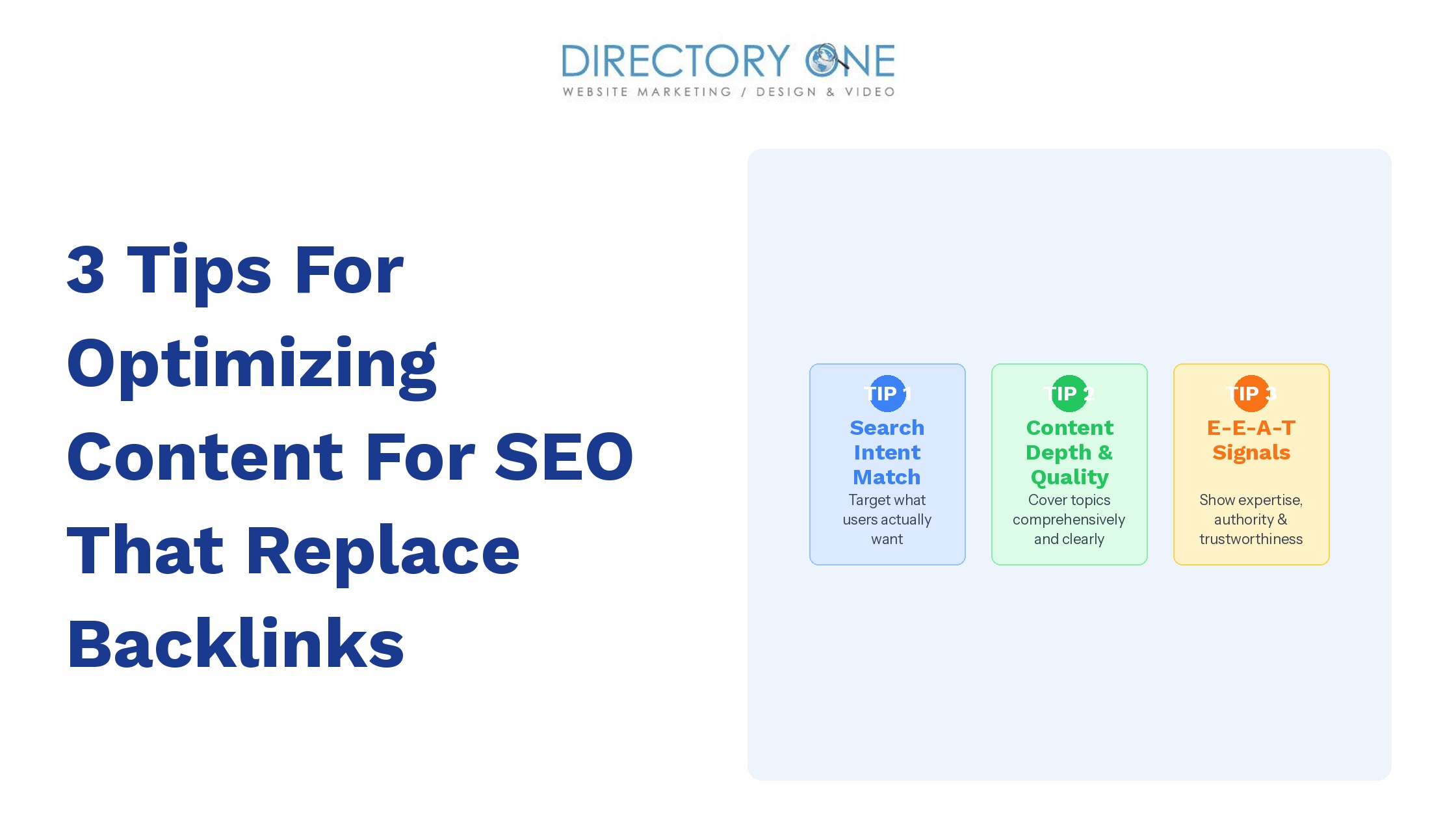
3 Tips For Optimizing Content For SEO That Replace Backlinks
These three tips for optimizing content for SEO without backlinks are proven, practical, and something you can implement today.
Tip 1: Match Search Intent Precisely
Google’s AI now interprets intent at a granular level. If someone searches ‘how to rank a website without backlinks,’ they want a how-to guide, not a sales page. Match the format, depth, and angle Google expects.
Search intent personalization is one of the fastest-growing Google ranking factors 2026. Get it right, and your page can rank even against websites with strong backlink profiles.
Tip 2: Write Long-Form, Comprehensive Content
Pages in the top 10 on Google average 1,447 words, according to Backlinko. Content with 3,000+ words earns 3x more traffic, per Semrush. Comprehensive content signals topical authority.
That’s why investing in quality content writing, or working with quality content writing services, pays off. Thin content simply doesn’t compete anymore.
Tip 3: Refresh and Update Existing Content
Refreshing old blog posts can increase organic traffic by up to 106%, according to HubSpot. Google values freshness. Update statistics, add new sections, and re-optimize for current keywords regularly.
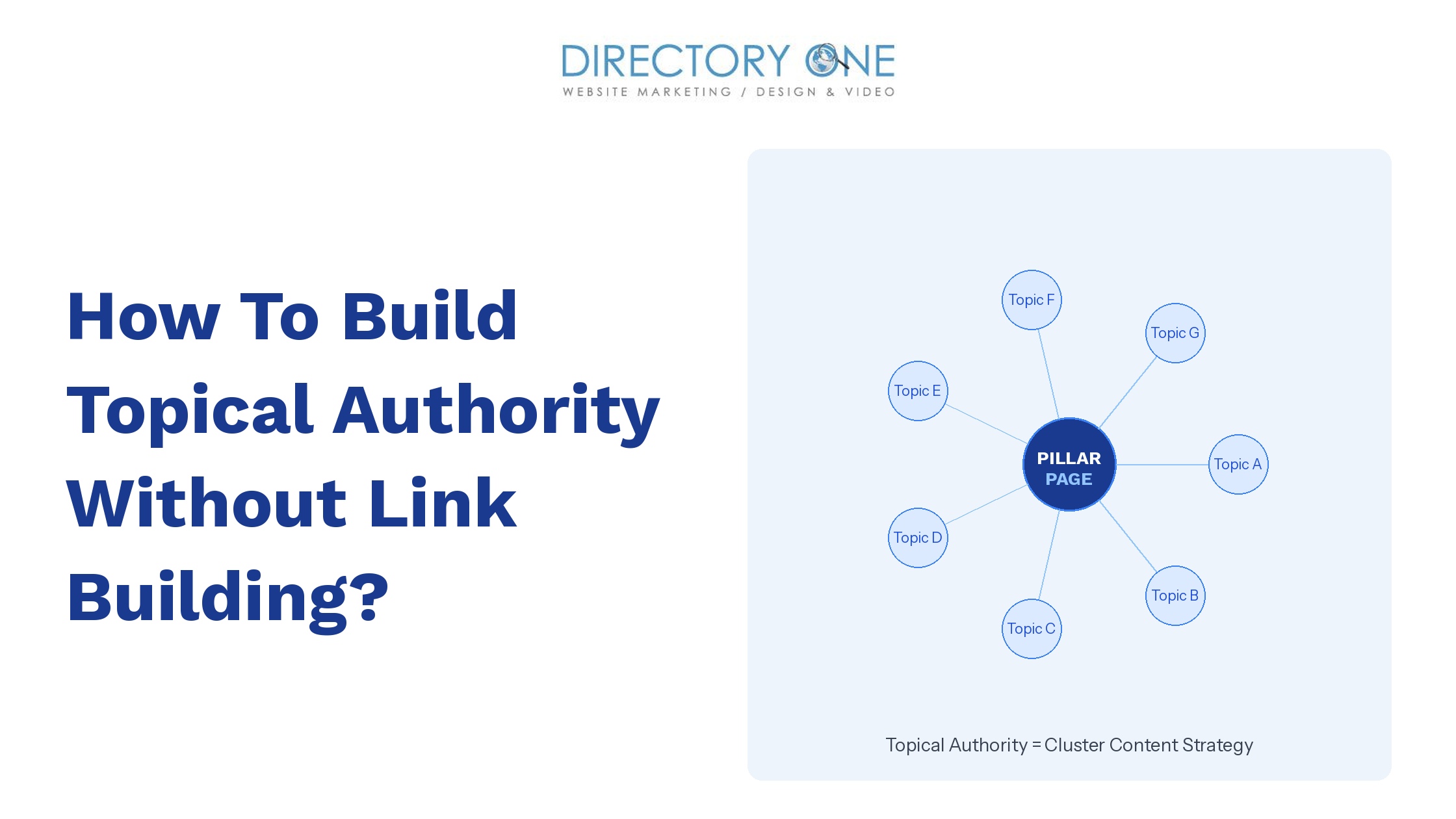
How To Build Topical Authority Without Link Building?
Topical authority means owning a subject in Google’s eyes. When your site consistently covers every angle of a topic, Google trusts it even without many external links.
Here’s how to build it:
Create content clusters:
Write a pillar page on a broad topic, then link to detailed supporting posts. For example, a pillar on “Local SEO” with cluster posts on Google Business Profile, citation building, and NAP consistency.
Cover every question in your niche:
Use tools like Semrush’s Topic Research or Google’s “People Also Ask” to find every sub-topic your audience cares about.
Publish consistently:
Google rewards sites that demonstrate sustained expertise. One blog post a week beats five posts one month, then silence for three months.
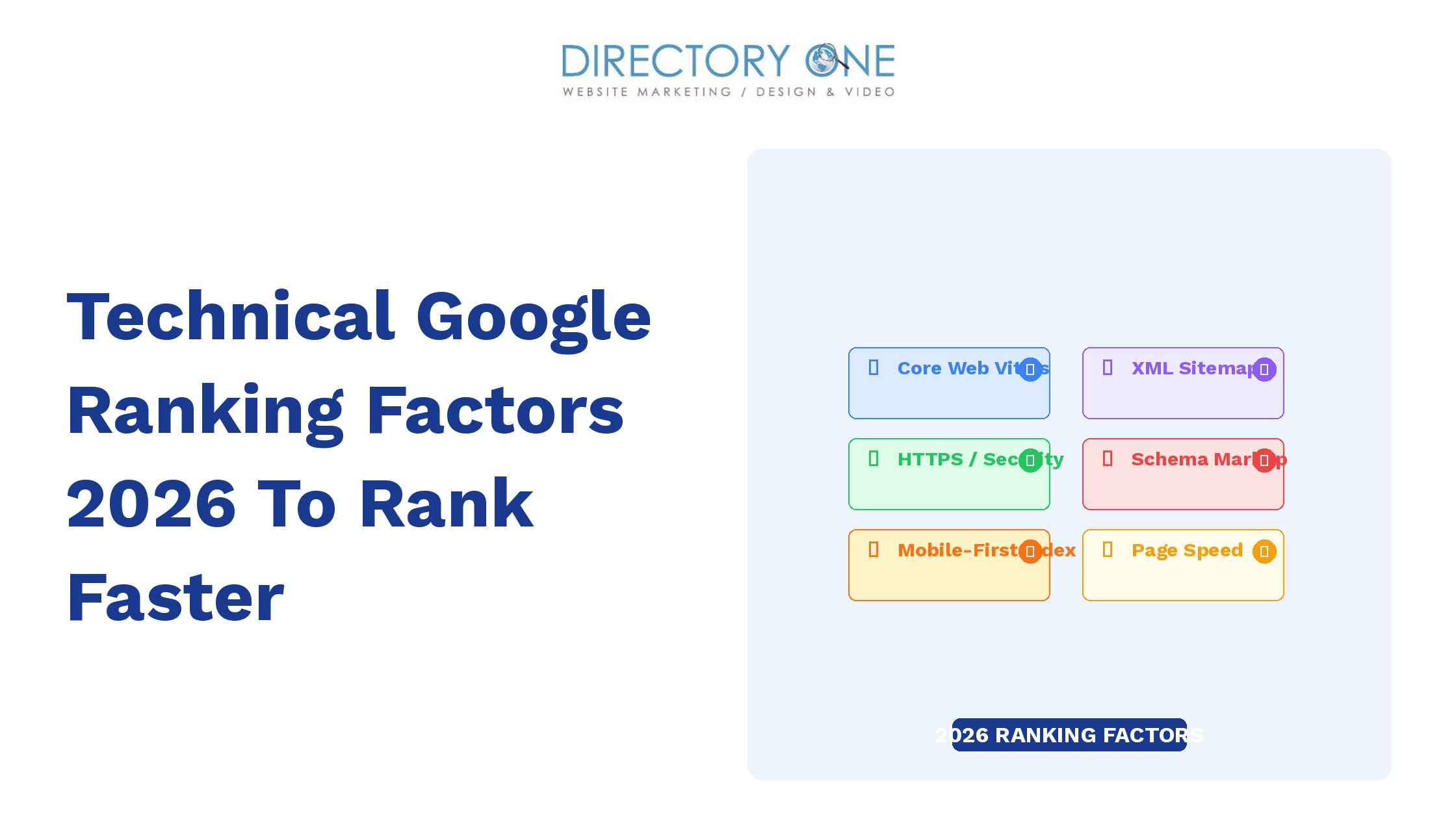
Technical Google Ranking Factors 2026 To Rank Faster
Even the best content won’t rank if your site has technical problems. Here are the Google ranking factors 2026 you can’t ignore:
Core Web Vitals: LCP (Largest Contentful Paint), INP (Interaction to Next Paint), and CLS (Cumulative Layout Shift). Only 33% of websites currently meet Google’s Core Web Vitals standards.
Mobile-first indexing: Over 62% of global search traffic comes from mobile devices (Statista, Q4 2024). If your mobile experience is poor, your rankings will suffer.
HTTPS: Secure sites are a baseline requirement. Non-HTTPS pages are penalized in modern Google algorithms.
Crawlability and site structure: A clean sitemap, logical URL structure, and fast server response help Google index your content quickly.
Schema markup: Structured data helps Google understand your content and improves the chances of appearing in featured snippets.
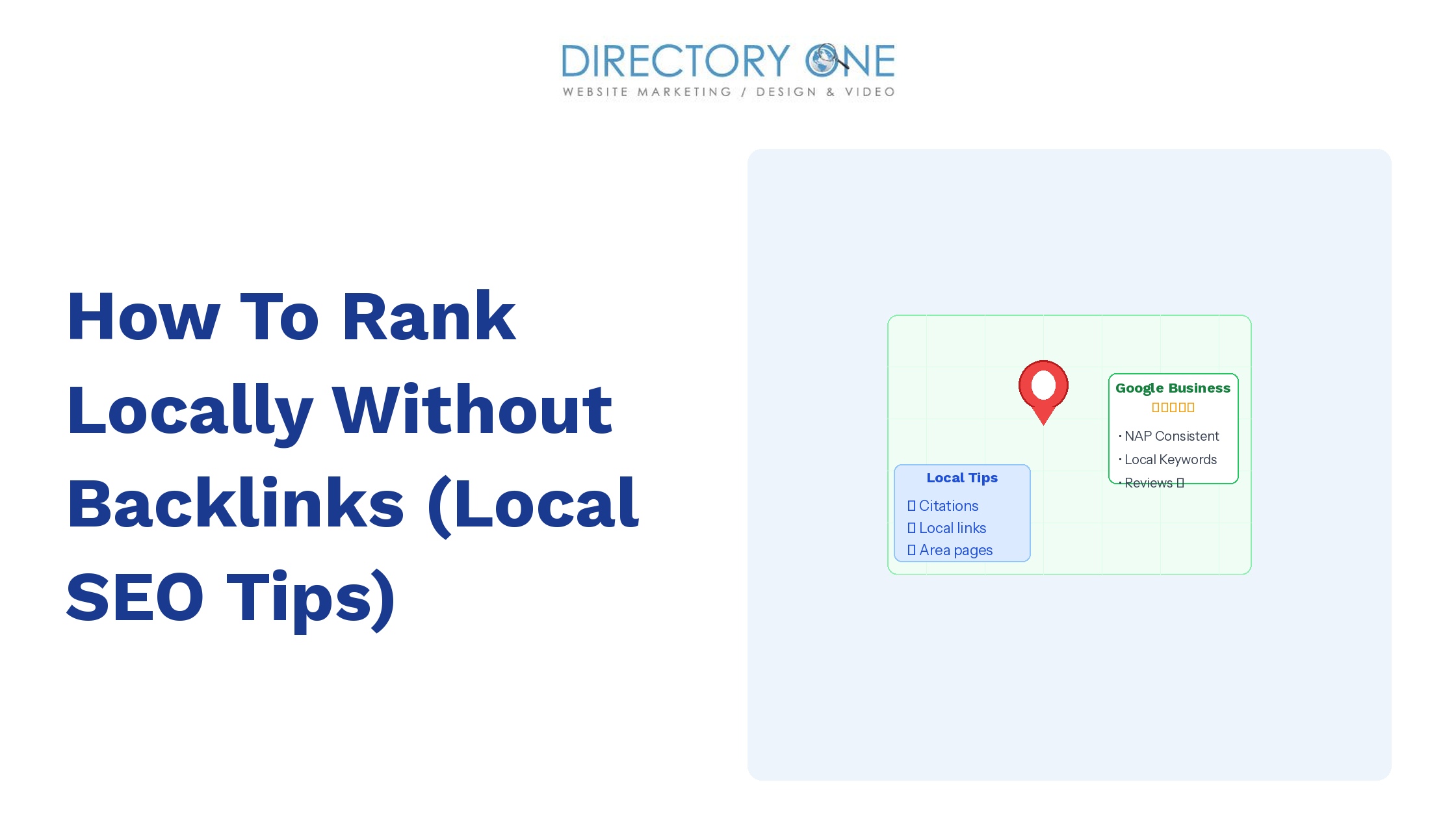
How To Rank Locally Without Backlinks (Local SEO Tips)
Local SEO is where the no-backlinks strategy truly shines. And the numbers back it up:
Around 28% of local searches result in a purchase. Businesses in the Google local 3-pack earn 126% more traffic than those ranked just outside it (positions 4–10).
Here’s how to win locally without backlinks:
Claim and optimize your Google Business Profile: Add your business category, hours, photos, services, and posts. Only 64% of businesses have done this (BirdEye).
Build consistent NAP: Name, Address, Phone across all directories must match exactly.
Get reviews: Google’s local algorithm heavily weights review quantity and recency.
Create location-specific landing pages: If you serve multiple areas, each needs its own optimized page.
As a local SEO company Houston businesses trust, we’ve helped dozens of companies dominate local search without relying on backlink campaigns.
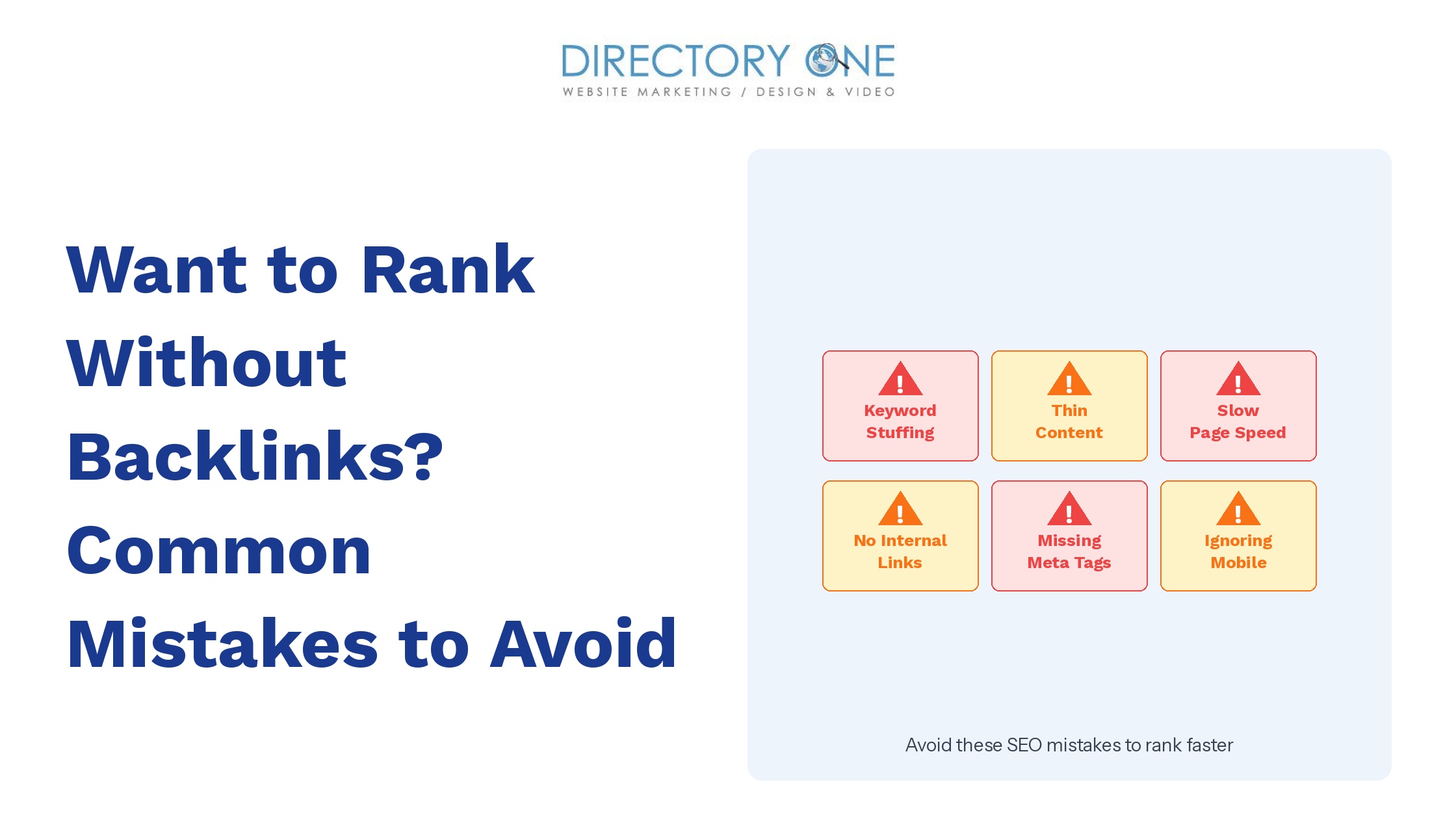
Want to Rank Without Backlinks? Common Mistakes to Avoid
Most websites that fail to rank on Google without backlinks are making one of these avoidable errors:
Keyword stuffing: Google penalizes unnatural keyword use. Pages in the top 10 today have 50% lower keyword density than those that ranked a few years ago (Brightedge).
Ignoring search intent: Publishing a listicle when Google wants a how-to guide, or vice versa, will bury your page.
Thin content: Pages with fewer than 500 words rarely compete in 2026. Quality content writing means depth, not fluff.
No internal linking: Orphan pages (pages with no internal links pointing to them) rarely get crawled or ranked.
Skipping technical SEO: A 3-second load time is the difference between ranking and not. Fast, clean sites win.
Skipping the Helpful Content guidelines: Google’s Helpful Content Update rewards people-first content. Writing for search engines instead of users is a fast track to lower rankings.
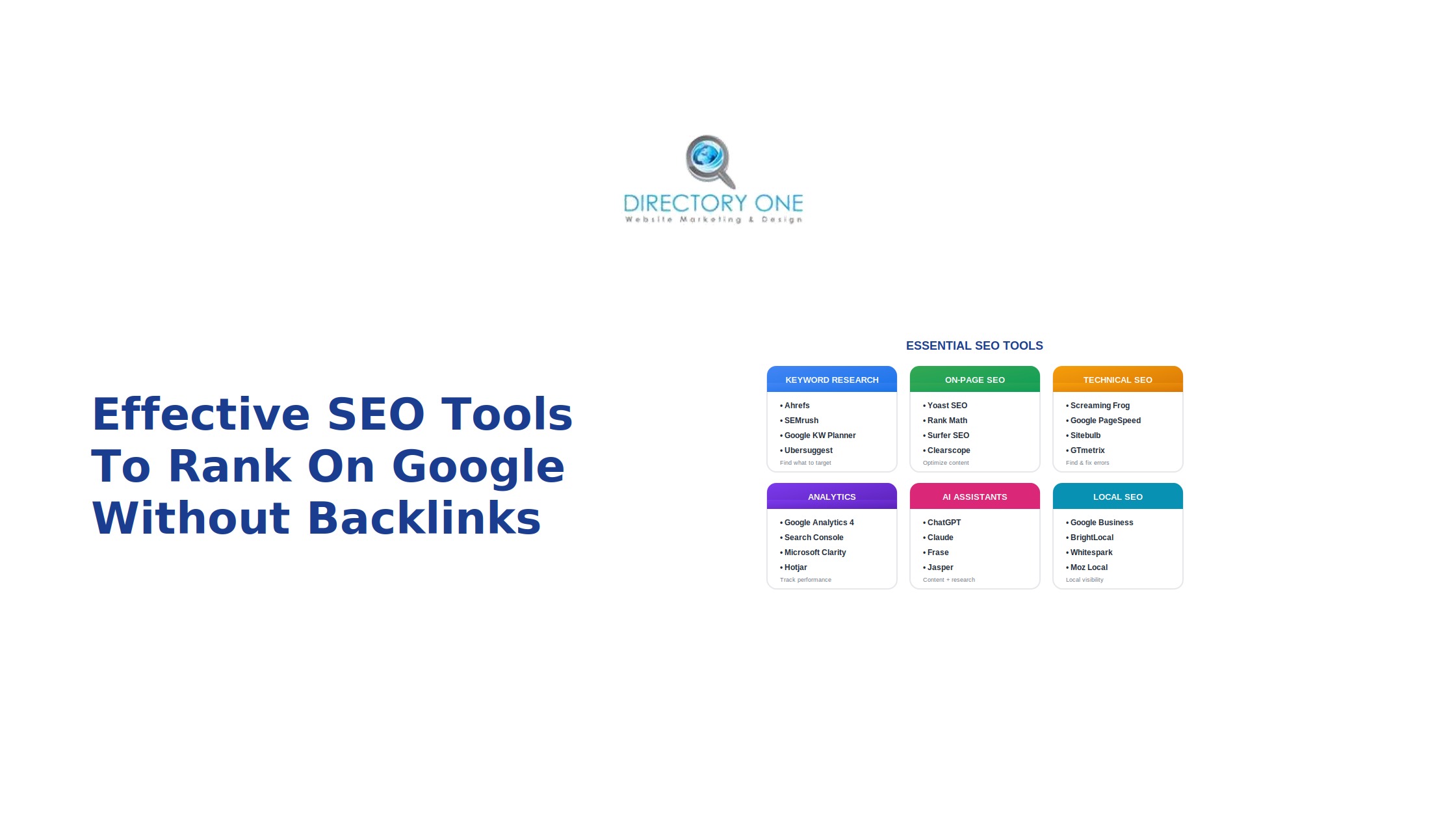
Effective SEO Tools To Rank On Google Without Backlinks
You don’t need backlinks — but you do need the right tools. Here are the most effective SEO tools for ranking without link building:
Semrush — Keyword research, content gap analysis, and on-page SEO auditing
Ubersuggest — Free keyword ideas and competitor insights
Yoast SEO — WordPress plugin for on-page SEO optimization and readability scoring
Surfer SEO — AI-powered content optimization based on top-ranking pages
Want a professional search engine optimization audit of your site? Our team at Directory One runs comprehensive audits to identify every opportunity — from keyword gaps to technical fixes. Call us at 713.269.3094.
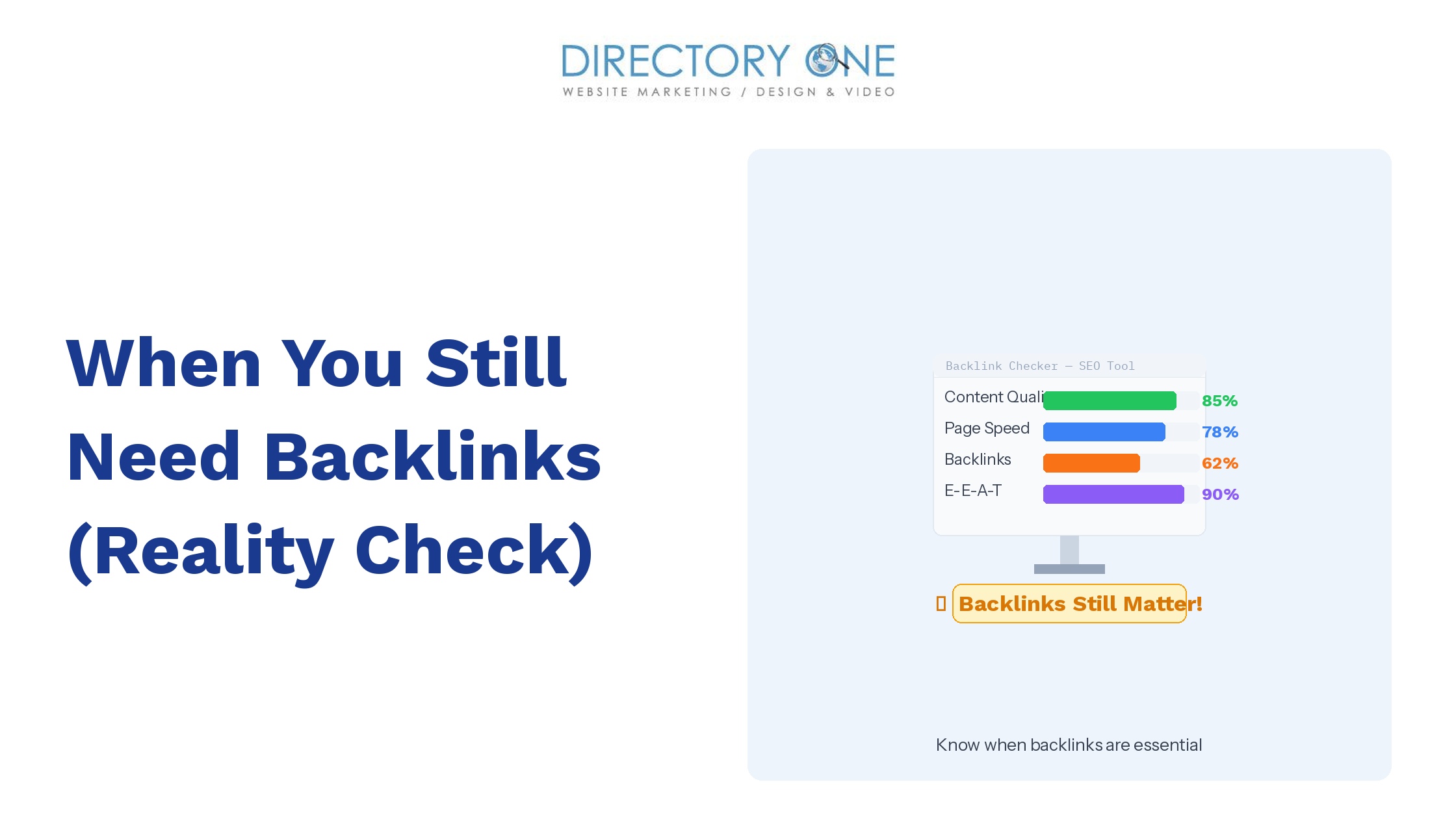
When You Still Need Backlinks (Reality Check)
Let’s be clear: this guide is not anti-backlinks. Backlinks remain a critical authority signal. A 13-month Semrush study found that 92.3% of top-ranking domains have at least one backlink. Google’s #1 result has 3.8x more backlinks than positions 2–10 (Backlinko).
So when do you need them?
Competing in high-authority niches (law, finance, healthcare, SaaS)
Targeting high-volume national or global keywords
Trying to rank a new domain against established websites
That’s where our SEO link building services come in. Our Houston link-building company team builds high-quality, editorial backlinks that compound over time, not spammy directories that get penalized.
Now comes the most awaited question: “How long does it take to rank on Google?”
Typically, 3 to 6 months for content-based strategies on low-competition terms. Competitive terms may take 6 to 12 months or more, especially without backlinks.
Conclusion
Yes, you can rank on Google without backlinks, and in 2026, it’s more achievable than ever. The shift toward helpful content, search intent, and user experience has leveled the playing field. The formula is straightforward: target the right keywords, create genuinely useful content, optimize on-page elements, build topical authority, and keep your technical SEO tight. Do those things well, and Google will reward you with backlinks or not. But if you want to accelerate your results or finally crack page one for competitive terms, that’s what we’re here for. Directory One is Houston’s trusted SEO agency with 30+ years of proven results in organic search, on-page optimization, and local SEO. We help businesses across Houston and beyond rank faster without shortcuts. Call Us at 713.269.3094 to schedule a consultation.
]]>Directoryone<![CDATA[Content Marketing Best Practice And Strategy For Long-Term Growth]]>https://www.directoryone.com/blog/?p=69902026-06-01T14:18:32Z2026-06-03T13:17:00ZMost businesses create content. But very few follow content marketing best practice lists to create content that actually grows their business. The difference? A smart, well-executed content marketing strategy. Content marketing generates over 3x as many leads as outbound marketing and costs 62% less yet most brands still treat it as an afterthought. If you are ready to change that, this guide is for you. At Directory One, we provide SEO and content marketing services that help businesses build real, lasting visibility online. Let’s break down everything you need to know. What Is a Content Marketing Strategy? A content marketing strategy is your roadmap. It defines what you create, who you create it for, and how you distribute it to attract and convert your target audience. It is not just blogging. It includes blog posts, videos, social content, email, case studies, and more — all working together toward one goal: growth. Besides, content strategy vs content marketing is a question we get often. Here is the simple answer: content strategy is the plan; content marketing is the execution. You need both. For a foundational look at how SEO and content work together, read our post on SEO Writing: 9 Proven
]]>Most businesses create content. But very few follow content marketing best practice lists to create content that actually grows their business. The difference? A smart, well-executed content marketing strategy.
Content marketing generates over 3x as many leads as outbound marketing and costs 62% less yet most brands still treat it as an afterthought. If you are ready to change that, this guide is for you.
At Directory One, we provide SEO and content marketing services that help businesses build real, lasting visibility online. Let’s break down everything you need to know.
What Is a Content Marketing Strategy?
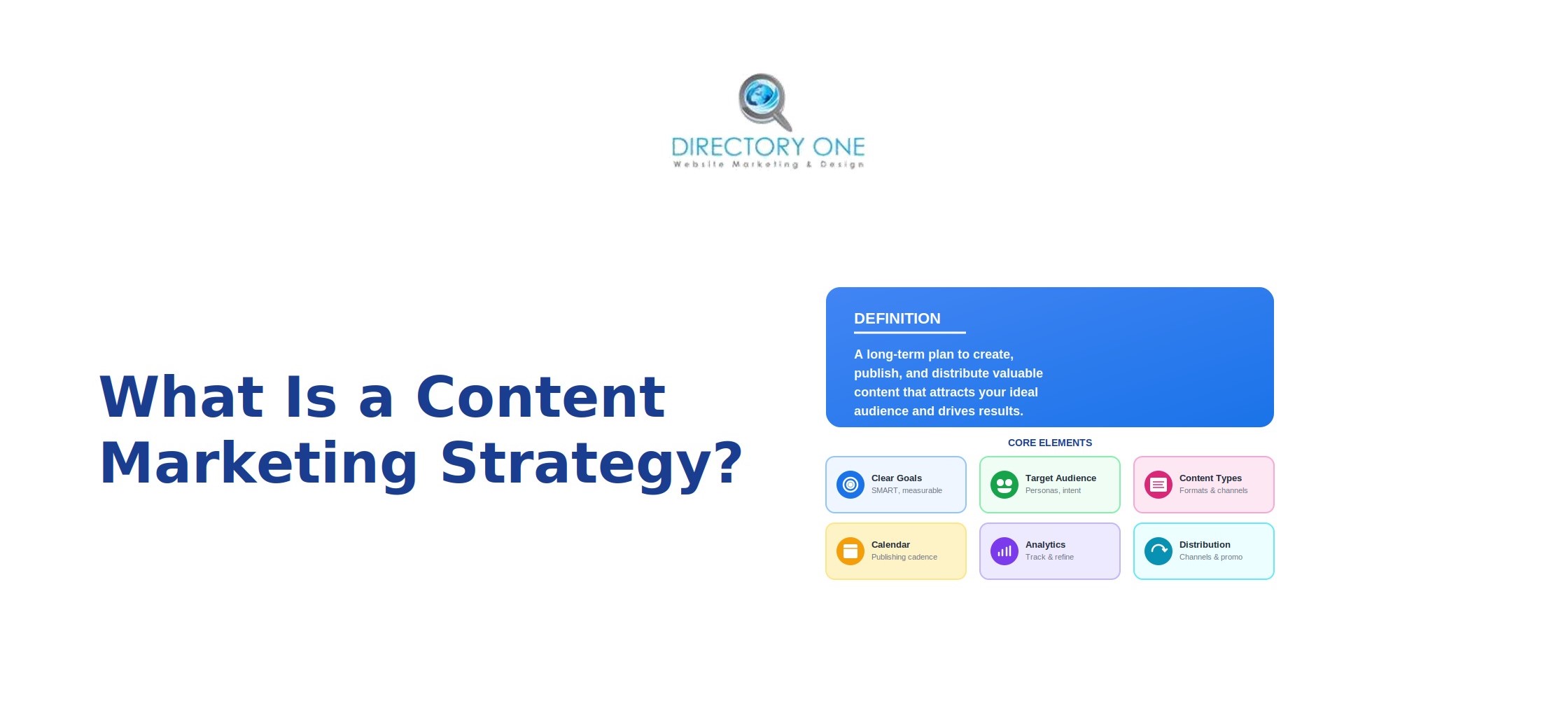
A content marketing strategy is your roadmap. It defines what you create, who you create it for, and how you distribute it to attract and convert your target audience.
It is not just blogging. It includes blog posts, videos, social content, email, case studies, and more — all working together toward one goal: growth.
Besides, content strategy vs content marketing is a question we get often. Here is the simple answer: content strategy is the plan; content marketing is the execution. You need both.
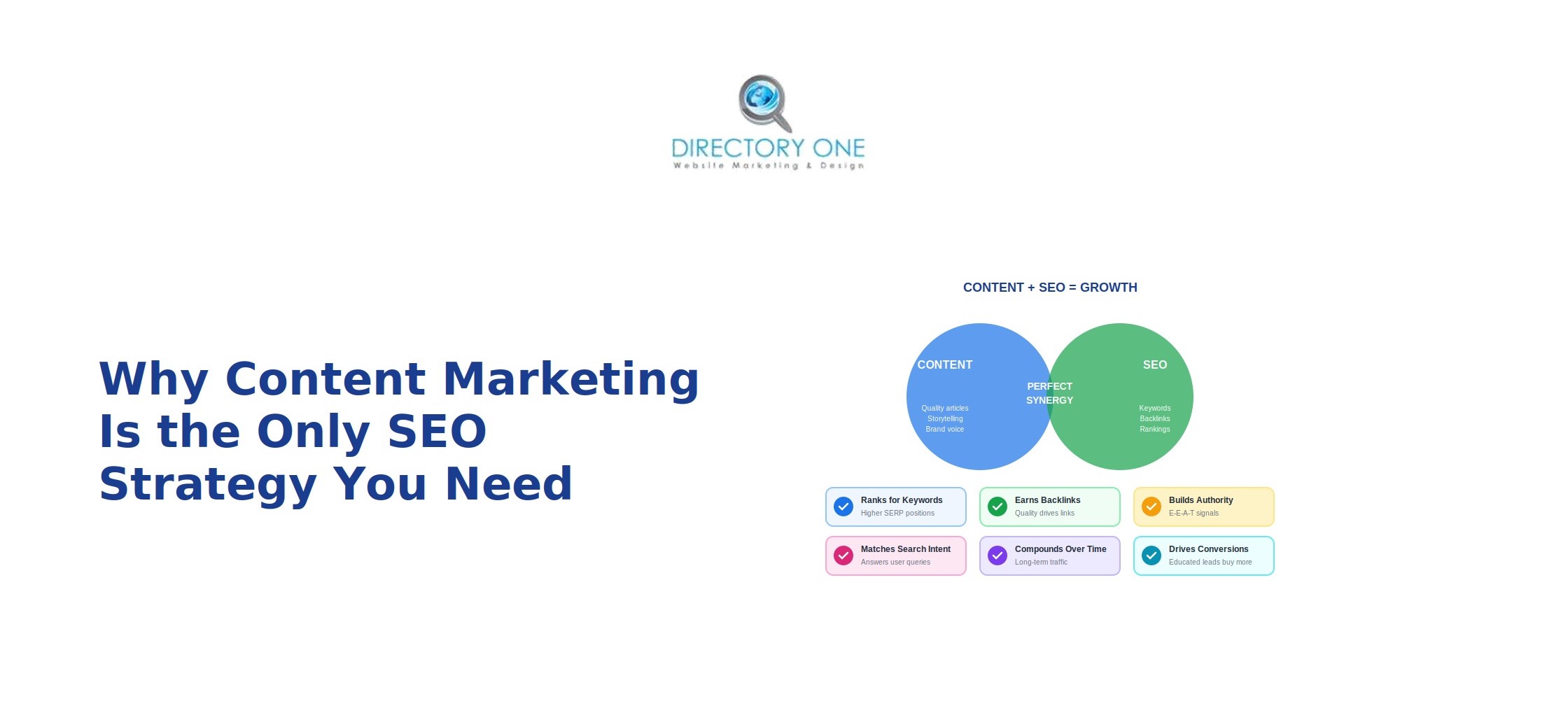
Why Content Marketing Is the Only SEO Strategy You Need
Some say SEO is about keywords. We say it is about answers. In 2026, Google’s algorithms are so advanced that they prioritize user intent over mere keyword density. This is why content marketing is the only SEO strategy you need.
When you provide high-quality information, you naturally earn backlinks, increase dwell time, and reduce bounce rates. High-authority content is what convinces Google that you are an expert in your niche.
Think about it. Every keyword you want to rank for needs a page. Every backlink needs something worth linking to. Every visitor needs something worth reading. Content is the foundation of all of it.
Website, blog, and SEO remain the #1 ROI-generating channel, according to marketers, second only to social media in 2026. And social media itself depends heavily on great content.
In B2B, organic search generates 44.6% of all revenue, making content-driven SEO the single most powerful growth lever for business-to-business brands. Our SEO marketing services are built entirely around content-first strategies that produce measurable results.
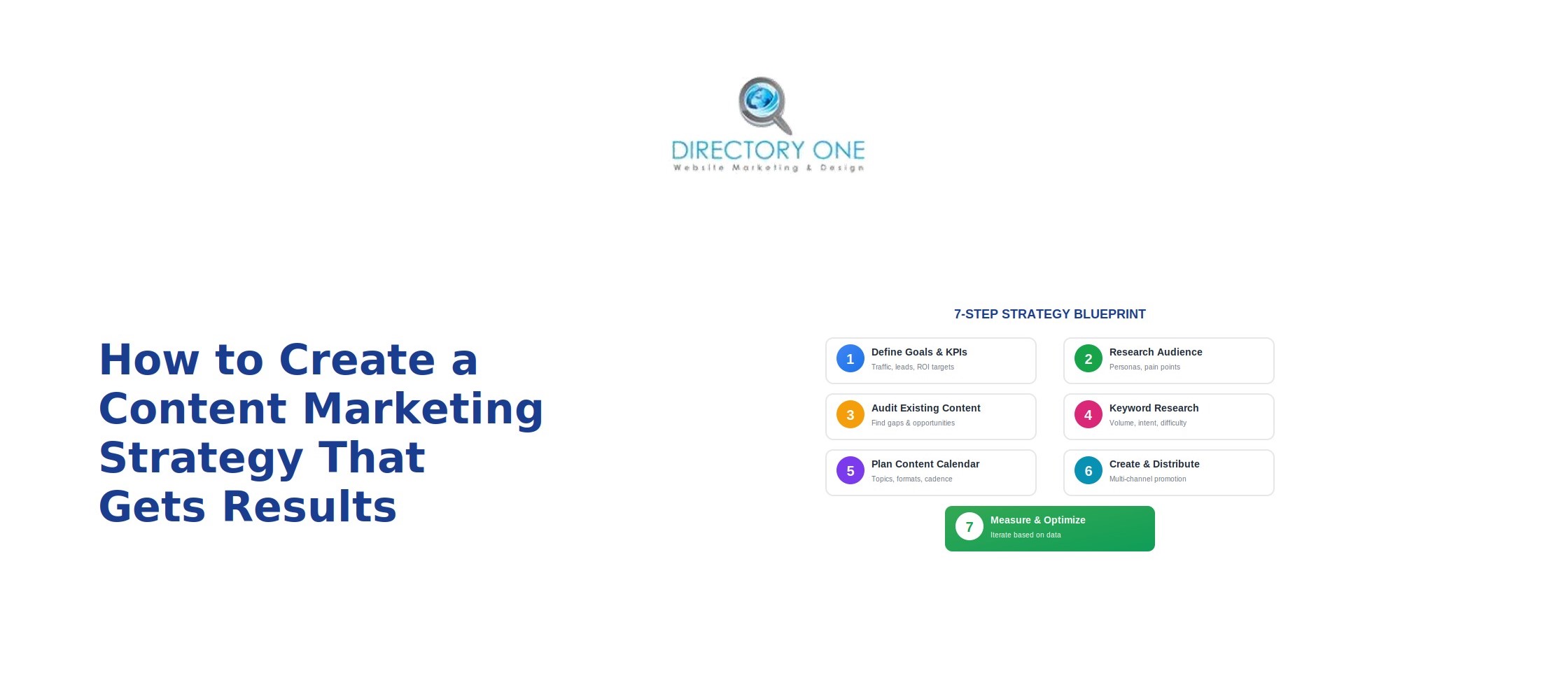
How to Create a Content Marketing Strategy That Gets Results
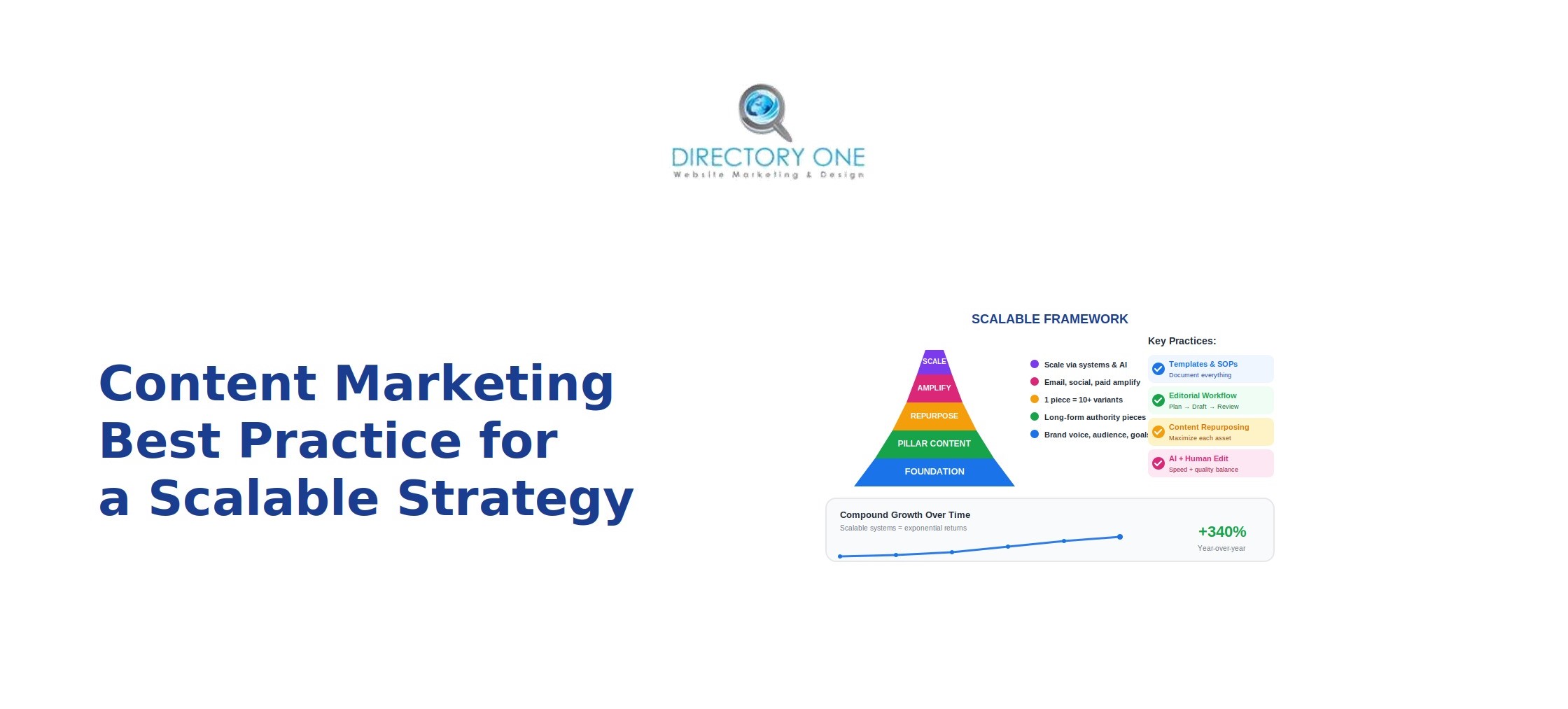
Content Marketing Best Practice for Building a Scalable Strategy
Knowing content marketing best practice is the difference between a strategy that fades in six months and one that compounds for years. Here are the principles that matter most.
Quality always beats quantity.
Posts of 1,890 or more words earn 77% more backlinks and rank higher on Google. Write less if you must, but make every piece exceptional.
Target search intent, not just keywords.
Google’s algorithm rewards content that answers what people actually want to know. Understand the “why” behind every search.
Update existing content regularly.
Updating existing content can boost organic traffic by 106% — one of the most effective and underused SEO tactics available.
Use internal linking strategically.
Content organized in topic clusters ranks 36% higher on average than standalone articles. Link related pages together to build authority.
Repurpose across formats.
A single blog post can become a video, a social carousel, a podcast episode, and an email series. Work smarter, not harder.
Content Marketing Strategy Framework to Maximize Reach and Visibility
A solid content marketing strategy framework gives your team a repeatable system — not a one-time project. The framework we use at Directory One follows four pillars:
1. Attract — Use SEO-driven blog content, landing pages, and social content to bring new visitors in.
2. Engage — Use in-depth guides, case studies, and email content to deepen relationships with your audience.
3. Convert — Use bottom-of-funnel content like comparison pages, testimonials, and service pages to drive action.
4. Retain — Use newsletters, product updates, and community content to keep customers coming back.
This framework applies equally to a content marketing strategy for B2B and B2C. It scales with you as your audience grows. Pair this with our Social Media Marketing services to amplify every piece of content you create.
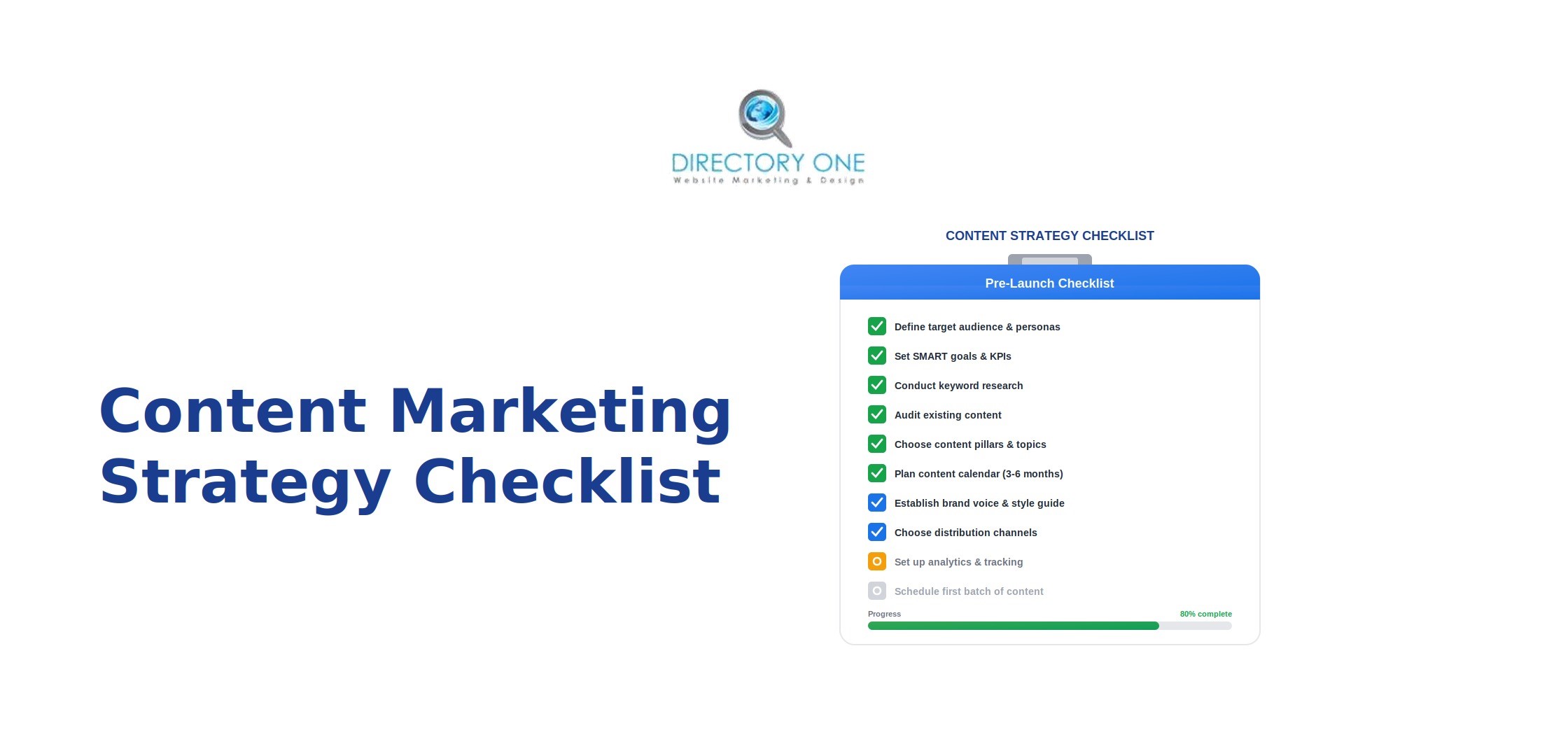
Content Marketing Strategy Checklist
Use this content marketing strategy checklist before launching any campaign:
Buyer personas are defined and documented
Business goals clearly set (leads, traffic, sales)
Keyword research completed for primary and secondary topics
Content mapped to awareness, consideration, and decision stages
Publishing calendar built for the next 90 days
Internal linking structure planned using topic clusters
Distribution channels identified (email, social, SEO)
KPIs and tracking set up (traffic, leads, conversions, ROI)
Content refresh schedule in place for existing posts
Team roles and responsibilities are clearly assigned
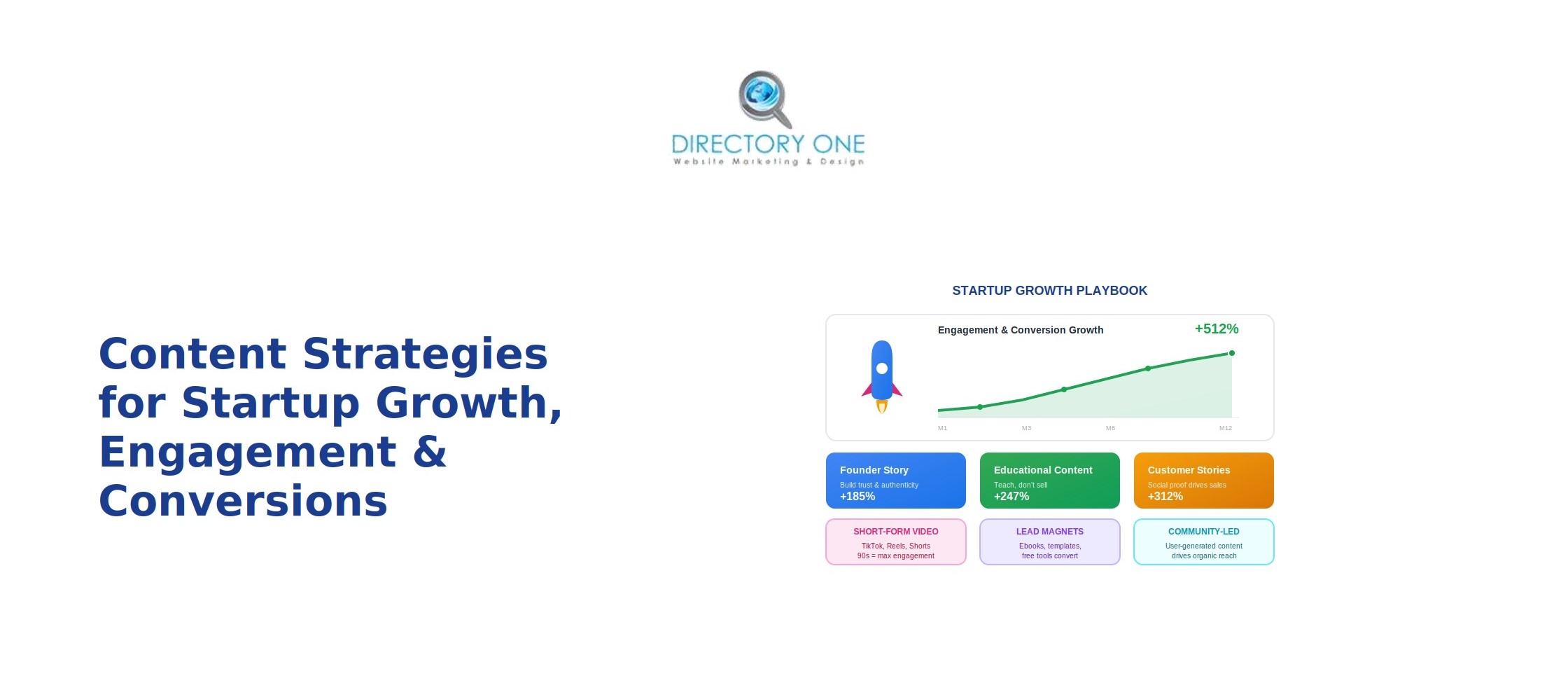
Best Content Marketing Strategies for Startups Growth, Engagement and Conversions
The best content marketing strategies for startups growth focus on doing more with less. Here is what actually works when resources are tight.
Go niche, not broad.
Startups cannot compete with large brands on high-volume keywords. Instead, dominate a narrow topic area first. Build authority there, then expand.
Lead with education.
Almost 50% of buyers read a company’s blog when evaluating their purchase options. Teach your audience before you try to sell to them.
Invest in case studies and social proof.
Nothing converts better than real results. Document customers’ wins and turn them into content that builds credibility.
Leverage long-tail keywords.
They have lower competition, higher intent, and convert better. According to Backlinko, long-tail searches make up the majority of all Google searches.
Consistency compounds.
Businesses that blog regularly have 434% more indexed pages — which means far more opportunities to be found.
For startups scaling their digital presence, our best content marketing agency team can fast-track your growth without wasting budget.
How to Create Evergreen Content That Drives Long-Term Traffic
Evergreen content is the secret weapon of a strong content marketing blog strategy. It answers questions that never go out of date — so it keeps driving traffic for years.
Great evergreen topics include how-to guides, glossaries, FAQs, industry fundamentals, and comparison posts. These formats stay relevant regardless of trends. A few rules for evergreen content success:
Match it to a durable search query. Ask: “Will someone still be searching for this in three years?” If yes, it is evergreen.
Update it annually. Even timeless content needs a refresh. New statistics, updated examples, and current internal links keep it competitive.
Build links to it. Evergreen pages are your best candidates for link-building because they provide lasting value to anyone who links to them.
The average page in Google’s top 10 results is more than two years old — proving that content marketing is a long-term investment with compounding returns.
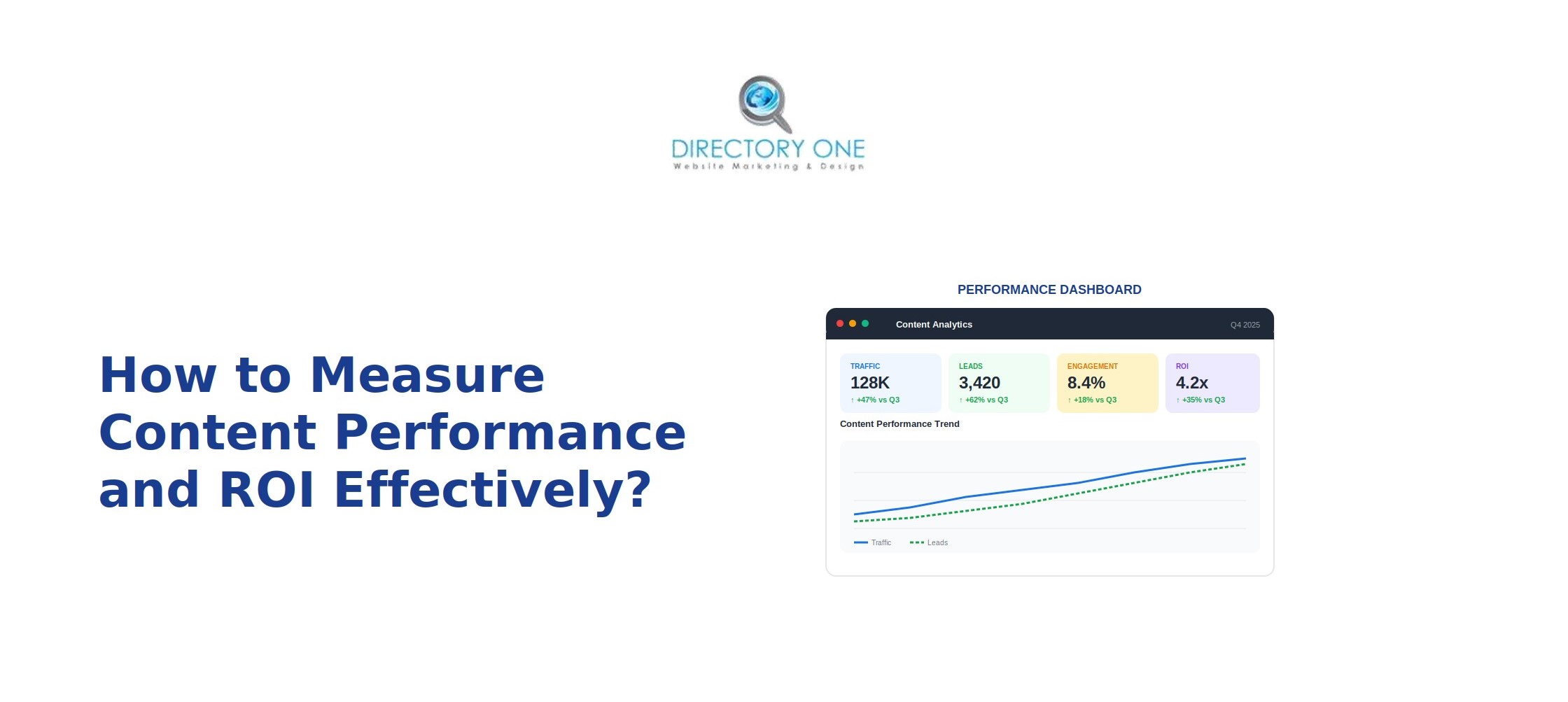
How to Measure Content Performance and ROI Effectively?
You cannot improve what you do not measure. Yet, only 29% of marketers actively track content’s contribution to revenue — a massive missed opportunity. Here are the metrics that actually matter:
Traffic — How many people are finding your content through organic search? Track this monthly in Google Search Console.
Engagement — Time on page, scroll depth, and bounce rate tell you whether your content holds attention.
Leads generated — How many form fills, calls, or sign-ups came from a specific piece of content?
Keyword rankings — Are your target pages moving up in search results over time?
Conversions and revenue — Ultimately, good content drives sales. Track assisted conversions in your analytics platform.
According to data, over 41% of marketers measure content marketing success through ROI. If you are not in that group yet, now is the time to start. For content marketing strategies for local SEO, tracking local keyword rankings and Google Business Profile engagement is equally important. Learn more through our local SEO services.
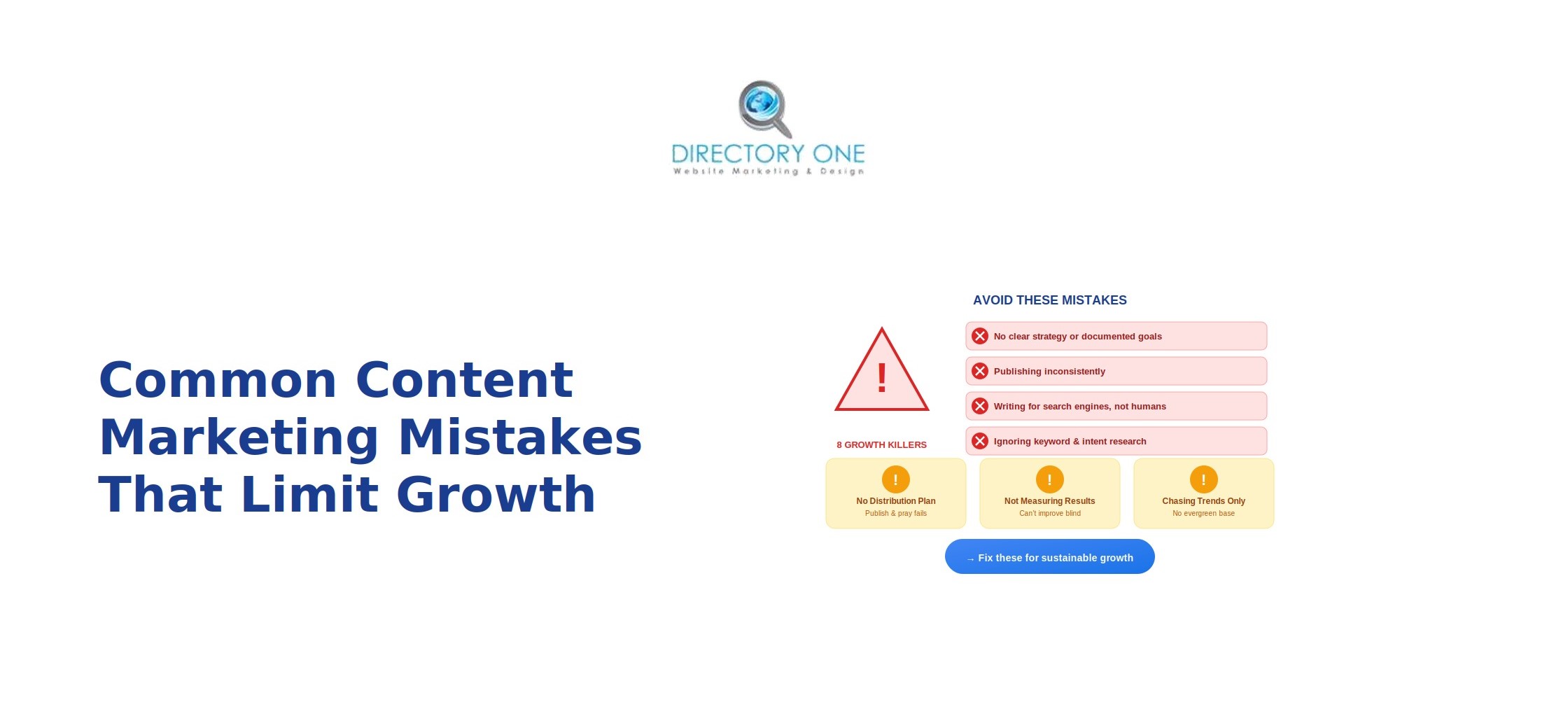
Common Content Marketing Mistakes That Limit Long-Term Growth
Even smart brands make these mistakes. Avoid them, and you will be ahead of most of your competition.
Publishing without a strategy.
Random acts of content do not build authority. Every piece needs a purpose and a target keyword.
Ignoring search intent.
Writing what you want to say instead of what your audience wants to read is the fastest way to create content nobody finds.
Focusing only on new content.
Refreshing old content is often faster and more effective than creating something new. Do not neglect your existing library.
Skipping distribution.
Great content with no promotion is like a great product with no marketing. Share everything you publish across every relevant channel.
Giving up too early.
The average page in Google’s top 10 is more than two years old. SEO and content take time. Consistency is the strategy.
Not using a documented strategy.
Only 29% of content marketers say their documented strategy is very effective because most teams are still working without one.
Working with a reliable agency providing result-driven B2B content marketing service or SEO and content marketing services helps you avoid these pitfalls from day one.
Ready to Build a Content Marketing Strategy That Works?
Content marketing is not a trend. It is the foundation of every sustainable digital growth strategy. But it only works when it is built right — with the right keywords, the right formats, and the right consistency.
At Directory One, we are a full-service content marketing agency serving businesses across Houston and beyond. Whether you need a content marketing strategy framework for a startup, B2B content marketing services, or a complete SEO and content marketing service package, we build strategies that deliver real results.
]]>Directoryone<![CDATA[Best Tips on Social Media Marketing in 2026]]>https://www.directoryone.com/blog/?p=69682026-06-01T14:04:30Z2026-06-02T13:04:00ZToday, social platforms are not just for engagement; they drive traffic, leads, and sales. It is where your customers spend their time, and where your competitors are actively building visibility. Hence, the right tips on social media marketing in 2026 can transform your business growth. There are now 5.17 billion active social media users worldwide, representing 63.7% of the global population, according to reports. And 73% of marketers say social media has been effective for their business, per the Sprout Social Index 2025. The opportunity is real. But only for businesses that approach it with a clear strategy. Whether you are a beginner or a business owner, these social media marketing tips for beginners and professionals cover everything from first steps to advanced tactics — practical, actionable, and built for how social actually works in 2026. What Is Social Media Marketing? Social media marketing is the process of using social platforms to promote your brand, connect with your audience, drive traffic, and generate leads or sales. It includes both organic activities, such as creating content, engaging with followers, and building community, as well as paid activities like targeted advertisements and sponsored posts. Done well, it builds brand awareness, strengthens customer
]]>Today, social platforms are not just for engagement; they drive traffic, leads, and sales. It is where your customers spend their time, and where your competitors are actively building visibility. Hence, the right tips on social media marketing in 2026 can transform your business growth.
There are now 5.17 billion active social media users worldwide, representing 63.7% of the global population, according to reports. And 73% of marketers say social media has been effective for their business, per the Sprout Social Index 2025. The opportunity is real. But only for businesses that approach it with a clear strategy.
Whether you are a beginner or a business owner, these social media marketing tips for beginners and professionals cover everything from first steps to advanced tactics — practical, actionable, and built for how social actually works in 2026.
What Is Social Media Marketing?
Social media marketing is the process of using social platforms to promote your brand, connect with your audience, drive traffic, and generate leads or sales.
It includes both organic activities, such as creating content, engaging with followers, and building community, as well as paid activities like targeted advertisements and sponsored posts.
Done well, it builds brand awareness, strengthens customer relationships, and creates a consistent stream of inbound interest. Done poorly, it wastes time and budget with little to show for it. The difference comes down to strategy.
How to Start Social Media Marketing for Small Business?
The question “How to start social media marketing for small business?” comes down to three decisions made before posting a single piece of content:
1. Define your goal.
Are you building brand awareness? Generating leads? Driving website traffic? Promoting a specific product or service? Every other decision flows from this.
2. Identify your audience.
Who are your best customers? What platforms do they use? What problems are they trying to solve? Specific answers to these questions make your content more relevant, and your budget goes further.
3. Choose one or two platforms to start.
Trying to be everywhere at once produces mediocre results everywhere. Start where your audience is most active and where your content type fits best. Then expand once you have built a working rhythm.
Expert social media marketing tips for small businesses: Do not try to replicate what large brands do. Small businesses have a natural advantage; they can be personal, responsive, and community-focused in ways that big brands cannot. Use it.
List of the Most Popular Social Media Platforms in 2026
Facebook remains one of the largest social media platforms, making it ideal for reaching a broad audience. Businesses can share posts, run ads, and build communities through groups. It works well for brand awareness and lead generation. With advanced targeting options, Facebook helps businesses connect with the right audience effectively.
Instagram (Visual Content)
Instagram focuses on visual storytelling through images, reels, and stories. It is perfect for brands that rely on strong visuals, such as fashion, food, and lifestyle businesses. Features like reels and hashtags help increase reach. Consistent posting and engaging visuals are key to growing followers and boosting engagement.
LinkedIn (B2B Marketing)
LinkedIn is the top platform for B2B marketing and professional networking. It allows businesses to connect with decision-makers, share industry insights, and generate high-quality leads. Content like articles, case studies, and thought leadership posts performs well. It is especially effective for building credibility and long-term business relationships.
TikTok (Short-Form Video Growth)
TikTok is rapidly growing and focuses on short-form video content. It offers massive organic reach, even for new accounts. Creative, entertaining, and trend-based content performs best. Businesses can use TikTok to increase brand visibility and connect with younger audiences quickly through viral content and challenges.
YouTube (Long-Form Content)
YouTube is the leading platform for long-form video content and educational material. It is ideal for tutorials, product demos, and in-depth guides. Videos on YouTube can rank on Google, providing long-term traffic. Consistent, high-quality content helps build authority and trust with your audience over time.
X (Twitter)
X (formerly Twitter) is a fast-paced platform focused on real-time updates and conversations. It is ideal for sharing quick insights, industry news, and engaging directly with your audience. Hashtags and trending topics help increase visibility. Businesses use X for brand awareness, customer support, and thought leadership.
Threads
Threads, launched by Meta, is a text-based platform designed for conversations and community building. It is closely connected to Instagram, making it easy to grow an audience. Brands use Threads for casual updates, storytelling, and engagement. It is effective for building authentic connections and staying relevant with trending discussions.
TikTok leads all platforms in engagement with a 3.70% average rate in 2025, per statistics.
Instagram Reels generate 2.6x higher engagement than standard posts.
LinkedIn is the #1 platform for B2B marketing, with 44% of professionals ranking it the most important, according to Statista.
How to Create a Social Media Marketing Strategy That Works?
Social media marketing tips for beginners start with a documented strategy, not gut feeling. Here is how to build one:
Set SMART goals.
Specific, Measurable, Achievable, Relevant, and Time-bound. Not “get more followers”, but “grow LinkedIn followers by 20% in 90 days while maintaining a 2%+ engagement rate.”
Choose platforms based on audience, not assumptions.
Platform selection should follow where your target customers spend their time, not where you personally prefer to scroll.
Define your content mix.
A practical framework: 40% educational content, 30% brand storytelling, 20% promotional content, 10% engagement content (polls, questions, UGC reposts). This balance keeps your audience engaged without making every post feel like an ad.
Build your posting cadence.
Hootsuite’s 2025 research recommends posting 3–5 times per week on Instagram, 4–7 times per week on LinkedIn, and at least 5 times per week on Facebook for optimal reach. Consistency beats volume.
For a social media marketing strategy for small business that compounds over time, focus on one platform deeply before spreading thin across five. Master the format, understand the algorithm, build an audience, then replicate it elsewhere.
Tips on Social Media Marketing to Grow Your Audience Faster
These are the most impactful social media tips for marketing that compound over time:
Tip 1: Lead with value, not promotion.
The fastest way to grow an audience is to give them something useful before you ever ask for anything. Educational posts, how-to content, and industry insights outperform promotional posts in reach and engagement across every platform.
Tip 2: Use short-form video consistently.
Short-form video drives the highest ROI among all content formats, according to Sprout Social’s 2026 statistics, with 92% of marketers planning to maintain or increase video investment. Even simple videos — 30–60 second clips filmed on a phone — outperform polished static images in reach.
Tip 3: Post at peak times for your audience.
The average user checks social media 7.4 times per day, with peak activity between 12–2 pm and 8–10 pm local time, according to GWI’s 2026 data. Use platform analytics to confirm when your specific audience is most active.
Tip 4: Respond to every comment, fast.
Around 73% of social users say they will buy from a competitor if a brand does not respond on social, per Sprout Social Index 2025. Responsiveness is not just good service; it directly affects revenue.
Tip 5: Use hashtags strategically.
On Instagram and LinkedIn, 3–5 highly relevant hashtags consistently outperform 20–30 generic ones for discovery.
Tip 6: Repurpose content across platforms.
One well-researched LinkedIn article becomes a Twitter/X thread, a short-form TikTok script, three Instagram carousel slides, and an email newsletter segment. Repurposing dramatically extends the value of each content effort.
Tip 7: Share user-generated content.
User-generated content (UGC) influences purchasing decisions almost 10 times more than influencer content, according to CMI research. Ask happy customers to tag you. Repost and credit. It builds trust faster than any branded content.
How to Grow Followers on Social Media Organically?
Post content that your ideal follower would bookmark.
The best organic growth comes from content so useful or entertaining that people save it and share it. Before posting, ask: would someone screenshot this?
Engage in conversations beyond your own posts.
Comment on posts from accounts your audience follows. Contribute to industry discussions. Show up as a knowledgeable voice in your niche, not just on your own feed.
Collaborate with complementary accounts.
Cross-promotion with accounts targeting a similar audience but offering something different exposes your brand to warm, pre-qualified followers at zero cost.
Optimize your profile for discovery.
Use keywords in your bio and handle where possible. Your bio is your landing page, so it should immediately tell a new visitor who you are, what you do, and why they should follow.
Why Is a Social Media Content Calendar Important for Consistency?
What is a social media calendar?
A Social media content calendar is a planning tool, typically a spreadsheet, document, or dedicated app, that maps out what content you will post, on which platform, on which date, in which format.
What is the purpose of a social media content calendar?
Consistency. The brands that grow fastest on social media are not those that post the most; they are the ones that post reliably, with intentional variety.
Without a calendar, content creation becomes reactive and stressful. With one, it becomes systematic. You plan in batches, create in batches, and schedule in advance, removing the daily scramble that causes most businesses to abandon consistent social media marketing.
How to Create a Social Media Calendar for Better Content Planning?
Start with a 30-day calendar. Weekly planning works for very small teams; monthly planning works better for those with at least one dedicated person on content.
Step 2: Map your content pillars.
Based on your 40/30/20/10 content mix, assign specific themes or series to each day of the week. For example: Monday = industry tip, Wednesday = behind-the-scenes, Friday = client result or testimonial.
Step 3: Fill in your content calendar ideas for social media.
Generate specific post ideas under each pillar. Include: platform, content type (image/video/carousel/text), caption direction, hashtags, and any links or CTAs.
Step 4: Schedule in advance.
Use a scheduling tool like Buffer, Hootsuite, or Sprout Social, to queue posts ahead of time. This frees your focus from daily execution to strategy and community engagement.
Content Ideas That Drive Engagement on Social Media
Industry statistics — data-backed posts that position you as a knowledgeable source
Polls and questions — direct engagement prompts that invite audience participation
Behind-the-scenes content — team moments, processes, day-in-the-life content that builds authenticity
Customer testimonials and reviews — social proof in the voice of real clients
Trend commentary — your take on a current industry development or news story
Social media marketing B2Bcontent ideas specifically: case studies with quantified results, LinkedIn thought leadership articles, short video explainers of complex processes, and original research or data reports your ideal clients would find valuable.
Tools and Resources to Improve Your Social Media Marketing Efforts
Content scheduling: Buffer, Hootsuite, Sprout Social — all allow cross-platform scheduling and analytics from a single dashboard.
Design: Canva — the fastest way to create professional, on-brand visuals for any platform without design experience.
Analytics: Native platform insights (Meta Business Suite, LinkedIn Analytics, TikTok Analytics) combined with Google Analytics 4 for tracking social traffic to your website.
Video: CapCut for fast short-form video editing on mobile; Adobe Premiere Pro for professional-level content.
Content research: BuzzSumo or SparkToro to identify what content resonates most with your specific audience before you create it.
Measuring Performance: How to Track Social Media Marketing Success
These metrics tie tips on social media marketing execution back to actual business outcomes:
Goal
Primary Metric
Secondary Metric
Brand awareness
Reach, impressions
Follower growth rate
Engagement
Engagement rate (%)
Comments, shares, saves
Website traffic
Sessions from social (GA4)
Bounce rate, time on page
Lead generation
Form submissions, DMs
Cost per lead
Sales
Social commerce conversions
Revenue from social channels
Review platform analytics weekly. Adjust content mix and posting times monthly. Realign the overall strategy quarterly based on what the data shows. The businesses with the best social media results are not the ones with the most followers; they are the ones who measure the right things and adjust fastest.
When to Hire a Social Media Marketing Consultant or Agency
Social media marketing tips for beginners can take you far. But there comes a point where the time investment of DIY management outweighs the cost of professional help.
Consider hiring a social media marketing consultant or agency when:
You are consistently posting but not seeing meaningful growth or engagement
Social media is taking time away from serving clients or running your business
You want to scale paid campaigns alongside organic content
You are managing multiple locations or a larger brand presence
As the best social media marketing company for Houston businesses and national brands, Directory One provides full-service Houston social media marketing services, from strategy and content creation to paid campaign management and performance reporting. Our team builds and manages social media programs that generate real business results, not just vanity metrics.
Social media marketing ideas are only as good as the execution behind them. If you need a partner who combines creative content with data-driven strategy, our social media marketing consultant team is ready to help.
Conclusion
The best tips on social media marketing share a common thread: consistency, clarity, and genuine value for your audience. Social media marketing is not about being everywhere. It is about being where your audience is, showing up reliably, and giving them a reason to pay attention.
Whether you are just learning how to create a marketing plan for social media or refining an existing strategy, Directory One provides Houston social media marketing services for businesses ready to turn social media into a real growth channel. From strategy and content to paid campaigns and community management, we handle it all.
Call us at 713.269.3094 or explore our social media services at www.directoryone.com.
]]>Directoryone<![CDATA[Types of Search Engine Algorithm: Complete Guide to Google Updates & Ranking Factors]]>https://www.directoryone.com/blog/?p=69572026-06-01T13:44:21Z2026-06-01T13:44:19ZYour website did not change. But your rankings did. That is the unsettling experience millions of website owners face after a Google algorithm update. Understanding the types of search engine algorithm, specifically how Google’s systems work, is the difference between reacting in panic and responding with a clear strategy. This guide covers the types of search engine algorithm, the complete Google algorithm update list, key SEO ranking algorithms, and exactly what to do when updates shift your rankings. What Are Search Engine Algorithms? A search engine algorithm is a set of automated rules and systems that determine which web pages appear in search results and in what order when a user types a query. Think of it as a judge in an enormous competition. Billions of pages are competing for the top spots. The algorithm evaluates each page across hundreds of factors — relevance, quality, authority, experience, and technical health and returns a ranked list of results within fractions of a second. According to Google Search Central, Google’s ranking systems analyze many factors and signals about hundreds of billions of web pages to present the most relevant, useful results. These systems operate at both the page level and the site-wide
]]>Your website did not change. But your rankings did. That is the unsettling experience millions of website owners face after a Google algorithm update. Understanding the types of search engine algorithm, specifically how Google’s systems work, is the difference between reacting in panic and responding with a clear strategy.
This guide covers the types of search engine algorithm, the complete Google algorithm update list, key SEO ranking algorithms, and exactly what to do when updates shift your rankings.
What Are Search Engine Algorithms?
A search engine algorithm is a set of automated rules and systems that determine which web pages appear in search results and in what order when a user types a query.
Think of it as a judge in an enormous competition. Billions of pages are competing for the top spots. The algorithm evaluates each page across hundreds of factors — relevance, quality, authority, experience, and technical health and returns a ranked list of results within fractions of a second.
According to Google Search Central, Google’s ranking systems analyze many factors and signals about hundreds of billions of web pages to present the most relevant, useful results. These systems operate at both the page level and the site-wide level.
Critically, Google’s algorithm is not a single formula. It is a collection of interconnected systems — each designed to evaluate a different dimension of quality. Understanding the types of search engine algorithm within Google’s system is the foundation of any effective SEO strategy.
How Does the Search Engine Algorithm Work?
At the highest level, they follow three stages: crawling, indexing, and ranking.
Crawling is when Google’s automated bots (Googlebot) discover and read web pages by following links across the internet.
Indexing is when Google stores and organizes crawled content in its database — the Google index — making pages eligible to appear in search results.
Ranking is when Google’s algorithms evaluate all indexed pages and determine which to show, and in what position, for a given query.
The ranking stage is where SEO ranking algorithms do their heaviest work. They evaluate content relevance, backlink authority, page experience, E-E-A-T signals, query intent, and dozens of additional signals, all in under a second.
According to Danny Sullivan from Google, the search engine makes an average of nine algorithm changes per day, equivalent to over 3,200 changes per year. Most are invisible. But several each year are broad enough to shift rankings significantly across entire industries.
What Is Search Engine Indexing?
It is the process by which a search engine stores and organizes the content it has crawled, making pages eligible to appear in search results.
Search engine indexing is the bridge between discovery and ranking. A page cannot rank if it is not indexed. And a page can be crawled without being indexed — Google actively filters out thin, duplicate, or low-value content before adding pages to its index.
Search engine indexing algorithms evaluate each crawled page for originality, quality, canonical status, and content depth before deciding whether to store it. These are part of Google’s quality systems, including the Helpful Content system (now integrated into core ranking), that filter out pages made for search engines rather than for real users.
Google crawling and indexing are the prerequisites for everything else. If your pages are not indexed, no amount of on-page optimization or backlink building will produce rankings. Always verify your most important pages are indexed using Google Search Console’s Page Indexing report. Confirm that being indexed by search engines means your pages are in the pool of eligible results.
How Do SEO Ranking Algorithms Work with Google Crawling and Indexing?
How do search engine algorithms work in the context of crawling, indexing, and ranking? These three stages work as a pipeline.
First, Googlebot crawls pages by following links. Second, search engine indexing algorithms evaluate crawled pages and decide which to enter the index. Third, ranking algorithms evaluate indexed pages and assign positions for relevant queries.
A breakdown at any stage stops the process entirely. A page blocked from crawling is never indexed. A page with thin content is crawled but not indexed. A page that is indexed but lacks authority and relevance never ranks well.
This is why SEO ranking algorithms cannot be addressed in isolation. Technical health (crawlability), content quality (indexability), and authority (ranking strength) must all be solid simultaneously.
Complete Google SEO Algorithm List
Here is the Google SEO algorithm list — the major named systems and updates that have shaped Google search engine algorithm behavior:
Named Algorithm Systems (ongoing):
Panda (2011, integrated 2015) — Targets thin, duplicate, and low-quality content. Rewards comprehensive, original pages. Sites with large amounts of low-quality content saw site-wide ranking drops.
Penguin (2012, real-time 2016) — Targets manipulative link-building. Evaluates backlink quality and penalizes spammy or irrelevant links. Now runs in real-time as part of core ranking.
Hummingbird (2013) — A complete replacement of Google’s core algorithm. Enabled understanding of conversational queries and user intent — not just individual keywords.
Pigeon (2014) — Overhauled local search rankings, tying local results more closely to web search signals.
RankBrain (2015) — A machine learning system that interprets novel queries and understands the context behind search intent.
Mobilegeddon (2015) — Made mobile-friendliness a direct ranking factor for mobile searches.
BERT (2019) — Bidirectional Encoder Representations from Transformers. A major NLP upgrade that helps Google understand the meaning of words in context, not just individual keywords.
Core Web Vitals / Page Experience (2021) — LCP, FID/INP, and CLS became official ranking signals.
MUM (2021) — Multitask Unified Model. Processes text, images, and video simultaneously to answer complex queries.
Helpful Content System (2022, integrated into core 2024) — Rewards content written for people first. Penalizes content created primarily for search engine rankings.
The Google Algorithm Update List For 2024–2025
March 2024 Core Update — The most complex core update to date, involving changes to multiple core systems simultaneously. Introduced new spam policies targeting scaled content abuse, expired domain abuse, and site reputation abuse.
August 2024 Core Update — Continued the push to surface genuinely helpful content, with emphasis on small and independent sites producing original work.
December 2024 Core Update — Standard quality improvement update, one of four confirmed updates in 2024.
March 2025 Core Update — First core update of 2025, took 14 days to complete.
June 2025 Core Update — Favored sites with transparent authorship, expert sourcing, and genuine human involvement in content creation.
August 2025 Spam Update — Broad global spam update targeting various spam tactics. Hit hard and fast.
December 2025 Core Update — Third core update of 2025, took 18 days to complete.
In 2025, Google confirmed three core updates and one spam update. Google noted it does not announce all algorithm changes — only the larger, broader core updates.
Google Search Engine Algorithm Updates: What Changed and Why It Matters
Google search engine algorithm updates share a consistent direction: each update pushes harder toward rewarding content that genuinely helps users and punishing content created to manipulate rankings.
The March 2024 update was a turning point. Google described it as its most complex update to date — involving multiple core systems simultaneously — and integrated the Helpful Content system into core ranking permanently. This means quality evaluation is no longer a separate check. It is woven into every ranking decision Google makes.
The 2025 updates continued this direction. The June 2025 update specifically favored pages with transparent authorship, expert credentials, and content that cited reputable sources. According to post-update analysis, pages with LCP load times above 3 seconds experienced 23% more traffic loss than faster competitors with comparable content during the December 2025 update — confirming that Core Web Vitals act as a quality tiebreaker when content is otherwise similar.
The new search algorithm Google’s direction for 2026 is clear: E-E-A-T signals (Experience, Expertise, Authoritativeness, Trustworthiness), original content with human expertise, fast technical performance, and genuine relevance to user intent. Generic, templated, AI-mass-produced content without human review continues to underperform significantly after each update cycle.
SEO Ranking Algorithms: Key Factors That Influence Search Rankings
According to First Page Sage’s Q1 2025 Google algorithm analysis, the top ranking factors by weight are:
Key shifts from previous years: Backlinks dropped from 15% to 13% as Google’s AI has grown capable of evaluating content quality without relying as heavily on external links. Searcher engagement — time on page, pogo-sticking avoidance, completion of the user’s goal — has increased each of the last three years. Content that fully satisfies user intent now carries more weight than content that merely mentions keywords.
Search Engine Algorithm Changes Business Impact and SEO Strategy
Search engine algorithm changes business impact, which are misunderstood mostly.
When rankings drop after an update, the most common instinct is to panic and make immediate changes. However, this is usually counterproductive. As Google’s documentation confirms, most ranking drops after a core update are reassessments, not penalties. A page drops because Google found another page that better satisfies the user’s intent, not because your page was penalized.
The business implications are real. Rankings fluctuations affect traffic, leads, and revenue, sometimes sharply. However, the underlying cause is almost always one of three things: content that has not kept pace with user expectations, technical issues that have accumulated, or a backlink profile that has grown stale.
A strong SEO strategy built around consistent content quality, technical health, and genuine authority building weathers algorithm updates far better than one built around exploiting ranking signals.
How to Adapt to the New Search Algorithm Google Updates for Better Rankings
These steps apply after any Google search update today algorithm event:
Step 1: Wait for the rollout to complete.
Core updates typically take 2–3 weeks to roll out fully. Rankings are volatile during this window. Avoid making reactive changes until the rollout is complete and rankings have stabilized.
Step 2: Diagnose before acting.
Use Google Search Console to identify which pages lost rankings and for which queries. Look for patterns — were they specific page types? Specific topics? Content from a certain time period? The pattern tells you where the problem is.
Step 3: Evaluate your content against E-E-A-T.
Ask: Does this page demonstrate real experience with the topic? Has the author demonstrated expertise? Is the information accurate and current? Is there original value — data, insight, or perspective — that other pages do not offer?
Step 4: Fix technical issues.
Run a Core Web Vitals audit. Check for pages failing LCP, INP, or CLS thresholds. Verify that your key pages are indexed and crawlable. Address any errors in Search Console.
Step 5: Improve, do not discard.
Thin pages should be expanded with original, useful content. Outdated pages should be refreshed with current data. Duplicate content should be consolidated. Rarely should pages be deleted before being improved.
Step 6: Be patient.
Recovery from a core update typically requires waiting for the next core update, which happens every 3–4 months. However, Google also makes smaller, unannounced updates continuously, and improvements can surface between major updates if content quality genuinely improves.
Need Help Adapting Your SEO Strategy to Google’s Evolving Algorithms?
Directory One provides enterprise SEO services, organic search engine optimization services, and AI search engine optimization services for businesses of all sizes, from local Houston companies to national brands.
As a full-service digital marketing agency for SEO and a trusted full-service branding and SEO agency, our team monitors algorithm changes continuously, adapts strategies proactively, and builds organic visibility that compounds over time, not one that crumbles after the next update.
The types of search engine algorithm at Google are not a static formula. They are evolving systems; all moving in the same direction. Content that helps real people. Pages that load fast. Sites that demonstrate genuine expertise.
Understanding how do search engine algorithms work gives you the foundation to build an SEO strategy that does not collapse every time a new update rolls out. Because when your strategy aligns with what the algorithm is trying to reward, rather than what it used to reward, updates become opportunities, not threats.
Whether you need enterprise SEO services or organic search engine optimization services for a local startup, our team provides AI-driven SEO services in Houston with proven ROI. Call us at 713.269.3094 or explore our SEO services.